
Best HVAC Lead Generation Strategies That Actually Work
Compare proven lead generation channels including SEO, Google Ads, Local Services Ads, referrals, social media, email marketing, and partnerships to build a reliable flow of new customers.
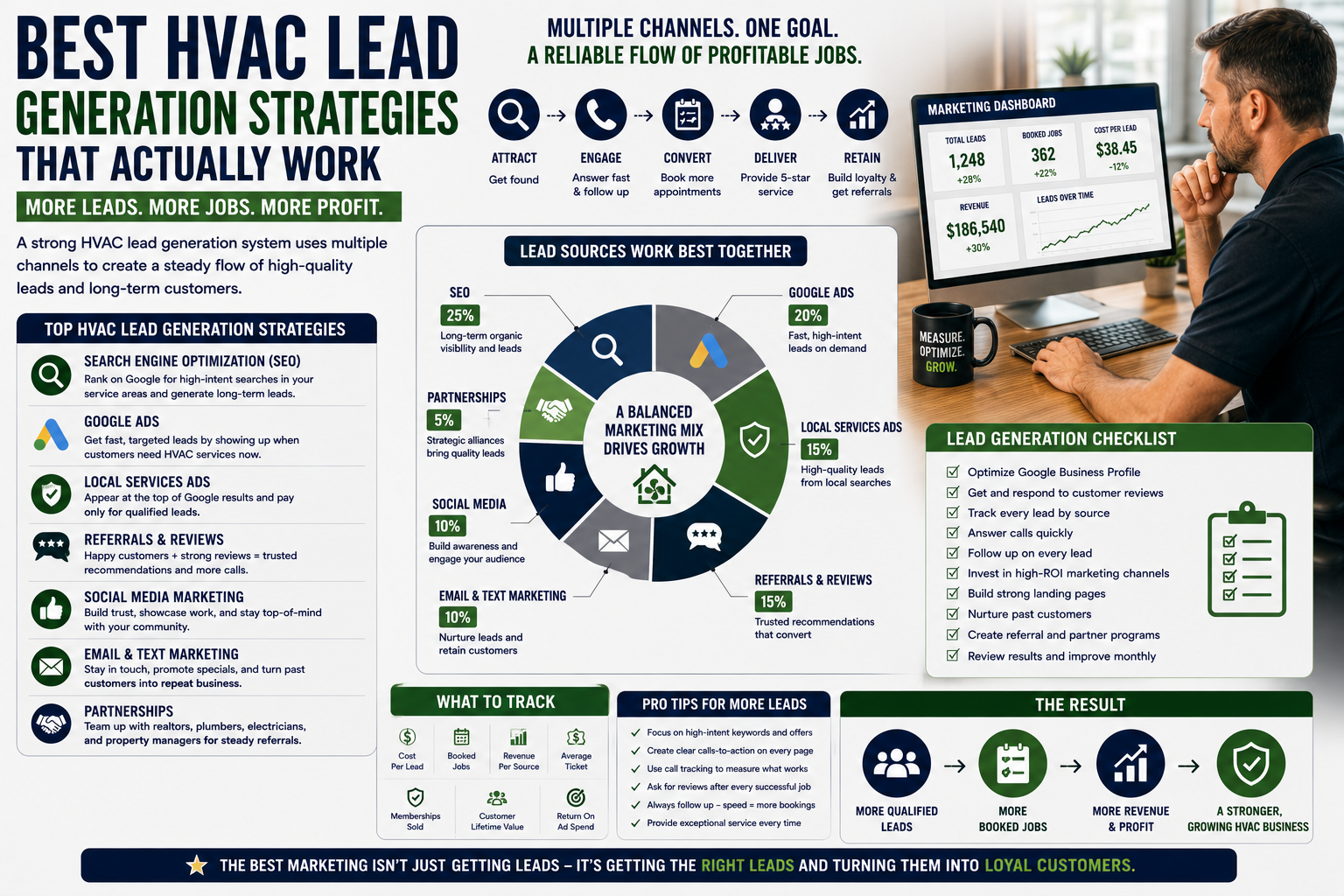
Table of Contents
Introduction
Most HVAC companies do not need more marketing ideas.
They need a more reliable way to generate profitable jobs.
A full schedule built entirely on referrals can disappear during a slow season.
Google Ads can create calls quickly, but costs can rise fast.
SEO can create strong long-term leads, but it takes time.
Local Services Ads can work well, but only when your company answers calls quickly and has strong reviews.
The best HVAC lead generation strategy is not one channel.
It is a system.
A strong company builds several lead sources so it is not dependent on one platform, one season, or one referral partner.
The goal is not just more leads.
The goal is more booked, profitable jobs.
What Makes an HVAC Lead Source Worth Using?
A lead source is not valuable just because it produces phone calls.
A channel only matters if it produces customers your company can serve profitably.
Track:
- Leads generated
- Booked calls
- Cost per lead
- Cost per booked job
- Average ticket
- Membership sales
- Replacement opportunities
- Revenue by source
- Gross margin by source
- Customer lifetime value
- Callback rate
- Cancellation rate
A channel that generates cheap leads can still be expensive if those customers do not book, cancel often, only price-shop, or create low-margin jobs.
The best lead sources create customers who become repeat customers.
A broader HVAC marketing strategy should connect lead generation with conversion, retention, reviews, and operating capacity instead of treating every channel as a separate tactic.
Start With Google Business Profile
For many HVAC companies, Google Business Profile is one of the highest-value marketing assets.
When a homeowner searches for:
- HVAC repair near me
- AC repair near me
- Furnace repair near me
- HVAC company in [city]
- Emergency AC repair
- Heat pump repair
Your Google Business Profile can help your company appear before the customer ever visits your website.
To improve it:
- Use your real business information
- Select accurate service categories
- Add service areas
- Upload real team and truck photos
- Add services
- Keep business hours current
- Respond to reviews
- Ask happy customers for reviews
- Post updates regularly
- Make sure your phone number is easy to call
The profile should make it easy for customers to trust you quickly.
Strong reviews, recent photos, clear service details, and fast responses can make a major difference.
Build Local SEO for Long-Term Leads
SEO is slower than paid ads.
But it can become one of the most valuable lead sources over time.
Local SEO helps your HVAC company appear when people search for services in your market.
That may include searches like:
- AC repair in [city]
- Furnace installation in [city]
- HVAC maintenance in [city]
- Heat pump replacement in [city]
- Ductless mini-split installer in [city]
- Emergency HVAC service in [city]
A strong local SEO system usually includes:
- A fast, mobile-friendly website
- Clear service pages
- City and service-area pages
- Helpful blog content
- Strong internal linking
- Google Business Profile optimization
- Customer reviews
- Local backlinks
- Accurate business information across directories
- Clear calls to action
- Easy phone and form conversion paths
SEO takes patience.
But once pages begin ranking, the leads can be more sustainable than paying for every click.
For a more complete breakdown of search visibility, service pages, and local ranking opportunities, see how HVAC companies can generate consistent leads with SEO.
Use Google Ads for Immediate Demand
Google Ads can create fast demand when your company needs more calls now.
It can be especially useful for high-intent searches such as:
- AC repair near me
- Emergency HVAC repair
- Furnace repair
- HVAC replacement
- Heat pump installation
- Same-day AC service
The advantage is speed.
You can appear near the top of search results quickly.
The downside is cost.
Bad campaigns can burn money fast.
To make Google Ads work better:
- Focus on high-intent keywords
- Use service-specific landing pages
- Track phone calls
- Track booked jobs, not just clicks
- Exclude irrelevant searches
- Use clear geographic targeting
- Review search terms regularly
- Use call extensions
- Follow up on missed calls quickly
- Measure revenue by campaign
A click is not a customer.
A booked, profitable job is the goal.
For campaign setup, measurement, and avoiding wasted spend, see Google Ads for HVAC contractors.
Use Local Services Ads
Local Services Ads can be useful for HVAC companies because they appear prominently for local service searches.
These leads can be strong because the customer is usually actively looking for help.
But Local Services Ads only work well if the company can handle them correctly.
You need:
- Fast response times
- Strong reviews
- Good call handling
- Accurate service areas
- Reliable scheduling
- Clear service categories
- Consistent follow-up
If calls go unanswered, you can waste the opportunity.
The lead may go to another company within minutes.
Local Services Ads work best when they are connected to a strong front-office process.
For a focused guide to setup, responsiveness, and lead quality, review Local Services Ads for HVAC companies.
Make Reviews a Lead Generation System
Reviews do more than improve your reputation.
They help convert strangers into customers.
A homeowner comparing three HVAC companies may choose the one with:
- More reviews
- Better recent reviews
- Detailed comments
- Professional responses
- Photos
- Evidence of reliable service
The review request process should be simple.
Ask after a successful job while the customer is still happy.
You can request reviews through:
- Text message
- Technician follow-up
- Automated CRM workflows
- Printed leave-behinds
- Customer-service follow-up calls
Do not pressure customers.
Make the process easy.
A steady flow of real reviews improves trust, local visibility, and conversion rates.
Build a Referral System
Referrals are still one of the best HVAC lead sources.
They usually convert better because the customer already trusts the recommendation.
But referrals should not happen only by accident.
Build a referral process.
That can include:
- Asking happy customers directly
- Referral thank-you offers
- Membership referral incentives
- Follow-up after successful installs
- Email reminders
- Partnerships with real estate agents
- Partnerships with plumbers and electricians
- Community relationships
- Customer appreciation programs
The best time to ask for a referral is after a great customer experience.
Do not wait six months.
Use Maintenance Memberships to Create Future Leads
Memberships are not only recurring revenue.
They are a lead-generation engine.
A membership customer gives your company:
- Planned maintenance visits
- More customer touchpoints
- Repair opportunities
- Replacement opportunities
- Review opportunities
- Referral opportunities
- Better retention
The easiest customer to sell to is the one who already trusts you.
A strong membership program reduces dependence on constantly finding new customers.
It also helps fill slower periods with planned work.
Build Better Website Conversion Paths
Your website should not only look professional.
It should make it easy for customers to take action.
A strong HVAC website should include:
- Clear service pages
- Click-to-call phone numbers
- Fast loading speed
- Contact forms
- Online booking options
- Service-area coverage
- Customer reviews
- Financing information
- Emergency service messaging
- Trust signals
- Clear calls to action
- Mobile-friendly design
A visitor should not have to hunt for your phone number.
They should know within seconds:
- What services you offer
- Where you work
- Whether you can help today
- Why they should trust you
- How to contact you
Traffic does not matter if the website does not convert.
A practical HVAC website design checklist can help turn more of the traffic you already earn into booked calls.
Use Email and Text Follow-Up
A lot of HVAC companies focus only on new leads.
They forget the customers they already paid to acquire.
Email and text campaigns can help you:
- Follow up on open estimates
- Remind customers about maintenance
- Promote memberships
- Reactivate old customers
- Promote seasonal tune-ups
- Share financing options
- Request reviews
- Announce new services
- Offer replacement consultations
- Remind customers about expiring warranties
The key is relevance.
Do not send random promotions every week.
Send useful messages at the right time.
For example:
- Cooling tune-up reminders before summer
- Heating maintenance reminders before winter
- Filter reminders
- Membership renewal notices
- Replacement reminders for aging systems
- Estimate follow-up after a repair recommendation
Consistent follow-up turns past customers into repeat revenue.
Partner With Other Local Businesses
Partnerships can create steady lead flow without relying entirely on paid advertising.
Potential partners include:
- Plumbers
- Electricians
- Roofers
- Restoration companies
- Property managers
- Real estate agents
- Home inspectors
- General contractors
- Insurance agents
- Solar installers
- Local hardware stores
- Home warranty companies
The best partnerships are mutual.
Do not only ask for leads.
Find ways to send business back.
Strong local relationships can create higher-trust leads than many paid channels.
Use Social Media for Trust, Not Just Leads
Social media is rarely the fastest lead source for HVAC companies.
But it can support other channels.
It helps customers see that your company is real.
Use social media to show:
- Technician introductions
- Before-and-after jobs
- Maintenance tips
- Customer reviews
- Community involvement
- Team culture
- Educational videos
- Seasonal reminders
- New equipment installations
- Behind-the-scenes work
The goal is not to go viral.
The goal is to build familiarity.
When a customer sees your company on Google, Facebook, Instagram, or YouTube, they should recognize a real local business.
Create a Lead Follow-Up Process
Lead generation does not matter if the office does not follow up.
A lead should have a clear owner.
For every new inquiry, decide:
- Who answers the call?
- Who returns missed calls?
- How quickly are callbacks made?
- Who sends appointment confirmations?
- Who follows up on unsold estimates?
- Who contacts customers who submitted forms?
- Who tracks lead source?
- Who reviews conversion rates?
A missed call is not just a phone issue.
It is lost revenue.
Create standards such as:
- Return missed calls within five minutes
- Contact web leads immediately
- Follow up on open estimates within 24 hours
- Review lead-source performance weekly
- Track why leads did not book
The company does not need more leads if it is losing the ones it already has.
Track Which Channels Produce Profit
Not all lead sources create the same kind of customer.
Track performance by source.
| Channel | What to Track |
|---|---|
| Google Business Profile | Calls, direction requests, reviews, booked jobs |
| SEO | Organic traffic, calls, rankings, booked jobs |
| Google Ads | Cost per lead, booked jobs, revenue, margin |
| Local Services Ads | Leads, response time, bookings, revenue |
| Referrals | Conversion rate, average ticket, memberships |
| Email and text | Reactivated customers, memberships, booked work |
| Partnerships | Lead volume, close rate, repeat business |
| Social media | Engagement, branded searches, referral traffic |
Do not make decisions based only on lead count.
A source that generates fewer but higher-value customers may be better than a channel producing lots of low-quality calls.
Build a Balanced Lead Generation Mix
A strong HVAC marketing system usually includes three categories.
Fast Lead Sources
These can create demand quickly:
- Google Ads
- Local Services Ads
- Referral outreach
- Partnerships
- Reactivation campaigns
Long-Term Lead Sources
These take more time but can compound:
- SEO
- Google Business Profile
- Reviews
- Content
- Email list growth
- Referral systems
- Community reputation
Retention Lead Sources
These generate repeat revenue:
- Memberships
- Maintenance reminders
- Estimate follow-up
- Replacement campaigns
- Email and text follow-up
- Review and referral requests
The goal is balance.
You do not want the company dependent on one source.
Common HVAC Lead Generation Mistakes
Buying Leads Without Tracking Results
A lead is not valuable if you do not know whether it booked, produced revenue, or created profit.
Spending on Ads Before Fixing Call Handling
Paid traffic is expensive when calls go unanswered.
Ignoring Existing Customers
The easiest customers to sell to are the ones who already trust you.
Having a Weak Website
A slow, confusing website can waste every dollar spent on SEO or ads.
Not Asking for Reviews
Reviews influence trust, local rankings, and conversion.
Treating Marketing as Separate From Operations
Marketing creates demand.
Operations must answer the call, book the job, dispatch the technician, and deliver a good experience.
Chasing Every Channel at Once
Do not spread your budget too thin.
Start with a few channels, measure results, and expand what works.
How to Improve Lead Generation This Month
Start with the basics.
Improve Your Google Business Profile
Add photos, services, updates, and review responses.
Audit Missed Calls
Find out how many calls were missed and how quickly they were returned.
Launch a Review Request Process
Ask every happy customer for a review.
Follow Up on Open Estimates
You already paid to create those opportunities.
Build One High-Intent Service Page
Create a strong page for a major service such as AC repair, furnace repair, or heat pump replacement.
Track Lead Source on Every Call
You cannot improve what you do not measure.
FAQ
What is the best lead generation strategy for HVAC companies?
The best strategy is usually a balanced system that includes Google Business Profile optimization, reviews, local SEO, paid search, Local Services Ads, referrals, memberships, customer follow-up, and local partnerships.
Are Google Ads worth it for HVAC companies?
They can be worth it when campaigns target high-intent searches, calls are answered quickly, booked jobs are tracked, and the company measures revenue and profit by campaign.
How can HVAC companies get more referrals?
Ask after successful jobs, create referral incentives, maintain strong customer communication, build membership relationships, and partner with complementary local businesses.
How can HVAC companies generate leads without spending heavily on ads?
Focus on Google Business Profile, reviews, local SEO, referrals, memberships, email follow-up, estimate follow-up, partnerships, and customer reactivation.
Final Thoughts
The best HVAC lead generation strategy is not chasing the newest marketing tactic.
It is building a reliable system.
Show up where customers are searching.
Answer calls quickly.
Build trust with reviews.
Follow up on estimates.
Stay connected to existing customers.
Track which sources create profitable work.
Marketing works best when it is connected to strong operations.
More leads only help when the company can turn them into great customer experiences and profitable jobs.