
How to Get More HVAC Reviews (Without Breaking Google’s Guidelines)
Learn ethical, effective methods for generating more Google reviews, improving local search rankings, increasing customer trust, and staying compliant with Google's review policies.
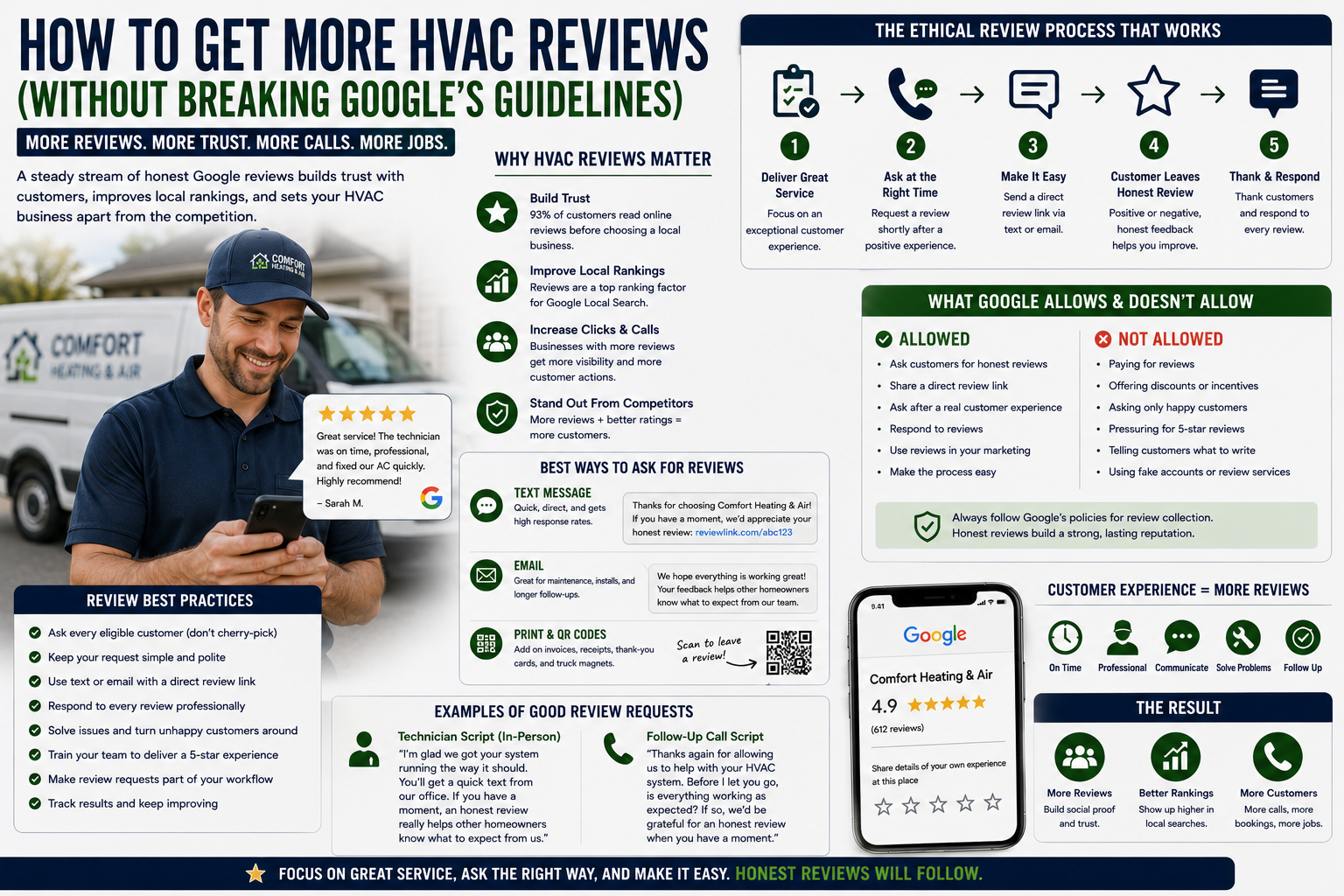
Table of Contents
Introduction
Most HVAC companies know reviews matter.
Customers read them before calling.
Google uses them as a trust signal.
Your sales team benefits when homeowners already feel confident about your company.
But a lot of contractors approach reviews the wrong way.
They wait until business is slow.
They ask only a few favorite customers.
They offer gift cards or discounts.
They pressure technicians to get a certain number of five-star reviews.
Or they ignore unhappy customers and hope the issue disappears.
That creates risk.
The best review strategy is simple:
Deliver a strong customer experience, then make it easy for every customer to share an honest opinion.
Google allows businesses to ask customers for reviews based on genuine experiences. But it does not allow incentives, fake reviews, selective requests for only positive reviews, or pressure to leave a specific rating or message.
The goal is not to manipulate your rating.
The goal is to build a real reputation that helps customers trust you.
Why HVAC Reviews Matter
HVAC is a trust-driven business.
A homeowner is letting someone into their home, asking for advice on expensive repairs, and often making a decision under pressure.
They want proof that your company:
- Shows up on time
- Communicates clearly
- Prices work fairly
- Treats people professionally
- Solves problems correctly
- Respects their home
- Stands behind the work
- Handles problems when something goes wrong
Reviews help answer those questions before the customer ever calls.
They also help your company stand out in local search results.
When a homeowner compares several HVAC companies, they may see:
- Star rating
- Number of reviews
- Recent review activity
- How the company responds
- Review details
- Photos from customers
- Mentions of specific services
A company with steady recent reviews usually looks more trustworthy than a company with a few old reviews.
Reviews are also an important part of a broader HVAC lead generation strategy because they can improve trust before a prospect ever calls or fills out a form.
What Google Allows and Does Not Allow
Before building a review process, understand the basic rules.
Google allows businesses to ask customers to leave honest reviews based on real experiences.
Google does not allow businesses to:
- Pay for reviews
- Offer discounts, gift cards, free services, or other incentives for reviews
- Ask only happy customers for reviews
- Discourage negative reviews
- Require employees to collect a certain number of reviews
- Pressure customers to leave a five-star rating
- Tell customers what to write
- Ask employees, friends, or relatives without a real customer experience to post reviews
- Use fake accounts or review services
- Ask customers to leave reviews while still on-site under pressure
Google also prohibits review manipulation, including incentives and selectively soliciting positive reviews.
That means your goal should be:
Ask all eligible customers for an honest review, not only the customers you think will leave five stars.
The Best Time to Ask for a Review
Timing matters.
The best time is usually shortly after the customer has had a positive service experience.
For HVAC companies, that may be:
- After a successful repair
- After a maintenance visit
- After a completed installation
- After an issue is resolved
- After the customer confirms they are satisfied
- After a positive follow-up call
- After a technician receives direct praise
Do not wait two weeks.
The customer may forget the details.
The experience is strongest right after the job is complete.
A simple follow-up message the same day or the next morning usually works better than asking much later.
Build Reviews Into the Workflow
The biggest review mistake is treating reviews as a random marketing task.
Reviews should be part of the normal customer journey.
A simple workflow could look like this:
| Step | Action |
|---|---|
| 1 | Technician completes the job |
| 2 | Technician confirms the customer is satisfied |
| 3 | Job is closed in your field-service software |
| 4 | Customer receives a receipt or job summary |
| 5 | Customer receives a review request by text or email |
| 6 | Office follows up only when appropriate |
| 7 | Team responds to reviews regularly |
The key is consistency.
Do not ask for 20 reviews one week and none for the next month.
A steady stream of real reviews is better than sudden spikes.
A strong HVAC workflow optimization process makes it easier to automate the handoff from completed job to receipt, follow-up message, review request, and response tracking.
Train Technicians to Ask Naturally
Technicians should not pressure customers.
They should simply make the request feel normal.
A technician can say:
“I’m glad we were able to get that taken care of for you. You’ll receive a short follow-up message from our office. If you have a moment, an honest review helps other homeowners know what to expect from us.”
That works because it is simple.
Avoid scripts like:
“Can you please leave us a five-star review?”
Or:
“My manager tracks how many reviews I get.”
That creates pressure and can feel uncomfortable.
The technician should focus on the service experience, not the rating.
Use Text Messages for Faster Results
Text messages often work well because customers see them quickly.
A good review request text should be short.
Example:
Thanks for choosing Example HVAC Company today. We appreciate the opportunity to help. If you have a moment, we would be grateful for an honest review of your experience: [Review Link]
Keep it simple.
Do not include long explanations.
Do not ask for a five-star rating.
Do not offer anything in return.
The easier the process is, the more likely customers are to complete it.
Use Email for Install and Membership Follow-Up
Email can work especially well after:
- System replacements
- Larger repairs
- Membership visits
- Commercial work
- Long-term customer relationships
- Follow-up satisfaction checks
Example:
Thank you for trusting Example HVAC Company with your home comfort. We hope everything is working well. Your feedback helps us improve and helps other homeowners choose a company they can trust. Would you share an honest review of your experience?
A larger installation may deserve a more personalized follow-up email from the owner, comfort advisor, or install manager.
Customers are more likely to respond when the message feels connected to the actual work completed.
Ask Every Eligible Customer
The safest and most sustainable approach is to ask every eligible customer for an honest review.
Do not create a process where only customers who say they are happy get the link.
That is often called review gating.
It creates biased review collection and can violate platform policies.
Instead, send a review request after completed jobs unless there is a clear reason not to, such as:
- An active unresolved complaint
- An unfinished job
- A billing dispute
- A major callback still in progress
- A serious customer-service issue being handled by management
The purpose is not to avoid negative feedback.
The purpose is to avoid asking for a review before the company has had a fair chance to resolve a problem.
Focus on Customer Experience First
The best review strategy is not better messaging.
It is better service.
Customers are more likely to leave reviews when they feel:
- Heard
- Respected
- Informed
- Treated fairly
- Comfortable with the technician
- Confident in the repair
- Happy with communication
- Appreciated after the job
Focus on the basics:
- Answer the phone
- Show up on time
- Send updates when delayed
- Explain the problem clearly
- Provide options
- Keep the home clean
- Document the work
- Send receipts quickly
- Follow up when needed
- Fix problems without making customers fight for help
A good review process cannot overcome bad operations.
But strong operations make review generation much easier.
Make the Review Link Easy to Use
Do not make customers search for your Google Business Profile.
Give them a direct review link.
Use the same link in:
- Text messages
- Email follow-ups
- Invoices
- Receipts
- Post-service messages
- QR code cards
- Membership communications
- Thank-you pages
The fewer steps a customer has to take, the better.
But do not force them to write a review while your technician is standing there.
Google specifically says businesses should not pressure customers to leave ratings or reviews while on-site.
Respond to Every Review
Responding to reviews shows customers that your company is present and professional.
For positive reviews, keep it warm and specific.
Example:
Thank you for taking the time to share your experience. We are glad our team was able to get your system back up and running. We appreciate the opportunity to serve your home.
For negative reviews, stay calm.
Do not argue.
Do not share private customer details.
Do not blame the customer.
A better response is:
We are sorry to hear that your experience did not meet expectations. We take feedback seriously and would appreciate the chance to learn more and make this right. Please contact our office directly so our team can help.
Your public response is not only for the unhappy customer.
It is for every future customer reading it.
Use Negative Reviews to Improve the Business
Negative reviews are not always a marketing problem.
Sometimes they reveal an operational problem.
Look for patterns.
For example:
- Customers complain about late arrivals
- Customers feel surprised by pricing
- Customers say technicians did not explain repairs
- Customers mention poor communication
- Customers complain about callbacks
- Customers say invoices were confusing
- Customers feel ignored after the job
Those patterns should lead to process improvements.
A bad review can point to:
- Weak call handling
- Poor dispatch
- Inconsistent technician communication
- Pricing issues
- Training needs
- Weak job closeout
- Poor follow-up
The goal is not to hide every negative review.
The goal is to make the next customer experience better.
Create a Simple Review Scorecard
Track reviews as part of your marketing and operations scorecard.
Monitor:
- New reviews per month
- Average rating
- Review response time
- Review request completion rate
- Reviews by technician
- Reviews by job type
- Positive keywords customers mention
- Recurring complaints
- Review volume compared with competitors
- Reviews from membership customers
- Reviews from install customers
Do not use this scorecard to pressure technicians into chasing ratings.
Use it to improve customer experience and recognize great service.
Recognize Technicians for Great Customer Feedback
It is okay to recognize employees for strong customer feedback.
For example:
- Mentioning positive reviews in team meetings
- Sharing customer compliments
- Celebrating service milestones
- Including review quality in performance discussions
- Highlighting technicians who communicate well
- Using customer feedback for coaching
Be careful not to create a quota that pressures employees to solicit specific ratings.
The best recognition focuses on service quality, not forcing review volume.
Use Reviews on Your Website
Reviews should not live only on Google.
Use them throughout your marketing.
Feature reviews on:
- Homepage
- Service pages
- Location pages
- Maintenance membership page
- System replacement page
- Financing page
- About page
- Email campaigns
- Social media
- Printed materials
Match reviews to the service.
For example:
- AC repair review on AC repair page
- Furnace replacement review on installation page
- Membership review on maintenance page
- Emergency repair review on emergency service page
Specific testimonials usually feel more credible than generic star ratings.
Pairing testimonials with the right conversion-focused page is one of the items covered in this HVAC website design checklist.
Create a Review Recovery Process
Sometimes a customer leaves a negative review before contacting the office.
Do not panic.
Use a clear process:
| Step | Action |
|---|---|
| 1 | Read the review carefully |
| 2 | Confirm the customer and job history |
| 3 | Contact the customer privately |
| 4 | Listen without arguing |
| 5 | Determine whether the company made a mistake |
| 6 | Offer a reasonable solution when appropriate |
| 7 | Document the issue |
| 8 | Improve the process if needed |
| 9 | Respond publicly with professionalism |
Do not offer compensation in exchange for changing or removing the review.
Google prohibits incentives for revising or removing reviews.
You can resolve the customer issue because it is the right thing to do.
But the resolution should not be tied to review removal.
Common HVAC Review Mistakes
Offering Gift Cards for Reviews
Do not offer money, discounts, free maintenance, gift cards, or prizes for reviews.
Asking Only Happy Customers
Ask eligible customers for honest feedback.
Do not selectively request only positive reviews.
Buying Reviews
Fake reviews can damage trust and create policy problems.
Pressuring Customers for Five Stars
Ask for an honest review, not a specific rating.
Letting Technicians Ask While Standing in the Home
Customers should not feel pressured.
Send the request after the service experience.
Ignoring Negative Reviews
Respond professionally and use the feedback to improve.
Waiting Too Long to Ask
Customers are more likely to review when the experience is still fresh.
A Simple 30-Day Review Plan
Week 1
- Create your direct Google review link
- Add it to your CRM or field-service system
- Build text and email templates
- Train technicians on a natural review request
- Create a review-response policy
Week 2
- Start sending requests after completed jobs
- Review how many customers receive the link
- Check for broken links or process gaps
- Begin responding to new reviews
Week 3
- Review customer feedback trends
- Identify technicians with strong feedback
- Identify recurring complaints
- Improve one operational issue
Week 4
- Add strong reviews to key website pages
- Compare review volume to previous months
- Review request completion rate
- Set a realistic process goal for the next month
The goal is not a sudden spike.
The goal is a reliable system.
For a complete marketing framework that connects reputation, search visibility, website conversion, follow-up, and lead generation, read HVAC marketing strategy: a complete system for steady job flow.
FAQ
Can HVAC companies ask customers for Google reviews?
Yes. Businesses can ask customers to leave honest reviews based on genuine experiences, as long as they do not offer incentives or pressure customers to leave a certain rating or message.
Can HVAC companies offer discounts for Google reviews?
No. Google does not allow businesses to offer incentives such as discounts, payment, free goods, or services in exchange for reviews.
Should HVAC companies ask only happy customers for reviews?
No. Selectively requesting positive reviews can be considered review gating. A better approach is to ask eligible customers for honest feedback after completed service.
What is the best way to ask for an HVAC review?
Send a short text or email shortly after a successful job, include a direct review link, thank the customer, and ask for an honest review without mentioning a rating.
Should HVAC companies respond to negative reviews?
Yes. Respond calmly, professionally, and without sharing private information. Then contact the customer privately to understand the issue and work toward a fair resolution.
Final Thoughts
More reviews do not come from begging customers.
They come from creating a better customer experience and making feedback easy.
Ask consistently.
Ask ethically.
Do not offer incentives.
Do not pressure customers.
Do not selectively ask only for positive reviews.
Instead, build a system around great service, fast follow-up, simple review links, professional responses, and continuous improvement.
A strong HVAC reputation is built one real customer experience at a time.
Continue Reading
- Best HVAC Lead Generation Strategies That Actually Work
- HVAC Website Design Checklist for Maximum Conversion Rate
- HVAC Marketing Strategy: A Complete System for Steady Job Flow
- How HVAC Companies Can Generate Consistent Leads with SEO in 2026
- Local Services Ads for HVAC Companies
- Why HVAC Marketing Agencies Fail
- HVAC Workflow Optimization: From Call to Payment System