
How HVAC Companies Can Generate Consistent Leads with SEO in 2026
Learn how HVAC companies can generate consistent leads with local SEO, Google Business Profile optimization, service pages, reviews, and a website built to convert.
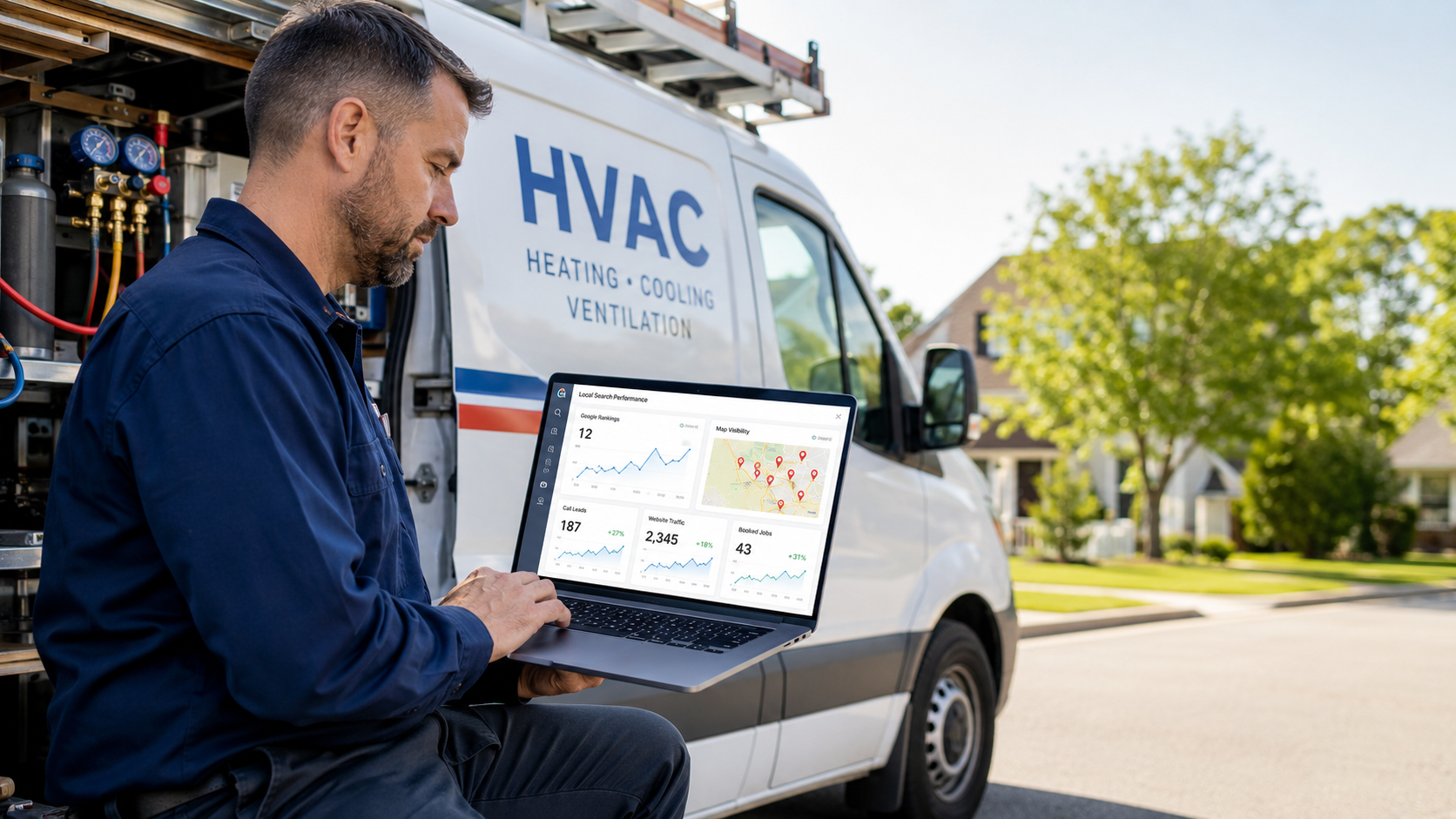
Table of Contents
Introduction
Most HVAC companies do not need more website traffic.
They need more of the right people finding them when they need service.
A homeowner searching “AC repair near me” does not care how many blog posts you published.
They want to know three things:
- Can you help me?
- Can you get here soon?
- Can I trust you?
That is what HVAC SEO should do.
Not win vanity keyword reports.
Not create traffic from people outside your service area.
Not fill your inbox with marketing jargon.
SEO should help your company show up when local customers are already looking for an HVAC company, then give them enough confidence to call.
Done right, SEO becomes a lead source that keeps working after the ad budget stops.
Done badly, it becomes another monthly bill with nothing to show for it.
What HVAC SEO Actually Means
HVAC SEO is the work of helping your company appear in Google when local customers search for heating, cooling, repair, maintenance, replacement, or indoor-air-quality services.
That includes searches like:
- AC repair in [city]
- Furnace repair near me
- HVAC maintenance [city]
- Heat pump installation [city]
- Emergency HVAC service
- HVAC company near me
For most contractors, the goal is not to rank nationally.
The goal is to show up in the cities and neighborhoods where you can actually send a truck.
That usually comes down to five things:
| SEO Foundation | Why It Matters |
|---|---|
| Complete Google Business Profile | Helps local customers find and trust your company |
| Clear service pages | Matches the exact service a customer is searching for |
| Real customer reviews | Builds credibility before the first call |
| Local proof | Shows that you genuinely serve the market |
| Easy conversion paths | Makes it simple to call, text, or book |
The good news is that most HVAC companies are weak at several of these.
You do not need to outsmart Google.
You need to be more useful, more trustworthy, and easier to contact than the companies around you.
Start With Google Business Profile
Your Google Business Profile is often the first thing a homeowner sees.
It may appear before your website.
That means an incomplete profile can cost you calls before someone ever reaches your site.
Make sure your profile includes:
- The correct business name
- Accurate phone number
- Correct service area
- Primary and secondary categories
- Current business hours
- A link to your website
- Real photos of trucks, technicians, installs, and office staff
- A clear description of what you do
- Regularly updated services
Do not stuff your business name with keywords.
Do not use a fake address.
Do not list service areas you cannot support.
Those shortcuts can create bigger problems than they solve.
Your profile should make it obvious that you are a real, local HVAC company with a team, trucks, customers, and experience.
Reviews Are Part of the Lead System
Reviews are not just reputation management.
They help the customer decide whether to call you or the company below you.
A homeowner with no AC is comparing risk.
They are asking:
“Which company looks like it will show up, treat me fairly, and fix this correctly?”
A steady stream of recent reviews answers that question.
Build a simple review process:
| Step | Action |
|---|---|
| 1 | Finish the job well |
| 2 | Confirm the customer is satisfied |
| 3 | Send one follow-up text or email |
| 4 | Make the review link easy to use |
| 5 | Respond to every review |
Do not buy reviews.
Do not pressure unhappy customers.
Do not make reviews a one-time campaign.
A few new reviews every week are more valuable than a burst of reviews once a year.
For a more detailed review system that avoids incentives and review gating, see how to get more HVAC reviews.
Build Service Pages That Match How Customers Search
A lot of HVAC websites make this harder than it needs to be.
They have one generic “Services” page with a long list of everything they do.
That is not enough.
A homeowner searching for furnace repair should land on a page about furnace repair.
A homeowner searching for heat pump installation should land on a page about heat pump installation.
Every core service should have its own page.
At a minimum, most residential HVAC companies need pages for:
- AC repair
- AC installation or replacement
- Furnace repair
- Furnace installation or replacement
- Heat pump repair
- Heat pump installation
- HVAC maintenance
- Emergency HVAC service
- Indoor air quality
- Ductwork, if it is a real part of your business
Each page should answer practical questions:
- What problems do you solve?
- What should the customer expect?
- What affects the cost?
- How quickly can you help?
- Which areas do you serve?
- Why should they choose your company?
- How do they book service?
Do not create ten pages that say the same thing with a different city name pasted into the headline.
That is thin content.
Create pages that actually help a homeowner understand the service and make a decision.
A conversion-focused HVAC website design checklist can help ensure service pages clearly explain the work, establish trust, and make booking easy.
Create Location Pages Only Where You Have Real Coverage
Location pages can work well for HVAC companies.
They can also turn into spam fast.
You should create a page for a city when you genuinely serve it and can back it up with real information.
That may include:
- The services you provide there
- The neighborhoods you commonly serve
- Local reviews or customer examples
- Common HVAC issues in that market
- Your service-area expectations
- Clear contact information
A strong location page is not:
“Best HVAC service in [city]. We offer HVAC service in [city]. Call us for HVAC service in [city].”
That reads like it was written for a search engine.
A useful page sounds like a local company explaining how it serves local customers.
Start with your main market.
Then add nearby cities where you have enough call volume, technician availability, and actual business reason to compete.
Make Your Website Convert the Traffic You Earn
Ranking is not the finish line.
A website that gets visitors but does not create calls is a brochure, not a lead system.
Every important page should make it easy to take the next step.
That means:
- A click-to-call phone number on mobile
- A visible booking button
- Clear service-area information
- Trust signals near the call to action
- Real reviews
- Photos of your team and trucks
- Financing information for replacement pages
- Emergency service details when applicable
- Fast-loading pages that work on a phone
Do not make people hunt for your number.
Do not force them through a five-page form.
Do not bury the booking button below a wall of text.
The customer may be standing in a hot house with a broken AC.
Make the decision easy.
Publish Content That Helps Before the Emergency
Service pages capture customers who are ready to call now.
Helpful content brings in homeowners earlier.
That is where blog posts, FAQs, and buying guides matter.
Good HVAC content answers questions customers are already asking:
- Why is my AC running but not cooling?
- How long should an HVAC system last?
- Should I repair or replace my furnace?
- How much does a heat pump cost?
- Why is my HVAC system freezing up?
- What does an HVAC maintenance plan include?
This content does two jobs.
First, it can bring in search traffic before the customer has an emergency.
Second, it gives your company something useful to send in follow-up emails, sales conversations, and social posts.
Do not publish articles just because someone gave you a keyword list.
Publish content that helps your customer understand a real decision, problem, or cost.
Then connect the content to a relevant service page and a clear way to contact your company.
A broader HVAC marketing strategy helps connect SEO content to paid ads, follow-up, memberships, reviews, and referral growth.
Track Leads, Not Rankings
Rankings can be useful.
But rankings do not pay payroll.
Booked calls do.
Track where leads come from and what happens after they arrive.
At a minimum, measure:
- Organic website calls
- Organic form submissions
- Google Business Profile calls
- Booked jobs from organic search
- Revenue from organic leads
- Cost per booked job
- Close rate by lead source
- Which service pages create the most calls
This is where many HVAC companies get fooled.
They hear that traffic is up.
But nobody checks whether calls are up.
A page with 100 visitors and 10 booked calls is more valuable than a page with 5,000 visitors and no real customers.
The point of HVAC SEO is not visibility for its own sake.
The point is profitable booked work.
A Simple 90-Day HVAC SEO Plan
You do not need to rebuild everything at once.
Start with the work that will make the biggest difference.
Days 1–30: Fix the Foundation
- Complete and verify your Google Business Profile
- Clean up your phone number, address, service areas, and hours
- Add real photos
- Create a review request process
- Make sure your website has clear phone and booking options
- Set up call and form tracking
Days 31–60: Build the Core Pages
- Improve your main service pages
- Add missing repair, maintenance, and replacement pages
- Create pages for your strongest service areas
- Add customer reviews and proof to key pages
- Improve mobile speed and booking flow
Days 61–90: Publish and Improve
- Publish helpful HVAC content around common customer questions
- Add internal links between blog posts and service pages
- Review which pages create calls
- Keep collecting reviews
- Improve the pages that get traffic but do not convert
SEO takes time.
But it should not feel mysterious.
You are building an online version of what a good HVAC company already does in person:
| Principle | What It Looks Like Online |
|---|---|
| Show up | Be visible in the right local searches |
| Be clear | Explain services, areas, pricing factors, and next steps |
| Build trust | Use real reviews, team photos, proof, and clear communication |
| Make it easy to buy | Give customers simple call, booking, and contact options |
FAQ
How long does HVAC SEO take to generate leads?
Most companies should expect several months before SEO becomes a reliable lead source.
Google Business Profile improvements and review growth may create movement sooner. Competitive service-page rankings usually take longer.
The important thing is to measure booked calls and revenue, not just ranking movement.
Is SEO better than Google Ads for HVAC companies?
They do different jobs.
Google Ads can create leads quickly when the campaign is managed well.
SEO takes longer but can create a more durable source of leads over time.
The strongest HVAC companies usually use both: paid search for immediate demand and SEO to reduce dependence on paid leads over the long term.
For immediate-demand campaign guidance, see Google Ads for HVAC contractors.
How many reviews does an HVAC company need?
There is no magic number.
You need enough recent, credible reviews to make a homeowner feel confident choosing you.
A company with 75 strong reviews from the last year can look more trustworthy than a company with 500 old reviews and no recent activity.
Should HVAC companies create a page for every city?
No.
Build city pages only for markets you genuinely serve and can support with useful, distinct information.
Thin pages with the city name swapped out do not help customers and rarely create lasting results.
Final Thoughts
Consistent HVAC leads from SEO do not come from tricks.
They come from being easy to find, easy to trust, and easy to contact.
Start with your Google Business Profile.
Build service pages around the work customers actually search for.
Collect real reviews.
Create helpful content.
Then track booked calls and revenue so you know what is working.
The company that wins local search is not always the biggest.
It is usually the one that looks like the safest, clearest choice when the customer needs help.