
Google Ads for HVAC Contractors: A Beginner’s ROI Guide
Learn how HVAC companies can set up, optimize, and measure profitable Google Ads campaigns, reduce wasted spend, and maximize return on investment from paid search.
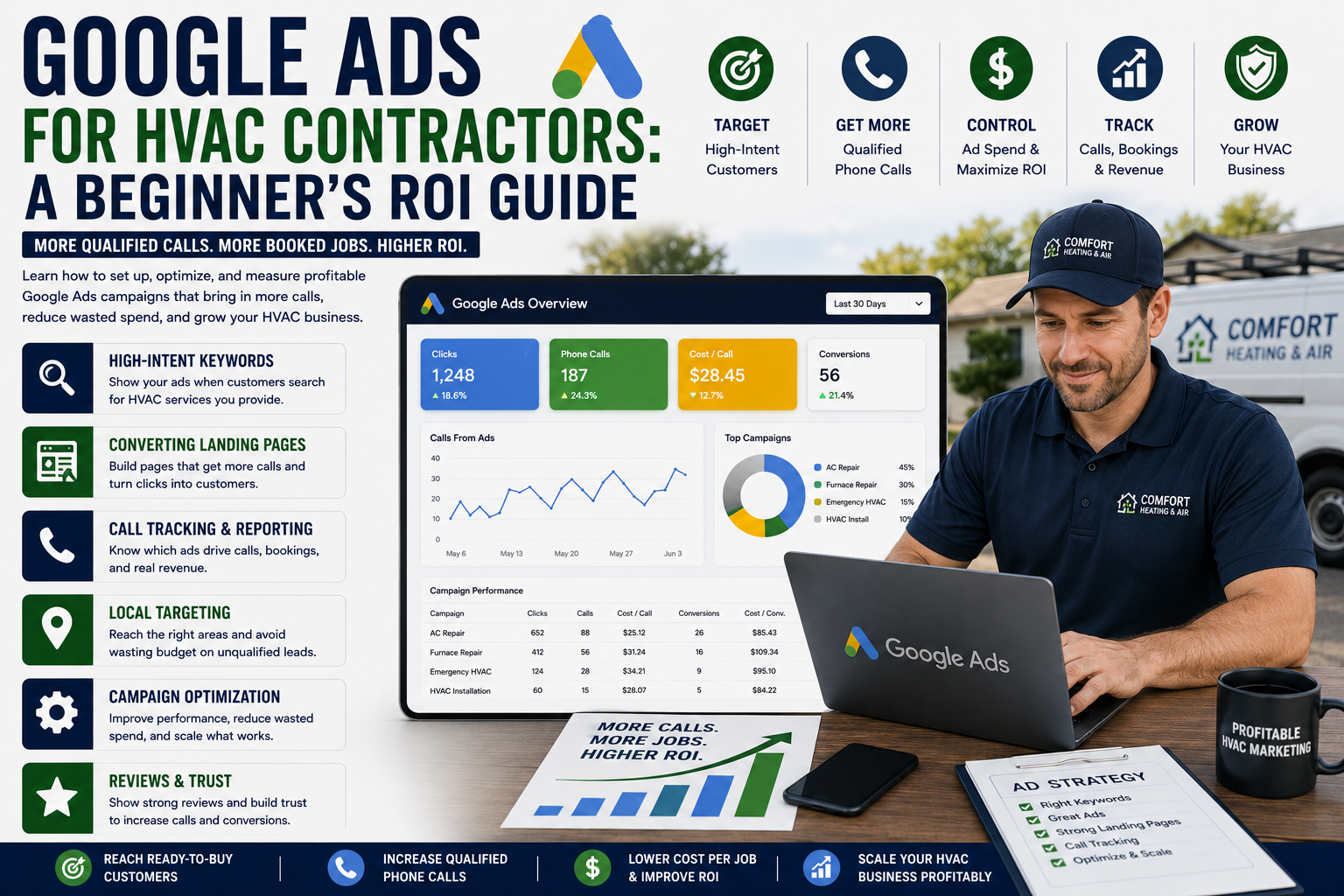
Table of Contents
Introduction
Google Ads can help HVAC companies generate calls quickly.
Unlike SEO, which takes time to build, paid search can put your business in front of homeowners at the exact moment they are searching for help.
That can be valuable when someone searches for:
- AC repair near me
- Furnace repair near me
- Emergency HVAC service
- Heat pump repair
- HVAC installation near me
But Google Ads can also become expensive fast.
Many contractors focus on clicks, impressions, and call volume without knowing whether the ads are actually producing profitable jobs.
That is the wrong goal.
The goal is not traffic.
The goal is booked jobs, collected revenue, and profitable customers.
What Google Ads Can Do for HVAC Companies
Google Ads helps your company appear in search results when customers are actively looking for HVAC services.
That makes it different from many other forms of advertising.
Someone scrolling social media may not need an HVAC technician today.
Someone searching for “emergency AC repair near me” probably does.
Google Ads can support services such as:
- AC repair
- Furnace repair
- Heat pump repair
- Emergency HVAC service
- System replacement
- AC installation
- Furnace installation
- Ductless mini-split service
- Maintenance plans
- Indoor air quality services
The advantage is speed.
The downside is that every weak part of your operation becomes more expensive.
If calls go unanswered, the landing page is weak, or your service area is too large, your budget can disappear without producing enough profitable work.
Start With the Right Goal
A campaign can generate plenty of clicks and still lose money.
That happens when:
- Leads are outside your service area
- The office misses calls
- The schedule is already full
- Customers only want the cheapest option
- Technicians cannot convert opportunities
- Jobs have low margins
- Estimates do not get followed up
Instead of asking:
“How many leads did we get?”
Ask:
“How much profitable revenue did this campaign create?”
That change in mindset improves every marketing decision that follows.
A broader HVAC marketing strategy connects paid search to call handling, conversion, retention, reviews, and operational capacity instead of treating ads as an isolated tactic.
Focus on High-Intent Keywords
The best HVAC keywords usually show immediate buying intent.
These are searches from people who likely need service soon.
Examples include:
- AC repair near me
- Emergency AC repair
- Furnace repair near me
- HVAC repair near me
- Heat pump repair
- Air conditioner repair
- AC installation near me
- Furnace replacement
- Same-day HVAC repair
Avoid spending heavily on informational searches unless you have a specific strategy for them.
Examples include:
- How does an AC work
- DIY AC repair
- HVAC salary
- HVAC jobs
- HVAC training
- Best HVAC brands
- Thermostat manual
Those searches can bring traffic, but most will not turn into service calls.
Separate Campaigns by Service
Do not put every service into one large campaign.
Emergency repair, maintenance, and replacement leads have different intent, different margins, and different customer expectations.
Separate campaigns help you control budget and messaging.
Useful campaign groups may include:
- AC repair
- Furnace repair
- Heat pump repair
- Emergency service
- AC installation
- Furnace replacement
- Maintenance memberships
- Ductless mini-split installation
- Commercial HVAC service
This makes it easier to see which services are producing the best leads and which are wasting spend.
Target Only Areas You Can Serve Profitably
A larger map does not always create better results.
It may create more calls, but it can also create:
- Longer drive times
- Higher fuel costs
- More missed appointment windows
- Lower technician productivity
- Harder dispatch decisions
- Lower margins
Target the areas your company can realistically serve well.
Before expanding your ad radius, ask:
- Can technicians reach this area quickly?
- Do we have enough capacity?
- Can calls be grouped by location?
- Are customers in this market a good fit?
- Will longer travel time reduce daily revenue?
- Do we need trip charges for distant calls?
A smaller, profitable service area is usually better than a huge area full of low-value leads.
Build Service-Specific Landing Pages
Do not send every ad click to your homepage.
A customer searching for AC repair should land on an AC repair page.
A customer searching for furnace replacement should land on a furnace replacement page.
Each landing page should include:
- A clear service headline
- Your service area
- Click-to-call phone number
- Online booking option
- Customer reviews
- Financing information when relevant
- Emergency messaging when relevant
- Trust signals
- Clear calls to action
- Short contact form
- Common questions customers ask
For example:
Fast AC Repair in [City]
Same-Day Appointments Available
Licensed Technicians. Clear Pricing. Easy Scheduling.
The visitor should immediately know they are in the right place.
A stronger HVAC website design checklist can help make sure each page is fast, clear, mobile-friendly, and built to turn paid traffic into calls.
Track Calls, Bookings, and Revenue
If you only track clicks, you do not know whether your ads are working.
At a minimum, track:
- Calls from ads
- Calls from landing pages
- Form submissions
- Online bookings
- Missed calls
- Jobs booked
- Jobs completed
- Revenue by campaign
- Revenue by service
- Average ticket
- Membership sales
- Replacement opportunities
- Gross margin
Your office should also track why leads do not book.
Examples include:
- Outside service area
- Wrong service type
- Price shopper
- No technician availability
- Duplicate lead
- Customer did not answer
- Customer canceled
- Invalid request
This is how you find where the budget is leaking.
Answer Paid Leads Fast
Paid leads are expensive.
If a customer calls from an ad and nobody responds, they will often call the next company listed.
Set a clear response standard.
For example:
Return missed paid-search calls within five minutes.
Your team should know who owns:
- Missed-call follow-up
- Lead screening
- Service-area verification
- Appointment availability
- Diagnostic-fee communication
- Lead-source tracking
Fast response often matters more than small ad optimizations.
Use Negative Keywords to Reduce Waste
Negative keywords help prevent ads from appearing for searches you do not want.
For HVAC companies, common negative keywords may include:
- Jobs
- Careers
- Salary
- Training
- DIY
- Manuals
- Parts only
- Free repair
- Used equipment
- Services you do not offer
- Commercial refrigeration, if you do not provide it
Review search terms regularly.
Look for clicks that do not create booked jobs, then add those terms as negatives.
This is one of the easiest ways to reduce wasted spend over time.
Match Ads to Customer Intent
Your ad message should match the type of service the customer is searching for.
Emergency Repair
AC Not Cooling?
Fast Repair Appointments Available
Call Now for Service in [City]
System Replacement
Upgrade Your HVAC System
Flexible Financing Available
Request a Replacement Estimate Today
Maintenance
HVAC Tune-Up in [City]
Keep Your System Running Efficiently
Schedule Maintenance Online
The closer the message matches the customer’s problem, the more likely they are to contact you.
Measure ROI, Not Just Cost Per Lead
Cost per lead is useful, but it is incomplete.
A cheap lead is not valuable if it does not book, cancels, or produces low-margin work.
Track:
- Ad spend
- Leads
- Calls answered
- Jobs booked
- Jobs completed
- Revenue
- Average ticket
- Gross margin
- Cost per booked job
- Cost per completed job
- Return on ad spend
A simple starting formula is:
| Calculation | Meaning |
|---|---|
| Revenue from Google Ads | Total collected revenue tied to paid-search campaigns |
| Less Google Ads spend | Campaign cost |
| Return before labor and overhead | Revenue remaining before delivery costs |
Then look beyond the first job.
A repair lead may later become:
- A maintenance member
- A replacement customer
- A repeat service customer
- A referral source
That is why the cheapest lead is not always the best lead.
Do Not Scale Spend Before Operations Are Ready
More Google Ads budget creates more demand.
That only helps if your company can handle the work.
Before increasing spend, ask:
- Do we have technician capacity?
- Can the office answer more calls?
- Can dispatch handle more appointments?
- Are callbacks under control?
- Are customers getting realistic appointment windows?
- Are current campaigns already profitable?
- Can we maintain a good customer experience?
Marketing should match capacity.
More leads are not useful when the company is already overwhelmed.
Avoid Weak Free-Estimate Messaging
Free estimates can attract calls.
They can also attract customers who only want free advice or the lowest possible price.
That does not mean free estimates are always wrong.
For replacement estimates, they can make sense.
For repair calls, a diagnostic fee often protects technician time and filters out poor-fit leads.
Your ad message should match your actual pricing model.
Do not advertise free service if your company needs to charge for diagnostics.
Follow Up on Every Open Estimate
Google Ads creates opportunities.
But the spend is wasted if estimates go cold.
Create a clear follow-up process:
- Follow up quickly
- Use text and email reminders
- Make financing easy to access
- Explain options clearly
- Track why jobs were not sold
- Assign ownership for each open estimate
- Review open estimates weekly
You already paid to generate the lead.
Do not lose the job because nobody followed up.
Common Google Ads Mistakes
Measuring Clicks Instead of Revenue
Clicks do not pay payroll. Profitable completed jobs do.
Sending Every Click to the Homepage
Match each ad to a focused service page.
Advertising Too Many Services
Start with the services your company handles best.
Targeting Too Wide an Area
Long drive times can quickly destroy margins.
Ignoring Missed Calls
Every missed paid call is wasted ad spend.
Using Weak Landing Pages
Customers should understand what you offer and how to book within seconds.
Skipping Negative Keywords
Irrelevant search traffic quietly drains budget.
Increasing Spend Too Fast
Scale only after the current campaigns are producing profitable work.
A Simple Google Ads Plan for Beginners
Week 1: Choose Services
Pick two or three high-intent, profitable services.
For example:
- AC repair
- Furnace repair
- Emergency HVAC service
Week 2: Create Landing Pages
Build pages with service details, reviews, booking options, trust signals, and clear calls to action.
Week 3: Set Up Tracking
Track calls, forms, booked jobs, completed jobs, revenue, and campaign source.
Week 4: Review Results
Look at:
- Search terms
- Cost per lead
- Booking rate
- Missed-call rate
- Revenue by campaign
- Average ticket
- Performance by service area
Then adjust.
Remove weak search terms.
Improve weak landing pages.
Increase budget only where results support it.
FAQ
Are Google Ads worth it for HVAC contractors?
Google Ads can be worth it when you target high-intent searches, answer calls quickly, track booked jobs, and measure revenue instead of only clicks.
How much should an HVAC company spend on Google Ads?
Start with a controlled budget based on your technician capacity, average ticket, gross margin, competition, and service area. Increase spend only when campaigns are producing profitable completed jobs.
What HVAC services work best with Google Ads?
High-intent services often perform well, including AC repair, furnace repair, emergency service, heat pump repair, system replacement, and installation services.
Why are my Google Ads getting clicks but no calls?
Possible causes include poor keyword targeting, weak landing pages, slow mobile load speed, unclear calls to action, poor reviews, weak trust signals, or targeting outside your true service area.
How can HVAC companies reduce wasted Google Ads spend?
Use negative keywords, focus on high-intent services, target profitable areas, build focused landing pages, track calls through booked jobs, and review search terms regularly.
Final Thoughts
Google Ads can generate HVAC demand quickly.
But it is not a shortcut to profitable growth.
The companies that get the best results focus on high-intent services, target the right areas, answer calls fast, build strong landing pages, track booked jobs, and make decisions based on revenue instead of clicks.
Start with a small, focused campaign.
Track the full customer journey.
Improve what works.
Cut what does not.
The goal is not more traffic.
It is more profitable customers.
Continue Reading
- Local Services Ads for HVAC: How to Get More Calls Without Wasting Budget
- Best HVAC Lead Generation Strategies That Actually Work
- HVAC Website Design Checklist for Maximum Conversion Rate
- How HVAC Companies Can Generate Consistent Leads with SEO in 2026
- HVAC Marketing Strategy: A Complete System for Steady Job Flow
- How to Get More HVAC Reviews
- Why HVAC Marketing Agencies Fail