
Estimating Software for HVAC Contractors: Top Options Reviewed
Review the best HVAC estimating software for creating accurate proposals, calculating labor and material costs, and winning more profitable jobs.
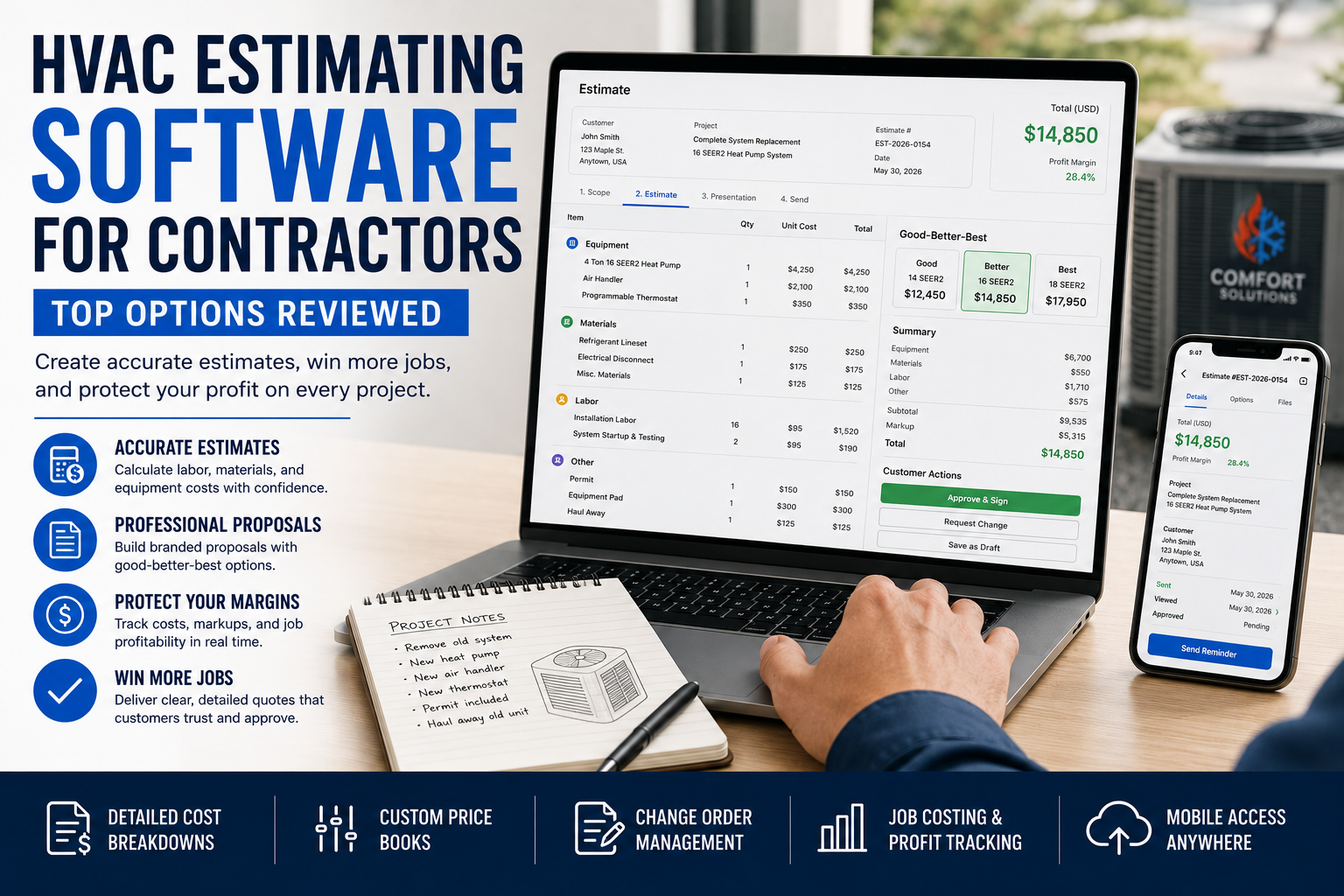
Table of Contents
Introduction
Most HVAC companies do not lose money because they cannot get work.
They lose money because they price work wrong.
The estimate misses labor.
The material cost changed.
The crew takes longer than expected.
The customer approves a job that looked profitable on paper but leaves almost nothing behind.
That is where estimating software matters.
Good estimating software helps HVAC contractors build faster proposals, use consistent pricing, protect margins, and make it easier for customers to approve work.
The goal is not to create prettier estimates.
The goal is to stop guessing.
A good estimate should answer a few important questions before the job starts:
- What will labor actually cost?
- What equipment and materials are needed?
- What margin should this job produce?
- What options should the customer see?
- What happens if the scope changes?
- Can the office and field team see the same numbers?
This guide breaks down what HVAC estimating software should do, which types of contractors need it most, and what to look for before choosing a platform.
What Is HVAC Estimating Software?
HVAC estimating software helps contractors create proposals for repairs, replacements, installs, maintenance work, and commercial projects.
Depending on the platform, it can help with:
- Labor calculations
- Equipment pricing
- Material costs
- Flat-rate pricing
- Good-better-best options
- Proposal templates
- Customer approvals
- Financing options
- Change orders
- Job costing
- Price books
- Estimate follow-up
- Margin tracking
For smaller companies, estimating software may be built into a field service platform.
For larger residential or commercial companies, it may be part of a bigger system that connects sales, dispatch, inventory, purchasing, job costing, and accounting.
The right tool depends on how complicated your work is.
For a broader look at platforms that connect estimating with dispatch, customer records, billing, and technician workflows, see field service management software for HVAC.
Why HVAC Companies Need Better Estimating
A lot of HVAC estimates are still built from experience, memory, old spreadsheets, and whatever the owner thinks sounds fair.
That works until it does not.
The company wins the job.
The crew starts work.
Then the problems show up.
The install takes two extra days.
A material was missed.
The equipment price changed.
The ductwork was worse than expected.
A permit was not included.
The customer asks for a change.
Nobody tracks the extra labor.
The invoice stays the same.
That is how profitable jobs become expensive lessons.
A better estimating process helps prevent those mistakes.
It creates consistency between the office, salesperson, technician, installer, and owner.
Everyone should understand what was sold, what was included, and what margin the company expected to earn.
What Good HVAC Estimating Software Should Include
Not every contractor needs every feature.
But these are the features that matter most.
Labor and Material Costing
The estimate should account for more than equipment cost.
It needs to include:
- Technician or installer labor
- Payroll burden
- Materials
- Equipment
- Permits
- Disposal
- Freight
- Subcontractors
- Equipment accessories
- Warranty risk
- Overhead
- Target profit
A $10,000 replacement job can look good until you realize labor ran long, materials were missed, and the crew had to return twice.
Estimating software should help the company see the real cost before the job gets sold.
For a detailed breakdown of why estimated costs must be compared with real job results, read HVAC job costing explained.
Price Books
Technicians should not be making up prices in the driveway.
A digital price book helps create consistency.
It gives the office and field team the same starting point for repairs, replacements, upgrades, and common tasks.
A good HVAC price book should help with:
- Flat-rate repairs
- Part and labor combinations
- Good-better-best options
- Standard task pricing
- Membership pricing
- Equipment upgrades
- Add-ons
- Financing options
- Customer-friendly descriptions
The goal is not to make every quote identical.
The goal is to keep pricing from changing based on which technician is standing in the customer’s house.
For more guidance on building pricing that protects margins instead of just winning jobs, see HVAC pricing strategies that protect profit margins.
Proposal Templates
A strong proposal makes it easier for customers to understand what they are buying.
The customer should not receive a vague estimate that says:
Replace HVAC system — $14,500
That creates confusion.
A better proposal should explain:
- What equipment is being installed
- What work is included
- What is not included
- Warranty information
- Payment options
- Financing options
- Optional upgrades
- Timeline
- Next steps
Good estimating software makes those proposals easier to build without starting from scratch every time.
Good-Better-Best Options
Customers do not always want the cheapest option.
They want to understand the tradeoffs.
Good-better-best proposals help the customer compare different equipment levels, efficiency ratings, warranty options, comfort upgrades, and financing choices.
This works best when the options are clear.
Do not overwhelm the customer with six different systems.
Give them a few logical choices and explain the difference.
The goal is not pressure.
The goal is clarity.
Customer Approvals and Digital Signatures
A proposal sitting in an email inbox does not help anyone.
Estimating software should make it easy for customers to review, approve, sign, and pay a deposit digitally.
That helps reduce the delay between quote and job.
It also gives the office a cleaner record of what was approved.
For larger jobs, it can help protect the company when questions come up later about scope, equipment, or pricing.
Change Orders
Change orders are where a lot of HVAC companies lose money.
The job starts.
Something changes.
Maybe there is unexpected ductwork.
Maybe the electrical panel needs work.
Maybe the equipment location changes.
Maybe the homeowner adds an upgrade.
If the scope changes, the price should change too.
Estimating software should make it easy to create a change order, explain the additional work, get approval, and keep the job record updated.
Without that process, the company often eats the extra cost.
Job Costing
The estimate is only useful if you compare it to what actually happened.
Job costing helps you see:
- Estimated labor versus actual labor
- Estimated material versus actual material
- Equipment cost changes
- Return trips
- Warranty work
- Gross margin by job
- Install crew performance
- Jobs that consistently miss the estimate
This is where estimating gets better over time.
The owner who reviews job costs learns from mistakes.
The owner who only checks the bank account repeats them.
A practical HVAC job costing process helps turn actual labor and material results into better future estimates.
Best Estimating Software for Small HVAC Companies
Small HVAC companies do not need a massive commercial estimating system.
They need a reliable way to create estimates, use consistent pricing, send proposals, collect approval, and track basic job details.
For many small residential contractors, estimating tools built into platforms like Jobber or Housecall Pro may be enough.
The important thing is that the system helps the company stop relying on memory.
For a small team, look for:
- Simple estimates
- Price-book access
- Mobile quoting
- Customer approvals
- Invoicing
- Payment collection
- Job notes
- Basic reporting
- Easy technician adoption
A simpler system that everyone uses is better than a complicated estimating platform nobody touches.
For a broader comparison of CRM and field-service platforms by contractor stage, see best HVAC CRM software compared.
Best Estimating Software for Growing HVAC Companies
Growing companies need more control.
Once you have multiple technicians, install crews, comfort advisors, maintenance plans, and a bigger office team, estimating becomes a bigger part of the business.
At this stage, look for:
- Detailed price books
- Good-better-best proposals
- Financing workflows
- Technician and sales reporting
- Estimate follow-up
- Job costing
- Membership pricing
- Equipment tracking
- Proposal templates
- Better approval workflows
FieldEdge can be a good fit for established service companies that need stronger HVAC-specific pricing, dispatch, service agreement, and technician workflow tools.
Best Estimating Software for Larger HVAC Companies
Larger HVAC companies usually need estimating tied into the entire operation.
The estimate affects:
- Sales
- Dispatch
- Install scheduling
- Purchasing
- Inventory
- Job costing
- Financing
- Customer communication
- Accounting
- Department reporting
At this stage, software like ServiceTitan may make more sense because the company needs pricing, estimates, dispatch, install work, reporting, and job costing connected in one system.
The bigger the company gets, the more expensive disconnected estimating becomes.
For companies deciding how connected their software stack needs to be, review best HVAC software stack for small business vs enterprise.
Best Estimating Software for Commercial HVAC Contractors
Commercial HVAC estimating is a different job.
You may be estimating:
- Large replacements
- Mechanical projects
- New construction
- Tenant improvements
- Service contracts
- Multi-site work
- Equipment packages
- Ductwork
- Controls
- Labor-intensive projects
Commercial contractors often need stronger control around:
- Labor estimates
- Material takeoffs
- Vendor pricing
- Project budgets
- Change orders
- Progress billing
- Purchasing
- Job profitability
- Contract management
Residential-first tools can work for simple commercial service.
But larger project-based work usually needs a more detailed estimating process.
Common Estimating Mistakes HVAC Companies Make
Pricing From Gut Feel
A lot of owners price based on what competitors charge or what feels fair.
That is not a system.
Your labor burden, overhead, truck costs, insurance, warranty risk, and profit goals are different from the company down the street.
If you do not know your actual costs, you are guessing.
And guessing is expensive.
Forgetting Indirect Costs
The estimate covers the equipment and basic labor.
But it misses:
- Fuel
- Office support
- Permits
- Disposal
- Financing fees
- Warranty risk
- Return trips
- Tools
- Truck costs
- Insurance
- Overhead
Those costs do not disappear because they are not listed on the estimate.
They come out of your profit.
Use how much profit an HVAC company should make to pressure-test whether the margin built into your estimates supports the business you are trying to run.
Not Using Change Orders
The scope changes.
The work gets harder.
The company keeps going.
Nobody updates the price.
That is a fast way to lose money.
Every meaningful change in scope should be documented and approved.
Not Reviewing Actual Job Costs
A company may keep winning the same type of job while losing margin every time.
Without job costing, the owner may never see it.
Track actual labor, materials, return trips, and warranty work.
Then update future estimates based on what you learn.
Giving Customers Too Many Choices
Good-better-best works when the customer can understand the options.
Too many choices create confusion.
Keep the proposal clear.
Explain the tradeoffs.
Make the next step easy.
How to Choose HVAC Estimating Software
Before booking a demo, ask:
- Are we pricing from memory?
- Are estimates consistent between technicians?
- Are we missing labor or material costs?
- Are change orders being tracked?
- Can customers approve estimates digitally?
- Can we offer good-better-best options?
- Can we track estimate follow-up?
- Can we compare estimated versus actual job cost?
- Do technicians need mobile access?
- Do we need commercial project estimating?
Then choose the platform that solves the biggest leak first.
A small company may need simple estimating built into field service software.
A growing company may need stronger price books, proposals, and job costing.
A commercial contractor may need more detailed project estimating.
For a broader contractor-stage comparison, see top HVAC software tools ranked by real contractor needs.
FAQ
What is HVAC estimating software?
HVAC estimating software helps contractors create proposals, calculate labor and material costs, use price books, present options, track approvals, and protect job profitability.
What is the best estimating software for a small HVAC company?
For many small HVAC companies, estimating tools built into field service software such as Jobber or Housecall Pro may be enough. The best choice is usually the system that helps your team create accurate estimates and actually use the process.
What should HVAC estimates include?
A good HVAC estimate should include labor, equipment, materials, permits, disposal, accessories, warranty considerations, overhead, target profit, scope of work, exclusions, timeline, and payment terms.
Why is job costing important after estimating?
Job costing shows whether the company earned the margin it expected. It compares estimated labor and materials against actual costs so you can improve future pricing.
Final Thoughts
The best HVAC estimating software does not just create polished proposals.
It helps protect profit.
It gives technicians and salespeople consistent pricing.
It helps customers understand their options.
It tracks approval.
It makes change orders easier.
And it helps the owner see whether estimates are actually producing the margins they were supposed to.
The goal is not more software.
The goal is fewer surprises after the job starts.
Continue Reading
- HVAC Job Costing Explained
- HVAC Pricing Strategies That Protect Profit Margins
- How Much Profit Should an HVAC Company Make?
- Best HVAC CRM Software Compared
- Field Service Management Software for HVAC: What to Look For
- Best HVAC Software Stack for Small Business vs Enterprise
- Top HVAC Software Tools Ranked by Real Contractor Needs