
HVAC Job Costing Explained: Stop Losing Money on Every Call
Understand how to accurately calculate labor, materials, overhead, and profit so every HVAC job contributes to your bottom line.
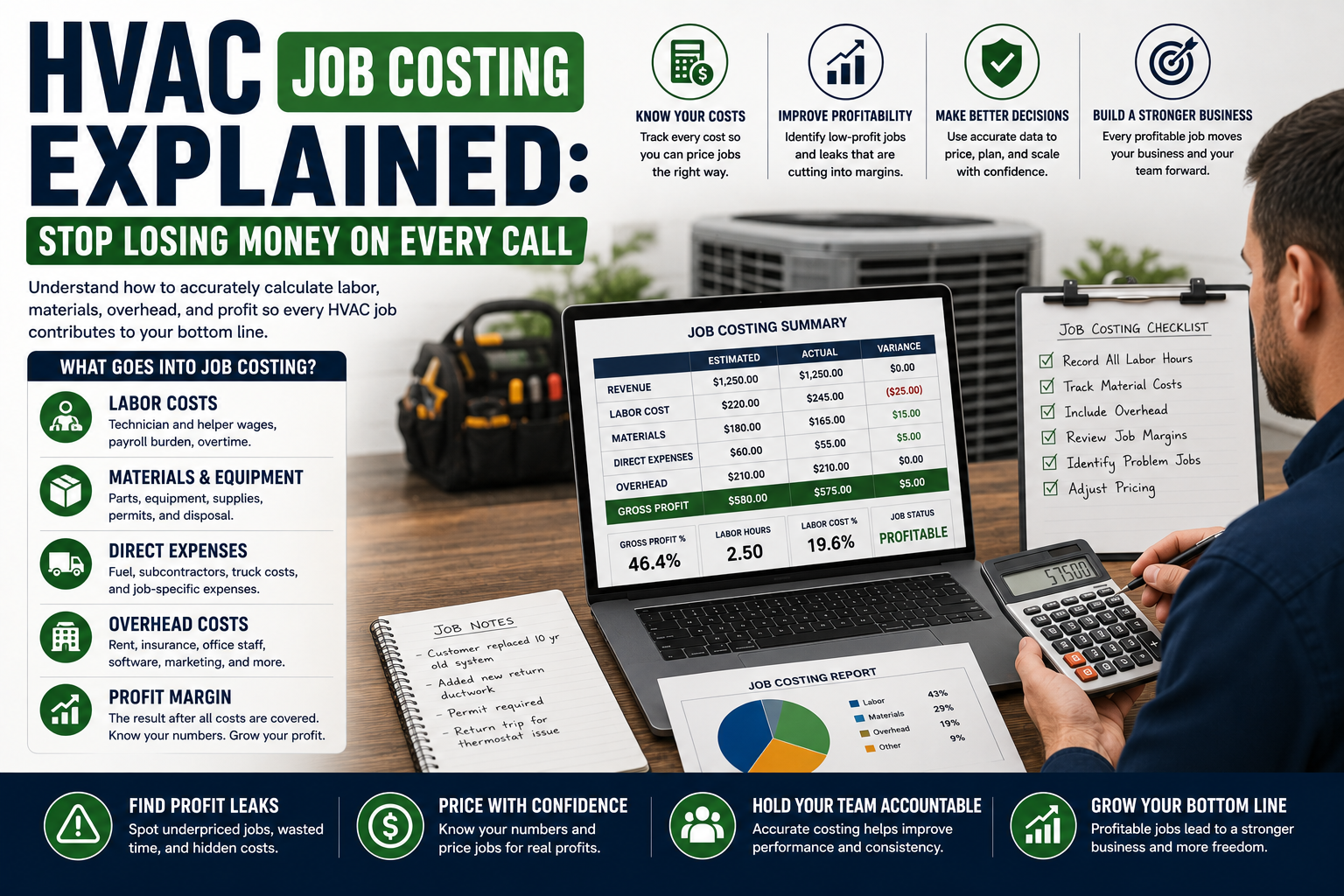
Table of Contents
Introduction
A lot of HVAC companies think they are profitable because the schedule is full.
Then payroll hits.
Parts bills show up.
A truck needs repairs.
A callback eats half a day.
And the owner wonders where all the money went.
That is what happens when you only look at revenue.
Job costing tells you whether a job actually made money after labor, materials, overhead, and mistakes are counted.
It answers one important question:
Did we make money on this job, or did we just stay busy?
Every HVAC company should know the answer.
A repair that brings in $750 can be a great job.
Or it can barely cover the technician, the part, the truck, and the office that supported it.
The difference is job costing.
Job costing also depends on a reliable estimate-to-invoice process; our estimates and invoicing solution explains the operational side of that workflow.
What Is HVAC Job Costing?
HVAC job costing is the process of comparing what you expected a job to cost against what it actually cost.
For each repair, maintenance visit, replacement, or install, you track:
- Revenue collected
- Technician or installer labor
- Payroll burden
- Materials and equipment
- Permits
- Subcontractors
- Travel and truck costs
- Discounts
- Return trips
- Warranty work
- Payment-processing fees
- Overhead
- Gross profit
The purpose is not more paperwork.
The purpose is to find out where profit is leaking.
A company that job costs consistently can spot patterns.
Maybe a repair is underpriced.
Maybe install crews are running over labor budgets.
Maybe one technician is discounting too often.
Maybe callbacks are eating the margin from otherwise good jobs.
Without job costing, those problems stay hidden.
Why HVAC Companies Lose Money Without Job Costing
Most owners know total revenue.
Many know what is in the bank account.
Far fewer know which jobs are actually profitable.
That creates blind spots.
A company may sell a system replacement for $14,000 and assume it was a win.
But after equipment, labor, materials, permits, financing fees, return trips, and warranty work, the actual margin may be far lower than expected.
The same thing happens with service calls.
A technician may run six calls in a day.
But if they are driving too far, discounting repairs, missing parts, and creating callbacks, the company may not be making much from that production.
Revenue feels good.
Profit keeps the business alive. Understanding how much profit an HVAC company should make helps put individual job results into a bigger financial target.
The Four Numbers Every HVAC Owner Should Know
You do not need a finance degree to start job costing.
You need to understand four numbers.
Revenue
Revenue is what the customer pays.
Examples:
- Repair invoice: $850
- Maintenance visit: $199
- System replacement: $12,500
- Commercial service call: $2,400
Revenue is the starting point.
It is not profit.
Direct Labor
Direct labor is the actual cost of the people doing the work.
That includes more than hourly pay.
Track:
- Technician wages
- Installer wages
- Overtime
- Payroll taxes
- Benefits
- Workers’ compensation
- Paid time off
- Bonuses or commissions
A technician making $30 per hour may cost much more after payroll burden is included.
If you only count base wages, your job costing will be wrong.
Materials and Equipment
This includes every physical cost tied to the job:
- Parts
- Equipment
- Refrigerant
- Filters
- Wire
- Thermostats
- Duct materials
- Electrical components
- Permits
- Disposal fees
- Freight
- Equipment delivery
- Miscellaneous supplies
A missed material cost can turn a good job into a weak job.
Gross Profit
Gross profit is what remains after direct labor and materials are subtracted from revenue.
| Calculation Item | Result |
|---|---|
| Revenue | Starting amount |
| Less direct labor | Direct technician or installer cost |
| Less materials and equipment | Parts, equipment, and job materials |
| Gross profit | What remains before overhead |
Example:
| Item | Amount |
|---|---|
| Repair revenue | $850 |
| Technician labor | -$145 |
| Part cost | -$110 |
| Payroll burden | -$45 |
| Gross profit | $550 |
That $550 still needs to help cover office payroll, trucks, insurance, software, marketing, rent, and owner profit.
That is why the invoice total alone does not tell the full story.
Direct Costs vs Overhead
One of the biggest job-costing mistakes is mixing up direct costs and overhead.
Direct Costs
Direct costs are tied directly to one job.
Examples include:
- Technician labor
- Installer labor
- Parts
- Equipment
- Refrigerant
- Permits
- Subcontractors
- Disposal
- Job-specific rentals
If you did not run the job, you would not have that cost.
Overhead Costs
Overhead is the cost of operating the company whether you run one call or 100.
Examples include:
- Rent
- Office payroll
- Insurance
- Marketing
- Software
- Phones
- Truck payments
- Fuel
- Management salaries
- Licensing
- Accounting
- Training
- Utilities
Every job needs to contribute toward overhead.
If your pricing only covers labor and parts, the business will stay busy but underfunded. A more complete HVAC pricing strategy makes sure each job carries its fair share of overhead and target profit.
How to Job Cost a Service Call
A service call may look simple.
It still needs to be measured.
| Item | Amount |
|---|---|
| Repair revenue | $725 |
| Technician labor | -$120 |
| Payroll burden | -$35 |
| Part cost | -$95 |
| Credit-card fee | -$22 |
| Estimated truck and travel cost | -$40 |
| Gross profit before overhead | $413 |
Then ask better questions:
- Was the repair completed on the first visit?
- Did the technician discount the work?
- Was a second trip required?
- Did the customer call back?
- Did the technician sell a maintenance membership?
- Did the price book account for actual labor time?
- Did this lead come from an expensive marketing source?
That is how job costing improves operations, not just accounting.
How to Job Cost an HVAC Installation
Install jobs need deeper costing because more things can go wrong.
Track:
- Equipment cost
- Labor hours
- Payroll burden
- Materials
- Permits
- Crane or lift costs
- Electrical work
- Duct modifications
- Disposal
- Sales commission
- Financing fees
- Return trips
- Warranty work
- Change orders
- Customer credits
Here is a simplified example:
| Item | Amount |
|---|---|
| Install revenue | $15,000 |
| Equipment | -$5,400 |
| Labor | -$2,100 |
| Payroll burden | -$620 |
| Materials | -$980 |
| Permit and disposal | -$340 |
| Sales commission | -$600 |
| Financing fees | -$375 |
| Gross profit before overhead | $4,585 |
That may look healthy.
But if labor runs over, ductwork was missed, or the crew has to return twice, the margin can shrink fast.
Every install should be reviewed after completion.
For companies managing more estimates and replacement work, HVAC estimating software can make it easier to standardize labor assumptions, materials, and proposal details before a job is sold.
Why Labor Is Usually the Biggest Leak
Parts are easy to see.
Labor problems are easier to miss.
A vendor invoice tells you exactly what you spent on a part.
Labor leaks happen quietly.
For example:
- A technician spends too long diagnosing a simple issue
- An installer waits on missing material
- A crew is sent without clear job notes
- A dispatcher creates too much drive time
- The technician has to return for a missed part
- Actual labor is never compared to estimated labor
Every unnecessary hour eats margin.
That is why you should track estimated labor against actual labor.
When jobs repeatedly take longer than expected, you have a pricing, training, dispatch, or process problem.
Track Callbacks Separately
Callbacks are not just a customer-service issue.
They are a profit issue.
A callback may include:
- Another truck roll
- More technician labor
- Extra fuel
- Lost schedule capacity
- Replacement parts
- Customer credits
- Reputation damage
- Missed opportunities elsewhere
Track callbacks by:
- Technician
- Job type
- Equipment type
- Part used
- Reason for the return visit
- First-time fix rate
Do not use callback reports only to blame technicians.
Use them to find patterns.
Maybe a technician needs training.
Maybe the dispatcher is assigning the wrong person.
Maybe the price book needs an update.
Maybe jobs are being rushed.
The goal is fewer repeat trips.
Job Costing Should Improve Pricing
Job costing is not a report you file away after the job is complete.
It should change how you price future work.
For example:
- A repair consistently takes 90 minutes, not 45
- A part cost has increased
- A membership visit takes longer than the plan can support
- Install crews use more duct material than estimated
- Financing fees are eating margin
- A common repair creates too many callbacks
When you see those patterns, update your price book.
Do not keep losing money on the same job because “that is how we have always priced it.”
A clear HVAC service pricing structure turns those job-level lessons into more consistent diagnostic fees, repair pricing, memberships, and installation margins.
How Often Should You Review Job Costs?
Review job costing weekly.
You do not need to analyze every invoice forever.
But you should regularly review:
- Large installs
- Low-margin repairs
- Discounted jobs
- Callbacks
- Jobs that ran over labor budget
- Jobs with high material costs
- Commercial work
- Membership visits
- Jobs with customer credits
- Jobs requiring multiple truck rolls
A weekly review lets you fix problems before they become a quarterly disaster.
Who Should Own Job Costing?
Job costing needs a clear owner.
That may be:
- Business owner
- Operations manager
- Service manager
- Install manager
- Controller
- Office manager
- Bookkeeper working with operations
Someone needs to make sure:
- Labor is entered correctly
- Materials are assigned to the correct job
- Change orders are tracked
- Margins are reviewed
- Low-profit jobs are identified
- Price books are updated
- Leadership sees the patterns
Without ownership, job costing becomes another report nobody uses.
A Simple HVAC Job Costing Scorecard
Start with a weekly scorecard.
Track:
- Revenue by job type
- Gross profit by job type
- Average ticket
- Estimated labor versus actual labor
- Estimated materials versus actual materials
- Callback rate
- Discount amount
- Membership sales
- Open estimates
- Revenue per technician
- Revenue per truck
- Install margin
- Outstanding invoices
You do not need 50 numbers.
You need the numbers that tell you where money is leaking.
A growing company also needs software that keeps job notes, estimates, invoices, dispatch, technician activity, and customer history connected. The right HVAC software stack can reduce the manual work required to track that information accurately.
Common HVAC Job Costing Mistakes
Only Looking at Revenue
Revenue tells you how much you billed.
It does not tell you whether you made money.
Ignoring Payroll Burden
Technician wages are not the full labor cost.
Taxes, benefits, insurance, paid time off, and overtime all matter.
Forgetting Small Materials
Wire, fittings, screws, drain line, refrigerant, tape, connectors, and miscellaneous supplies add up.
Track them.
Not Tracking Return Trips
A second truck roll can destroy the margin on a repair.
Track it separately.
Failing to Compare Estimate vs Actual
The estimate is only useful if you compare it with reality.
Waiting Until the End of the Month
By then, the same problem may already have repeated across dozens of jobs.
Review weekly.
FAQ
What is HVAC job costing?
HVAC job costing is the process of tracking revenue, labor, materials, overhead, and other costs for individual jobs to determine whether each job was profitable.
Why is job costing important for HVAC companies?
It helps identify underpriced work, labor overruns, missed materials, callbacks, weak margins, and jobs that look profitable but are actually losing money.
What should HVAC companies include in job costing?
Include revenue, labor, payroll burden, materials, equipment, permits, disposal, subcontractors, discounts, financing fees, credit-card fees, warranty work, return trips, and overhead allocation.
How often should HVAC companies review job costs?
Review job costs weekly, especially for installs, callbacks, discounted jobs, low-margin repairs, and jobs that exceed estimated labor or material costs.
Final Thoughts
Job costing is how you stop guessing whether the company is profitable.
It shows you which jobs make money.
It exposes missed materials, labor overruns, weak pricing, discounts, callbacks, and repeat trips.
Most importantly, it helps you make better decisions before the next job gets sold.
A full schedule is not enough.
Every job needs to leave profit behind.
Continue Reading
- HVAC Pricing Strategies That Increase Profit Margins
- How HVAC Companies Should Structure Service Pricing in 2026
- How Much Profit Should an HVAC Company Make?
- Cash Flow Management for HVAC Companies
- Estimating Software for HVAC Contractors: Top Options Reviewed
- Best HVAC Software Stack for Small Business vs Enterprise
- Why Most HVAC Companies Stay Small