
HVAC Pricing Strategies That Increase Profit Margins
Learn proven pricing strategies that help HVAC companies increase profit margins while remaining competitive and delivering exceptional customer value.
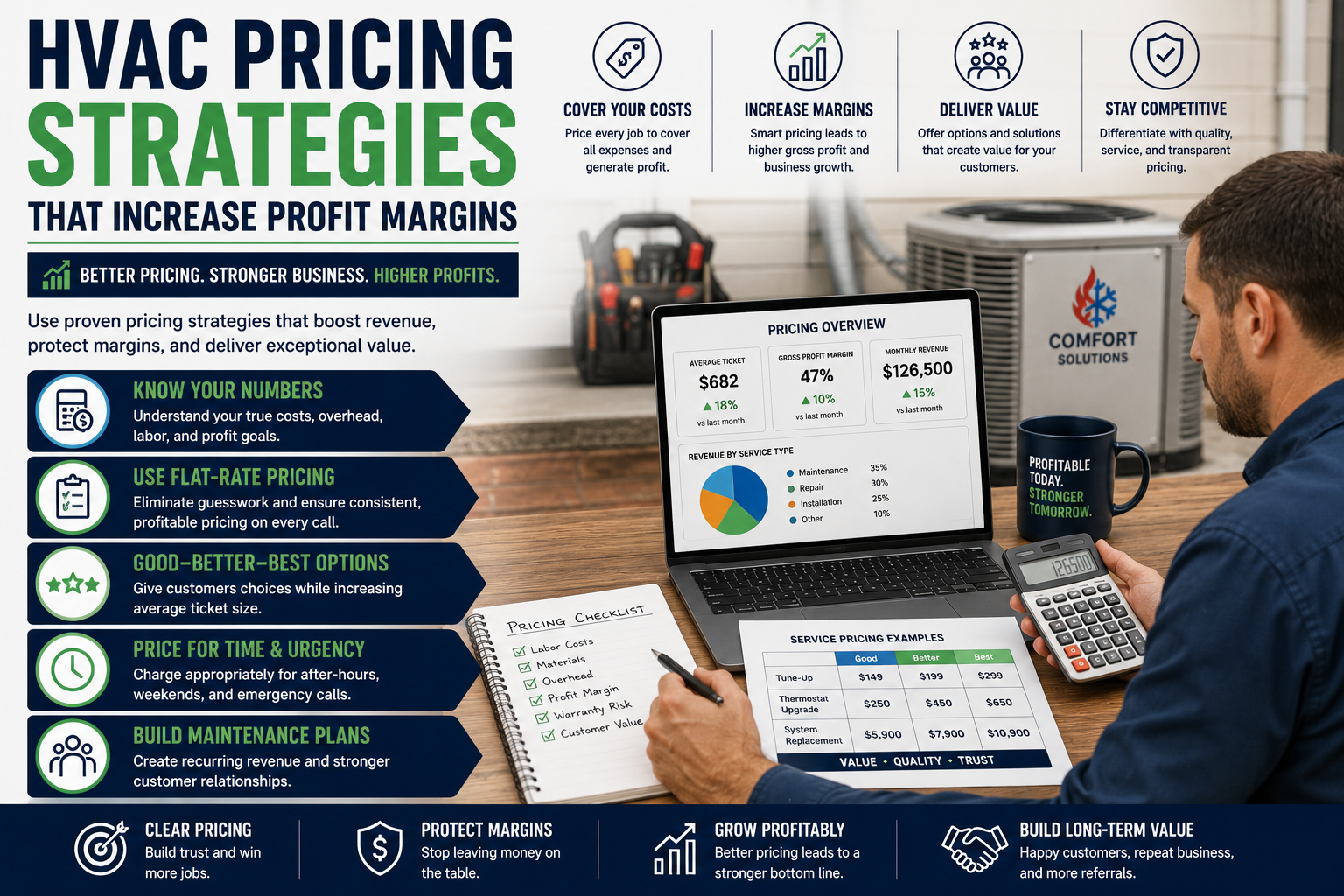
Table of Contents
Introduction
Most HVAC companies do not have a revenue problem.
They have a pricing problem.
The trucks are busy.
The phones are ringing.
The schedule is full.
But the owner still wonders where the money went.
That usually means the company is pricing work based on gut feel, competitor prices, old habits, or whatever the technician thinks the customer will accept.
That is not a pricing strategy.
That is guessing.
Good pricing protects the business.
It gives you enough money to pay good technicians, replace trucks, handle callbacks, invest in marketing, survive slow months, and still make a profit.
The goal is not to become the most expensive company in town.
The goal is to stop doing work that keeps everyone busy but leaves nothing behind.
Why HVAC Companies Underprice Work
Most HVAC owners do not intentionally underprice.
They just do not see all the costs attached to a job.
They see the part.
They see the technician’s hourly pay.
They see what the competitor charges.
Then they build a price around that.
But the real cost of a repair also includes:
- Payroll taxes
- Benefits
- Fuel
- Truck payments
- Insurance
- Software
- Office staff
- Marketing
- Tools
- Training
- Warranty risk
- Return trips
- Rent
- Credit-card fees
- Owner salary
- Profit
If your price only covers the part and the technician’s wages, you are not pricing for a business.
You are pricing for a side job.
Every repair has to carry its share of the company overhead.
That is how a healthy HVAC company stays healthy.
Revenue Is Not Profit
A company can do $2 million in revenue and still struggle to pay bills.
A company can do $800,000 in revenue and produce more owner income.
The difference is not always lead volume.
It is usually margin.
A full schedule is not automatically a good schedule.
You can be booked solid with low-margin work, callbacks, discounts, bad routes, and unpaid invoices.
That is a lot of activity.
It is not necessarily a profitable business.
The question is not:
“How much revenue did we do?”
The better question is:
“How much money did we keep after every cost of doing that work?”
That is why pricing has to be connected to HVAC job costing.
You need to know whether the estimate produced the margin you expected.
Build Pricing From Your Actual Costs
The first step is simple.
Know what it costs to operate the business.
That includes fixed costs and variable costs.
Fixed Costs
These are costs you pay whether you run one call or one hundred calls.
Examples include:
- Rent
- Office payroll
- Insurance
- Software
- Phones
- Marketing retainers
- Management salaries
- Equipment payments
- Licensing
- Accounting
Variable Costs
These increase as you do more work.
Examples include:
- Technician labor
- Payroll burden
- Fuel
- Parts
- Equipment
- Permits
- Disposal fees
- Credit-card processing
- Subcontractors
- Overtime
- Warranty work
Once you know these numbers, you can build prices that cover the cost of the work and contribute to profit.
Without that, you are hoping the margin is there.
Hope is not a pricing model.
Stop Pricing From Memory
Technicians should not be making up prices in the driveway.
That creates inconsistency.
One technician charges $450.
Another charges $625.
A third gives a discount because they feel uncomfortable explaining the price.
The customer notices.
The company loses margin.
The owner has no idea which price is right.
A flat-rate price book solves a lot of this.
It gives technicians a consistent starting point for common repairs, maintenance tasks, upgrades, and accessories.
A good price book should account for:
- Parts
- Labor
- Overhead
- Warranty risk
- Truck costs
- Target margin
- Customer-facing descriptions
- Good-better-best options
The goal is not to make every price rigid forever.
The goal is to stop every technician from creating their own version of the business.
For companies relying on manual estimates and scattered technician notes, the right HVAC estimating software can help standardize labor assumptions, equipment costs, options, and proposal presentation.
Use Good-Better-Best Pricing
Most customers do not want the cheapest option.
They want to understand the options.
Good-better-best pricing gives them a clearer way to decide.
For example, instead of saying:
“Your capacitor is bad. It will be $450.”
You may present:
| Option | What It Includes |
|---|---|
| Good | Replace the failed capacitor |
| Better | Replace the capacitor and install a surge protector |
| Best | Replace the capacitor, add surge protection, and enroll in a maintenance plan |
The customer gets choices.
The technician is not forcing an upsell.
The company creates a clearer conversation around value.
This works especially well for:
- Repair options
- Indoor air quality upgrades
- Thermostats
- Electrical upgrades
- Maintenance plans
- System replacements
- Equipment efficiency levels
- Warranty options
The key is to make the choices useful.
Do not create fake options just to push the most expensive one.
Charge for Convenience, Speed, and Risk
Not every call should be priced the same.
An emergency no-cool call at 9:00 PM is not the same as a scheduled maintenance visit on a Tuesday morning.
The technician may be working overtime.
The truck may need to be rerouted.
The customer expects a faster response.
The business takes on more risk.
Your pricing should reflect that.
Consider different pricing structures for:
- Emergency calls
- After-hours service
- Weekend service
- Same-day appointments
- Difficult access
- Rooftop equipment
- Commercial work
- Older systems
- Specialty equipment
- Remote service areas
You do not need to apologize for charging more when the work costs more to provide.
Customers understand urgency.
What they do not understand is surprise pricing.
Be clear before the work starts.
Build a Real Diagnostic Fee
Too many HVAC companies give away diagnosis.
They send a trained technician, a stocked truck, fuel, insurance, tools, and years of experience to a home for free.
Then they hope the customer approves the repair.
That is backwards.
Your diagnostic fee should cover the cost of sending a technician to the home and beginning the evaluation.
It should not be treated like a marketing coupon.
A strong diagnostic fee does a few things:
- Filters out price shoppers
- Protects technician time
- Protects truck costs
- Creates value for the visit
- Reduces free estimates disguised as service calls
- Gives the technician room to diagnose correctly
You can still apply the fee toward a repair when that fits your model.
But do not make every service call a free consultation.
Stop Discounting Without a Reason
Discounting feels harmless.
It is not.
A 10% discount comes straight out of your margin.
If your company is already underpriced, discounts can turn a decent job into a bad one.
Discounts should have a purpose.
For example:
- Membership pricing
- Military or senior discounts
- Slow-season promotions
- Equipment promotions from manufacturers
- Multi-system discounts
- Referral incentives
- Bundle offers
The key is to build the discount into the pricing strategy.
Do not let technicians create random discounts because they feel pressure in the field.
A customer may ask for a lower price.
That does not mean you have to give one.
You can often protect margin by changing the scope instead.
For example:
- Remove an optional upgrade
- Offer a lower-tier equipment option
- Adjust the payment plan
- Schedule the work during regular hours
- Bundle multiple repairs together
That is better than cutting the price without changing anything.
Price Maintenance Memberships for Retention, Not Just Revenue
Maintenance memberships should not be treated as cheap tune-ups.
They are a customer-retention system.
The real value is not only the membership fee.
The real value is that your company owns the relationship before the system fails.
A good membership program can create:
- Recurring revenue
- Planned work
- Better seasonal scheduling
- More repair opportunities
- More replacement opportunities
- Higher customer retention
- More reviews
- More referrals
Price memberships so they cover the service you promise to provide.
Do not sell a membership so cheaply that every visit loses money.
Know the cost of the labor, travel time, materials, office support, and included benefits.
Then build the pricing around the long-term value of keeping the customer.
Separate Repair Pricing From Replacement Pricing
Repair pricing and replacement pricing should not be handled the same way.
Repairs need consistent flat-rate pricing, clear options, and fast approval.
Replacements need deeper estimating.
That includes:
- Equipment costs
- Labor
- Materials
- Permits
- Ductwork
- Electrical work
- Crane or lift costs
- Disposal
- Accessories
- Warranty
- Financing fees
- Sales commission
- Expected margin
A system replacement can look profitable until the install runs long or materials get missed.
That is why replacement pricing should be connected to job costing.
After the install, compare:
- Estimated labor versus actual labor
- Estimated materials versus actual materials
- Expected margin versus actual margin
- Return trips
- Warranty work
- Change orders
- Permit costs
The owner who reviews job costs gets better at pricing.
The owner who only checks the bank account repeats the same mistakes.
Review Pricing Every Quarter
Your costs change.
Parts go up.
Equipment goes up.
Labor goes up.
Fuel goes up.
Insurance goes up.
Your pricing cannot stay frozen forever.
Review your price book and core pricing at least quarterly.
Look at:
- Labor burden
- Material cost changes
- Equipment cost changes
- Gross margin by job type
- Callback rates
- Discount usage
- Technician pricing consistency
- Warranty costs
- Average ticket
- Membership profitability
- Install margins
Do not wait until the end of the year to realize your prices were too low for six months.
A regular review also makes it easier to keep your HVAC service pricing structure aligned with changing labor, material, and overhead costs.
Train Technicians to Explain Value
Pricing problems are often communication problems.
A technician may know the repair is priced correctly.
But if they cannot explain the value, they get uncomfortable and discount it.
Train technicians to explain:
- What failed
- Why it failed
- What happens if it is not repaired
- What options are available
- What each option includes
- Why the price is what it is
- What warranty or protection comes with it
The goal is not to make technicians sound scripted.
The goal is to make them confident.
A technician who understands the value of the repair does not need to apologize for the price.
Common HVAC Pricing Mistakes
Copying Competitor Prices
You do not know their overhead.
You do not know their labor costs.
You do not know whether they are profitable.
Copying another company’s price is not strategy.
Charging One Price for Every Call
Emergency work, remote calls, commercial jobs, weekend calls, and difficult repairs do not cost the same to provide.
Your pricing should reflect the work.
Giving Away Diagnosis
A free diagnostic visit may attract more calls.
It can also attract customers who only want free advice.
Protect your technician time.
Ignoring Job Costing
If you do not compare estimates against actual job costs, you do not know whether your pricing is working.
Discounting Too Easily
Discounts should be part of a plan.
They should not be a reflex.
Treating Price as the Only Buying Factor
Customers do care about price.
But they also care about trust, speed, communication, professionalism, warranties, financing, reviews, and whether they feel confident in your company.
The cheapest company does not always win.
FAQ
How should HVAC companies price service calls?
HVAC companies should price service calls based on the true cost of sending a technician, including labor, payroll burden, truck costs, fuel, overhead, tools, insurance, and profit.
A diagnostic fee should protect the cost of the visit before repair work begins.
Should HVAC companies use flat-rate pricing?
For most residential HVAC companies, yes.
Flat-rate pricing creates more consistency between technicians, protects margins, makes customer communication easier, and reduces pricing from memory.
How often should HVAC companies update prices?
Most companies should review their price book and core pricing at least quarterly, especially when labor, equipment, material, fuel, or insurance costs change.
How can HVAC companies increase profit without raising every price?
Improve margins by reducing discounts, using better price books, presenting options, tightening job costing, reducing callbacks, improving dispatch, charging properly for diagnostics, and following up on unsold estimates.
Final Thoughts
Pricing is one of the most important systems in an HVAC company.
It affects every repair, maintenance visit, estimate, install, truck, technician, and customer conversation.
The goal is not to charge the most.
The goal is to charge enough to run a healthy company.
That means covering your real costs.
Protecting margin.
Training technicians to explain value.
Using consistent price books.
Reviewing job costs.
And stopping the habit of guessing.
A full schedule is not enough.
Your work has to leave profit behind.
Continue Reading
- HVAC Job Costing Explained
- How Much Profit Should an HVAC Company Make?
- Cash Flow Management for HVAC Companies
- HVAC Service Pricing 2026: What Contractors Should Charge
- Estimating Software for HVAC Contractors: Top Options Reviewed
- Field Service Management Software for HVAC: What to Look For
- Why Most HVAC Companies Stay Small