
How Much Profit Should an HVAC Company Actually Make?
Discover the profit margins HVAC companies should target, the financial metrics that matter most, and how to improve profitability over time.
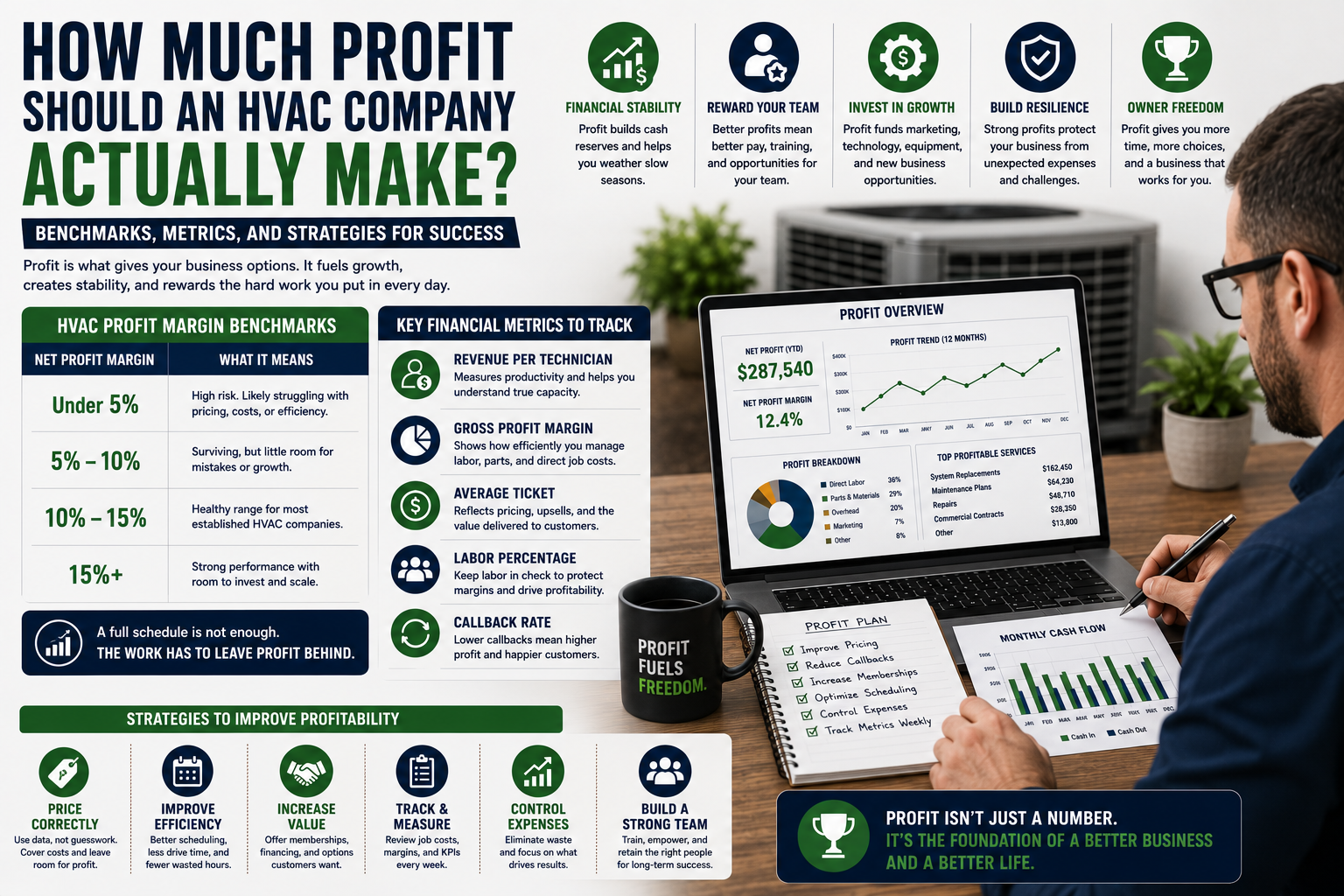
Table of Contents
Introduction
A lot of HVAC owners ask the wrong question.
They ask:
“How much revenue should my company do?”
A better question is:
“How much profit should we keep after doing the work?”
A company can bring in $3 million a year and still feel broke.
Another company can bring in $1 million and create a strong owner income, healthy cash reserves, better trucks, better employees, and room to grow.
The difference is not always lead volume.
It is margin.
Profit is what gives an HVAC company options.
It lets you survive slow months.
It lets you replace trucks without panic.
It lets you hire better people.
It lets you invest in marketing, software, training, and growth.
Without profit, the company is just creating jobs for everyone except the owner.
The Short Answer
A healthy HVAC company should aim to keep a meaningful percentage of revenue after all operating costs are paid.
That includes:
- Payroll
- Payroll taxes
- Parts and equipment
- Fuel
- Trucks
- Insurance
- Rent
- Marketing
- Software
- Office expenses
- Warranty work
- Debt payments
- Taxes
- Owner compensation
For many HVAC companies, the goal is not simply to break even.
A business that only breaks even is one truck repair, slow season, or bad install away from trouble.
A stronger business should create enough profit to fund:
- Owner income
- Cash reserves
- Truck replacement
- Hiring
- Marketing
- Technology
- Training
- Growth opportunities
The exact number depends on your company size, service mix, overhead, market, and business model.
But the bigger point is simple:
A full schedule is not enough.
The work has to leave profit behind.
Revenue Is Not Profit
Revenue is the money that comes into the company.
Profit is what remains after the company pays to earn that revenue.
Here is a simple example.
| Company | Annual Revenue | Net Profit | Owner Experience |
|---|---|---|---|
| Company A | $2,000,000 | $40,000 | Busy, stressed, short on cash |
| Company B | $1,200,000 | $180,000 | More stable, more flexible, more profitable |
Company A may look more successful from the outside.
But Company B may be the healthier business.
Why?
Because revenue does not pay the owner.
Profit does.
A company can be busy all year and still lose money through:
- Weak pricing
- Too much overtime
- Discounts
- Callbacks
- Poor dispatch
- Low-margin installs
- Slow collections
- Expensive marketing
- Too many trucks
- Too much overhead
That is why owners need to stop measuring success only by revenue. The broader HVAC business model should explain where revenue comes from, where margin leaks out, and which work actually helps the company grow.
Gross Profit vs Net Profit
You need to know the difference.
Gross Profit
Gross profit is what remains after direct job costs are removed.
Direct job costs include:
- Technician and installer labor
- Payroll burden
- Parts
- Equipment
- Permits
- Materials
- Subcontractors
- Disposal
- Job-specific expenses
Example:
| Item | Amount |
|---|---|
| Job revenue | $1,000 |
| Direct labor | -$220 |
| Materials | -$180 |
| Gross profit | $600 |
That $600 still has to cover the cost of running the company.
Net Profit
Net profit is what remains after all company expenses are paid.
That includes:
- Office payroll
- Rent
- Marketing
- Insurance
- Software
- Trucks
- Management salaries
- Accounting
- Training
- Interest
- Taxes
- Other overhead
Net profit is the number that tells you whether the company is actually healthy.
What Profit Margin Should HVAC Companies Target?
There is no one perfect number for every HVAC company.
Residential service companies, commercial contractors, install-heavy companies, and maintenance-focused businesses all have different economics.
But these ranges are useful as operating targets.
| Profit Level | What It Usually Means |
|---|---|
| Under 5% net profit | The company is vulnerable and likely has leaks |
| 5% to 10% net profit | The business is surviving, but there is little room for mistakes |
| 10% to 15% net profit | A healthier operating range for many established HVAC companies |
| 15%+ net profit | Strong performance if quality, customer experience, and growth are not being sacrificed |
These are not rules.
They are a reason to look closer.
A company at 4% net profit may have a pricing problem.
It may have too much overhead.
It may have weak dispatch.
It may be carrying too much payroll.
It may be doing too many low-margin installs.
A company at 15% net profit may be doing a lot right.
But it still needs to make sure profit is not coming from underpaying people, cutting quality, or avoiding needed investment.
The goal is healthy profit.
Not short-term profit at the expense of the business.
The Numbers HVAC Owners Should Watch Every Week
You do not need to stare at 50 reports.
You need a scoreboard.
Start with these numbers.
Revenue Per Technician
This shows whether each technician is producing enough revenue to support their labor, truck, tools, overhead, and profit contribution.
A technician can be busy all day and still be underproducing.
Look at:
- Service revenue
- Average ticket
- Calls completed
- Membership sales
- Repair conversion
- Callback rate
- Drive time
- Discount usage
Gross Margin by Job Type
Not every job makes money the same way.
Track margins on:
- Service repairs
- Maintenance visits
- Memberships
- System replacements
- Commercial work
- Add-on accessories
- Emergency calls
- Warranty work
This helps you see where the company is making money and where it is giving work away.
Labor Percentage
Labor is usually one of the biggest costs in an HVAC company.
Track labor against revenue.
If labor keeps rising, ask why.
Possible reasons include:
- Too much overtime
- Poor scheduling
- Weak technician training
- Bad install planning
- Missing materials
- Long drive times
- Too many callbacks
- Too much office payroll
Average Ticket
Average ticket is not just a sales number.
It is a pricing and communication number.
A low average ticket may mean:
- Technicians are underpricing work
- Options are not being presented
- Memberships are not being offered
- Customers are not being educated
- Discounting is too common
- The price book is outdated
Callback Rate
A callback eats profit fast.
It creates another truck roll, more labor, more fuel, lost schedule capacity, and sometimes customer credits.
Track callbacks by:
- Technician
- Job type
- Equipment type
- Reason for the return visit
- First-time fix rate
The goal is not to blame technicians.
The goal is to find patterns before they get expensive.
Why Some HVAC Companies Stay Stuck at Low Profit
Most low-profit HVAC companies are not lazy.
They are usually dealing with a few expensive problems at once.
Weak Pricing
The company is busy, but prices do not cover the real cost of labor, trucks, overhead, warranty work, and profit.
This is common when owners price from memory or copy competitors.
A stronger HVAC pricing strategy gives the team consistent rules for labor, overhead, discounts, and margin instead of relying on instinct.
Too Much Discounting
A 10% discount comes directly out of margin.
If the company is already underpriced, discounts can turn a decent job into a bad one.
Discounts should be planned.
They should not be a technician’s reaction to an uncomfortable customer conversation.
Poor Dispatch
Every unnecessary truck roll costs money.
Every technician driving across town costs money.
Every missed note that creates a second trip costs money.
Dispatch is not admin work.
Dispatch is a profit function.
No Job Costing
A company cannot improve what it does not measure.
Without HVAC job costing, the owner may not know that installs are losing margin, repairs are underpriced, or certain technicians are creating too many callbacks.
Too Much Overhead
Office payroll, trucks, software, rent, marketing, insurance, and management costs can quietly grow faster than revenue.
The owner may think the business has a sales problem.
The real issue may be that the company cannot support its current cost structure.
How to Increase HVAC Profit Margins
Improving profit is not always about raising every price.
It is about tightening the system.
Build Better Price Books
Technicians should not make up prices in the driveway.
A good price book helps create consistency around:
- Repairs
- Parts
- Labor
- Membership pricing
- Add-ons
- Good-better-best options
- Emergency service
- Warranty risk
The price should cover the cost of the work and leave margin behind. A clearer HVAC service pricing structure can help connect diagnostic fees, repair pricing, memberships, and installation work into one consistent model.
Improve Estimate Follow-Up
A lot of HVAC companies lose profitable work because estimates go cold.
The estimate gets sent.
Nobody follows up.
The customer calls another company.
A simple follow-up process can improve revenue without spending more money on leads.
Reduce Callbacks
Callbacks destroy profit.
Track them.
Review them.
Find patterns.
Train technicians where needed.
Fix dispatch issues.
Update price books.
Improve job notes.
The goal is more first-time fixes.
Protect Diagnostic Fees
Do not send trained technicians and stocked trucks to homes for free.
A diagnostic fee helps protect technician time, truck costs, fuel, tools, office support, and expertise.
You can apply it toward a repair when that fits your model.
But free diagnosis should not become the default.
Improve Dispatch
Better dispatch can create more revenue without adding another truck.
Group calls by area.
Match technicians to job type.
Reduce unnecessary drive time.
Fill schedule gaps.
Make sure technicians have customer history before they arrive.
Track Job Costs
Job costing shows whether pricing is working.
Compare:
- Estimated labor vs actual labor
- Estimated materials vs actual materials
- Planned margin vs actual margin
- Install time vs labor budget
- Callback costs
- Discount impact
The owner who reviews job costs gets better at pricing.
The owner who only checks the bank account keeps guessing.
Profit Is Not the Same as Owner Pay
A common mistake is treating owner compensation and profit as the same thing.
They are different.
Owner pay is what the owner earns for working in the business.
Profit is what remains after the business pays everyone, including a fair cost for the owner’s role.
For example:
- If you are the service manager, you should be paid like a service manager.
- If you are the salesperson, you should be paid like a salesperson.
- If you are the owner, profit is what remains after those jobs are accounted for.
That gives you a more honest view of whether the company can survive without you doing everything.
A business that only works because the owner does three jobs for free is not as profitable as it looks.
Build Profit Into Your Cash Plan
Profit should not disappear into the operating account.
A healthy business needs money set aside for:
- Taxes
- Emergency reserves
- Truck replacement
- Equipment purchases
- Slow-season payroll
- Growth investments
- Owner distributions
Do not treat every dollar in the bank as available to spend.
The company needs cash to survive the unexpected.
Profit gives you the ability to build that cash. A disciplined cash flow management system helps make sure profit turns into reserves instead of disappearing into late invoices, payroll pressure, and unplanned expenses.
Common Profit Mistakes HVAC Owners Make
Measuring Revenue Instead of Margin
Revenue is easy to celebrate.
Margin is what matters.
Pricing Based on Competitors
You do not know their costs.
You do not know whether they are profitable.
Copying their prices is not strategy.
Hiring Too Early
More people can create more capacity.
They can also create more payroll than the business can support.
Hire based on demand and numbers, not hope.
Ignoring Small Leaks
Discounts, callbacks, drive time, unbilled work, late invoices, and missed materials can each feel small.
Together, they destroy profit.
Not Reviewing Financials
The owner should know:
- Revenue
- Gross profit
- Net profit
- Labor percentage
- Break-even point
- Accounts receivable
- Cash balance
- Job profitability
You cannot lead the company from the bank account alone.
FAQ
What is a good profit margin for an HVAC company?
For many HVAC companies, a net profit margin above 10% is a healthier target than simply breaking even. The right number depends on company size, service mix, market, overhead, and how much investment the business needs to make.
Is 5% profit good for an HVAC company?
Five percent can keep a company alive, but it leaves little room for mistakes, slow months, truck repairs, warranty work, or growth investments.
A company at that level should look closely at pricing, labor, dispatch, overhead, and job costing.
Why is my HVAC company busy but not profitable?
Common reasons include underpricing, weak job costing, excessive discounts, callbacks, too much drive time, high payroll, poor collections, low-margin installs, and overhead that has grown too fast.
How can HVAC companies improve profit without raising every price?
Improve margins by reducing callbacks, tightening dispatch, following up on estimates, using stronger price books, protecting diagnostic fees, controlling discounts, reviewing job costs, and improving technician productivity.
Final Thoughts
A healthy HVAC company does not just create revenue.
It creates profit.
Profit gives the owner breathing room.
It gives the company cash reserves.
It creates better jobs, better systems, better service, and a stronger future.
Do not judge the business only by how full the schedule is.
Look at what is left after the work is done.
That is the number that matters.