
The HVAC Business Model Explained: How Successful Companies Actually Make Money
Learn how successful HVAC companies generate revenue through service calls, installations, maintenance agreements, replacement projects, and recurring income streams that drive long-term profitability.
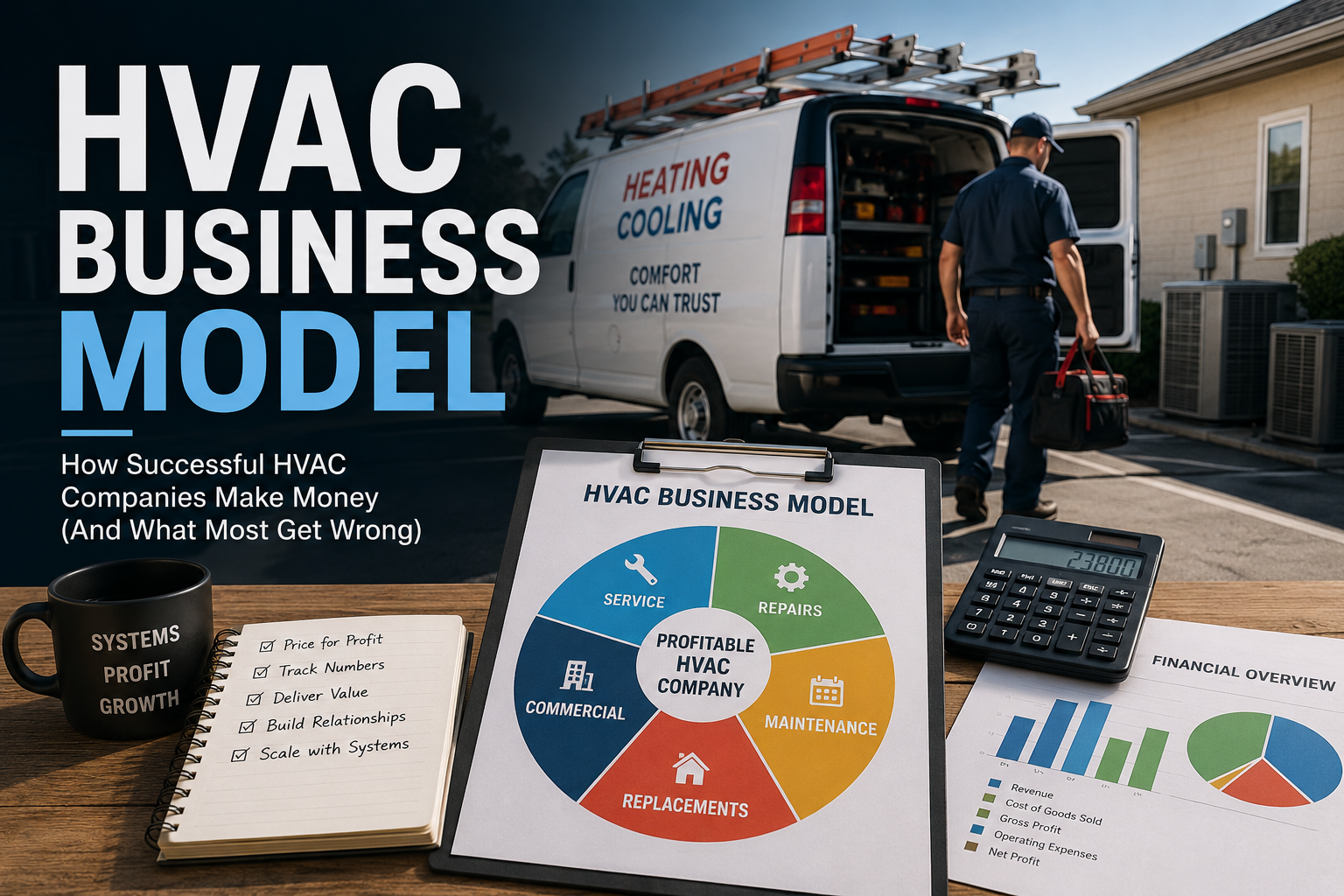
Table of Contents
Introduction
Most HVAC companies do not have a lead problem.
They have a business model problem.
The phones may be ringing. The trucks may be full. Technicians may be working long days.
But at the end of the month, the owner is still wondering where the money went.
That is usually not because the company needs more revenue.
It is because too much of that revenue gets eaten by payroll, weak pricing, callbacks, unprofitable installs, unnecessary truck rolls, and overhead.
A successful HVAC company does not make money from doing more work.
It makes money from doing the right work at the right price, with the right systems behind it.
This guide explains how profitable HVAC companies actually make money, where margin leaks out, and what separates a growing company from one that stays busy but never gets ahead.
What Is an HVAC Business Model?
An HVAC business model is how your company turns service calls, repairs, maintenance agreements, and installs into profit.
A lot of owners are running on activity instead of a model.
The phones ring. The trucks go out. Jobs get completed. Money comes in.
But they do not always know which work is making money and which work is quietly draining it.
A real business model answers a few basic questions:
- Where does revenue come from?
- Which jobs produce the best margins?
- How much does it cost to run each truck?
- How productive is each technician?
- How often do customers come back?
- What happens when the owner is not involved in every decision?
For most HVAC companies, the model is a mix of service work, maintenance memberships, repairs, replacement leads, installs, and repeat customers.
The strongest companies do not rely on only one of those.
Leads create opportunities.
Technicians create revenue.
Systems protect profit.
Repeat customers create stability.
That is the difference between owning a job and owning a business.
The Five Ways HVAC Companies Make Money
Most HVAC companies make money in five main ways:
- Service calls
- Repairs
- Maintenance agreements
- System replacements
- Commercial or new-construction work
The mistake is treating all revenue the same.
A $300 repair, a $12,000 replacement, and a $99 tune-up all count as revenue. But they do not create the same profit, cash flow, or future opportunity.
1. Service Calls
Service calls are the front door to the business.
The diagnostic fee matters. But the bigger opportunity is what happens after the technician earns the customer’s trust.
One service call can lead to a repair, a maintenance membership, a replacement conversation, a review, or a customer who calls you first for years.
The call is not always where the biggest profit is made.
It is where the relationship starts.
2. Repairs
Repairs create fast revenue because the customer already has a problem and needs an answer.
But repair work only makes money when it is priced correctly.
The part may cost $80. That does not mean the repair should cost $160.
You still have to cover technician time, payroll burden, truck costs, fuel, insurance, office staff, tools, warranty risk, and overhead.
If your price only covers the part and a little labor, you are keeping technicians busy without building profit. A stronger HVAC pricing strategy helps ensure every repair contributes to the real cost of running the business.
3. Maintenance Agreements
Maintenance agreements create recurring revenue, but that is not their biggest value.
Their real value is keeping your company in front of the customer before something breaks.
A maintenance customer is more likely to call you first, approve repairs, replace an aging system with you, leave a review, and refer friends or family.
The easiest customer to sell to is the one who already trusts you.
Memberships also give you planned work during slower periods instead of forcing the company to rely only on emergency calls.
4. System Replacements
System replacements usually create the largest tickets.
They can also create the biggest mistakes.
A $15,000 install is not automatically profitable. Bad estimates, labor overruns, missed materials, weak change orders, and warranty callbacks can wipe out the margin quickly.
Replacement work makes money when the company controls the details:
- System sizing
- Scope of work
- Equipment and material pricing
- Labor estimates
- Financing options
- Quality control
Big revenue with no margin is just a bigger problem.
5. Commercial and New-Construction Work
Commercial and new-construction work can create larger contracts and steadier volume.
It can also create slow payments, aggressive pricing, missed change orders, labor overruns, and cash-flow problems.
This work can be profitable when the company has strong estimating, project management, and billing systems.
It becomes dangerous when the owner takes jobs just to keep crews busy.
Work that keeps people busy but does not produce profit is not growth.
It is expensive employment.
Why Revenue Doesn’t Equal Profit
A lot of HVAC owners look at top-line revenue and assume the business is doing well.
“We did $2 million last year.”
That sounds good.
But the better question is:
“How much did the company keep after everyone got paid?”
Revenue is the money coming in.
Profit is what is left after you pay for labor, materials, trucks, office staff, marketing, insurance, warranty work, software, and everything else required to run the company.
A business can grow revenue and still get poorer.
That happens when the company adds work without enough margin.
More calls create more payroll.
More installs create more material costs.
More trucks create more fuel, repairs, insurance, and overhead.
If pricing is weak, every new job can create more work without creating more profit.
A company doing $1 million in revenue may only keep $50,000 after labor, materials, overhead, and mistakes.
Another company doing $750,000 may keep $150,000 because it prices correctly, controls labor, tracks job costs, and reduces callbacks.
The smaller company is healthier.
Revenue matters, but it should not be the only number you watch. Understanding how much profit an HVAC company should make gives owners a more useful benchmark than top-line sales alone.
Track:
- Gross profit by service type
- Average ticket
- Revenue per technician
- Revenue per truck
- Labor cost as a percentage of revenue
- Material cost on installs
- Callback rate
- Membership count
- Net profit after overhead
A truck can look busy all week and still lose money.
Every unnecessary truck roll costs money.
Every callback costs money.
Every estimate that misses labor or materials costs money.
Profit is built before the job starts.
The Systems That Separate Growing Companies
Growing HVAC companies do not win because the owner works harder.
They win because the business stops depending on the owner to remember everything.
At some point, hustle stops being enough.
You can keep answering calls at night, pricing jobs from the truck, fixing dispatch mistakes, checking every install, and putting out fires all day.
But that is not a scalable company.
That is an owner carrying the business on their back.
The companies that grow profitably build four basic systems.
1. Dispatch That Protects Productivity
Dispatch is not just about filling the calendar.
It is about getting the right technician to the right call at the right time.
Poor dispatch creates wasted drive time, missed appointments, overloaded technicians, and unnecessary truck rolls.
Good dispatch protects technician productivity and customer trust. Companies that want to tighten this part of the operation should focus on improving HVAC dispatch efficiency before adding more trucks or expanding their service radius.
2. Pricing That Protects Margin
Technicians should not be making up prices in the customer’s driveway.
A clear price book gives the team consistent pricing and protects margin on repair work.
It should account for labor, parts, truck costs, overhead, warranty risk, and your target profit.
When technicians price from memory, margins usually disappear.
3. A Consistent Customer Process
Most HVAC companies do not need aggressive sales tactics.
They need technicians who can explain the problem, show the customer their options, and make it easy to approve the right work.
The phone should be answered professionally. The appointment should be confirmed. The technician should arrive prepared, explain the issue, present options, collect payment, and follow up when needed.
The important steps cannot depend on which technician happens to be working that day. A documented HVAC workflow from call to payment gives the team a repeatable path for handling those handoffs.
4. Job Costing and Weekly Numbers
A large invoice does not always mean a profitable job.
HVAC job costing shows whether labor stayed on budget, materials were controlled, and the margin you estimated is the margin you actually earned.
Then review a few numbers every week:
- Booked and completed calls
- Average ticket
- Revenue per technician
- Memberships sold
- Replacement leads
- Callback rate
- Gross margin
The point is not more reports.
The point is seeing problems before they become expensive.
Common Mistakes That Keep HVAC Companies Small
Most HVAC companies do not stay small because there is no demand.
They stay small because the owner keeps solving the same problems with more effort instead of better systems.
1. Chasing Revenue Instead of Margin
More revenue feels like progress.
But more low-margin work can make the company harder to run without making it more profitable.
A bad job does not become a good job because the schedule is full.
2. Pricing From Gut Feel
A lot of owners price based on what competitors charge or what feels fair.
That is not a pricing strategy.
Your payroll, truck costs, insurance, office expenses, and profit goals are not the same as the company down the street.
The right price covers your real cost to deliver the work and leaves enough margin to grow.
If you do not know your labor burden, overhead, gross-margin target, and actual job costs, you are guessing.
And guessing is expensive.
3. Treating Technicians Like Order Takers
A technician is not just there to replace parts.
They see the equipment, understand the problem, and hear what the customer is worried about.
They can identify repair opportunities, offer maintenance memberships, and create replacement leads.
This is not about turning technicians into high-pressure salespeople.
It is about teaching them how to explain problems, present options, and help customers make informed decisions.
4. Letting the Owner Become the Bottleneck
The owner approves every estimate, handles every difficult customer, decides where every truck goes, and is the only person who knows how to price unusual work.
That may work with one truck.
It breaks down with five.
A company cannot scale when every important decision has to go through one person.
5. Ignoring Repeat Customers
A company that depends entirely on new leads is always paying to replace customers it already had.
Maintenance agreements, estimate follow-up, service reminders, review requests, and post-install communication turn one job into a long-term relationship.
Without those systems, every season becomes a scramble for new calls.
How to Build a Business That Scales
Scaling an HVAC company does not mean adding trucks as fast as possible.
It means building a company that can handle more calls, more customers, and more employees without creating more chaos.
Start here.
1. Know What the Current Trucks Are Producing
Do not add another truck until you know what the current trucks are producing.
Watch revenue per technician, average ticket, gross margin, callback rate, membership count, and net profit after overhead.
If one truck is not producing enough revenue, adding another truck will not solve the problem.
It usually makes the problem more expensive.
2. Fix Pricing Before Chasing Volume
Growth without margin creates stress.
Before spending more on marketing, hiring another technician, or expanding into a new service area, make sure your pricing supports the company you are trying to build.
Your prices need to cover labor, trucks, fuel, insurance, office staff, software, marketing, warranty work, owner compensation, and profit.
3. Fix One Constraint at a Time
Do not try to improve everything at once.
Find the most expensive bottleneck: not enough calls, weak booking rate, poor dispatch, low average ticket, bad pricing, callbacks, weak follow-up, or an owner bottleneck.
Fix that first.
Then move to the next one.
The goal is not to build the biggest HVAC company as fast as possible.
The goal is to build one that creates more profit, more control, and more freedom as it grows.
FAQ
What is the most profitable part of an HVAC business?
For many residential HVAC companies, system replacements create the largest dollar profit per job.
But service calls, repairs, and maintenance memberships are what create those replacement opportunities.
The best companies use service to build trust, maintenance to keep customers close, repairs to create cash flow, and replacements to create larger profit opportunities.
How much profit should an HVAC company make?
There is no single number that fits every company.
Your market, labor costs, service mix, debt, overhead, and growth stage all matter.
But every owner should know the difference between gross profit and net profit.
Gross profit tells you whether the job was priced correctly. Net profit tells you what is left after the whole business gets paid.
Can an HVAC company grow without adding more trucks?
Yes.
A lot of companies have room to grow before they buy another truck.
They can improve booking rate, average ticket, maintenance membership sales, repair conversion, replacement close rate, technician productivity, dispatch efficiency, estimate follow-up, and callback reduction.
Sometimes the fastest way to grow is getting more from the trucks and technicians you already have.
Final Thoughts
A successful HVAC company is not built by staying busy.
It is built by knowing where money comes from, where profit leaks out, and which systems keep the business moving when the owner is not involved in every decision.
The strongest companies price work for profit, turn service calls into long-term customer relationships, track job costs, and fix the biggest constraint before chasing more growth.
Revenue matters.
But revenue without margin creates stress.
More trucks without systems create more problems.
The goal is not to build the busiest HVAC company in town.
The goal is to build one that leaves money behind, gives customers a reason to stay, and grows without requiring you to solve every problem yourself.