
Cash Flow Management Tips for HVAC Business Owners
Learn practical cash flow management strategies to maintain healthy finances, survive seasonal fluctuations, and fund long-term business growth.
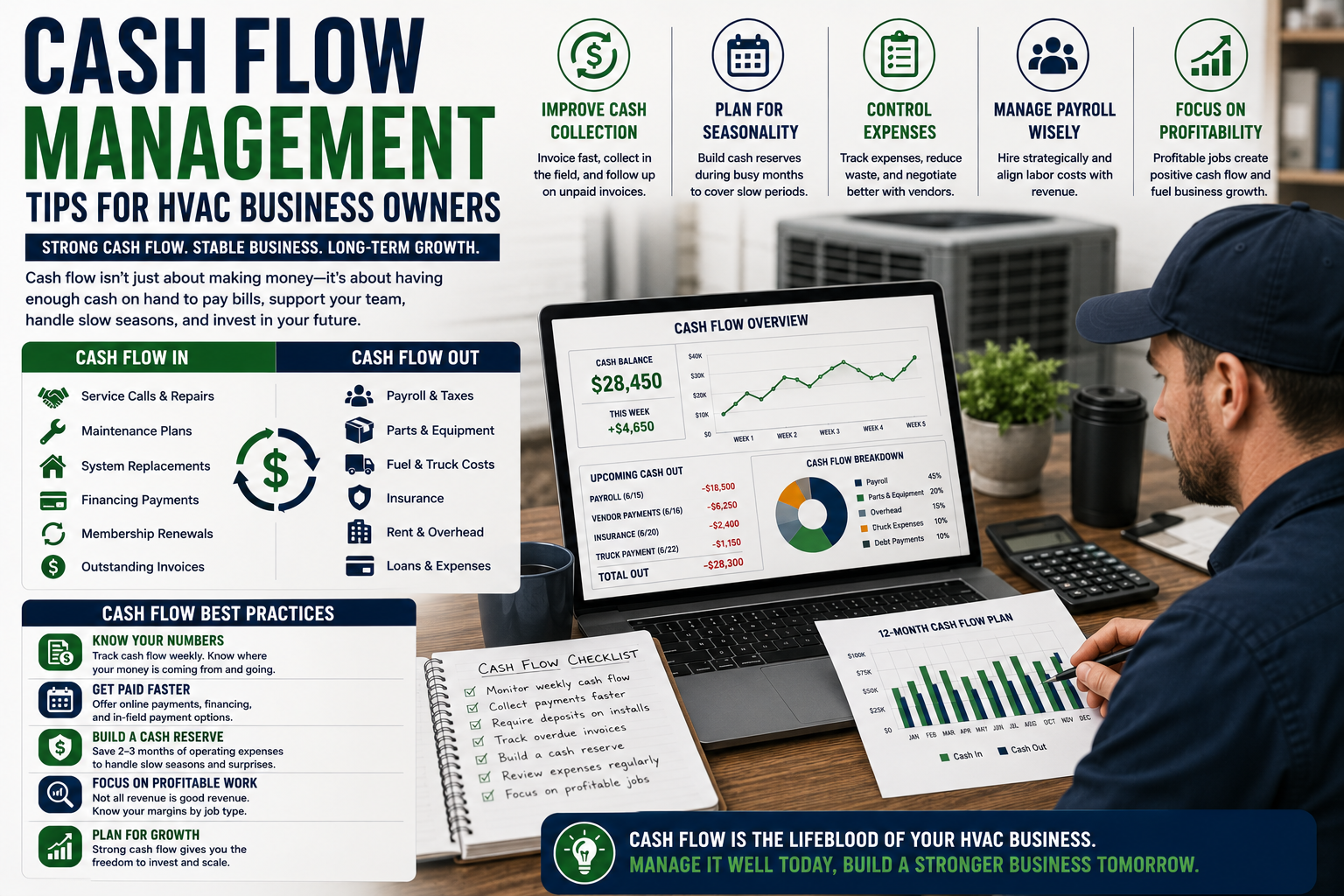
Table of Contents
Introduction
A lot of HVAC companies look profitable on paper and still struggle to pay bills.
The schedule is full.
The trucks are moving.
The team is busy.
But payroll is coming up, parts vendors need payment, insurance renewals hit, and the bank balance is lower than it should be.
That is a cash-flow problem.
Cash flow is not the same as profit.
Profit tells you whether the company made money over time.
Cash flow tells you whether enough money is available right now to run payroll, buy parts, repair trucks, survive slow months, and keep the business moving.
A profitable company can run out of cash.
An unprofitable company can look healthy for a while if money is coming in faster than bills are due.
Eventually, the numbers catch up.
The goal is not just to make money.
The goal is to keep enough cash moving through the business so one slow season, one bad install, or one delayed payment does not create a crisis.
What Cash Flow Means for HVAC Companies
Cash flow is the money moving in and out of the business.
Money comes in from:
- Service calls
- Repairs
- Maintenance memberships
- Install deposits
- System replacements
- Commercial contracts
- Financing payments
- Membership renewals
- Outstanding invoices being collected
Money goes out through:
- Payroll
- Payroll taxes
- Parts and equipment
- Truck payments
- Fuel
- Insurance
- Rent
- Marketing
- Software
- Vendor bills
- Credit-card fees
- Equipment purchases
- Loan payments
- Taxes
The problem is timing.
You may sell a $15,000 replacement today.
But if the customer finances it, the equipment vendor needs payment this week, and the install crew is paid before you receive the money, your bank account can still feel tight.
That is why HVAC owners need to watch cash flow every week, not just revenue at the end of the month.
Why HVAC Cash Flow Gets Tight
Most cash flow problems are not caused by one huge mistake.
They are caused by small leaks that stack up.
For example:
- Invoices go out late
- Customers are allowed to pay too slowly
- Deposits are not collected on installs
- Technicians do not collect payment in the field
- Membership pricing is too low
- Parts are bought before jobs are approved
- Payroll grows faster than revenue
- Discounts get handed out too easily
- The owner buys trucks before the company can support them
- Slow-season planning never happens
- Commercial customers take 60 or 90 days to pay
Each problem may seem manageable.
Together, they create stress.
The company may be busy, but the owner is constantly moving money around just to make payroll.
That is not growth.
That is survival mode.
Cash Flow vs Profit
A company can show profit and still have no cash.
Here is a simple example.
You sell a system replacement for $12,000.
The job looks profitable.
But before the money comes in, you need to pay:
- Equipment vendor
- Install crew
- Materials
- Permit fees
- Financing fees
- Sales commission
- Fuel
- Overhead
If the customer pays slowly or the financing process gets delayed, the company has to carry those costs.
That is why you need to track both profit and cash.
Profit tells you whether the business model works.
Cash flow tells you whether the company can keep operating while the money moves through the system.
Owners also need to understand how much profit an HVAC company should make, because healthy margins make it far easier to build and protect cash reserves.
Start With a Weekly Cash Flow Forecast
Most owners look at their bank account and hope it is enough.
That is not a cash-flow forecast.
A weekly forecast gives you visibility before there is a problem.
Track:
- Current bank balance
- Expected customer payments
- Outstanding invoices
- Upcoming payroll
- Vendor bills due
- Equipment purchases
- Loan payments
- Insurance payments
- Rent
- Taxes
- Credit-card processing withdrawals
- Marketing spend
- Scheduled install deposits
- Membership renewals
You do not need a complicated spreadsheet at first.
You need a simple answer to:
“Will we have enough cash to cover the next two to four weeks?”
That one habit can prevent a lot of stress.
Collect Payment Faster
A lot of HVAC companies create their own cash-flow problems by making it too easy for customers to delay payment.
The job is complete.
The invoice gets sent later.
The customer says they never saw it.
The office follows up a week later.
Then another week passes.
That is money you already earned sitting outside the business.
For residential service, the goal should usually be simple:
Complete the job. Collect payment.
Use tools that let technicians:
- Take card payments in the field
- Save customer payment methods
- Send invoices immediately
- Offer financing when needed
- Email or text receipts
- Collect deposits digitally
- Send automatic reminders
The faster you collect payment, the less pressure there is on the bank account.
Require Deposits on Larger Jobs
Large installs can hurt cash flow when the company pays for equipment and materials before collecting money from the customer.
A deposit helps protect the business.
It can help cover:
- Equipment purchases
- Materials
- Permit costs
- Scheduling commitment
- Early labor costs
- Customer cancellations
You do not need the same deposit structure for every job.
But you need a clear policy.
For example:
- Deposit due at approval
- Equipment ordered after deposit is collected
- Progress payment due before installation
- Final payment due at completion
The important part is consistency.
Do not make exceptions every time a customer pushes back.
A deposit policy protects the company from carrying too much risk.
Stop Letting Invoices Age
An invoice is not cash.
It is a promise that cash may arrive later.
That distinction matters.
Track accounts receivable every week.
Watch for:
- Invoices over 15 days old
- Invoices over 30 days old
- Commercial customers with slow payment history
- Customers with multiple unpaid invoices
- Disputed invoices
- Jobs that were completed but never billed
- Install balances that were not collected
Create a simple collection process.
For example:
- Invoice sent immediately after job completion
- Reminder after a few days
- Phone call after a set number of days
- Escalation before the balance becomes old
The longer an invoice sits, the harder it is to collect.
Build a Slow-Season Cash Reserve
HVAC cash flow is seasonal.
Cooling demand can spike in summer.
Heating demand can spike in winter.
Shoulder seasons can get quiet.
That is not a surprise.
It is part of the business model.
A strong HVAC company builds reserves during busy months so slow months do not create panic.
A good target is to build enough cash to cover several weeks of core operating expenses.
That may include:
- Payroll
- Rent
- Insurance
- Truck payments
- Software
- Loan payments
- Basic marketing
- Utilities
- Vendor obligations
The exact number depends on your business.
The point is to stop treating every busy season like extra spending money.
Some of that cash belongs to the slower months ahead.
Watch Payroll as You Grow
Payroll is usually one of the biggest expenses in an HVAC company.
Hiring can help you grow.
Hiring too early can crush cash flow.
Before adding another technician, dispatcher, installer, or office employee, ask:
- Is current demand high enough?
- Are existing trucks fully productive?
- Do we have enough work to support this role year-round?
- Can the company cover payroll during slower months?
- Will this hire increase profit or just add capacity we cannot fill?
- Do we have the systems to keep this person productive?
A new employee is not just an hourly wage.
It includes payroll burden, benefits, training, uniforms, tools, truck costs, insurance, and management time.
Do not hire based on hope.
Hire based on demand and numbers.
This is especially important for owners focused on scaling an HVAC business from $1M to $5M, where adding people too quickly can create more overhead than the company can support.
Manage Parts and Equipment Purchases Carefully
Inventory can quietly eat cash.
Parts on a truck are not cash in the bank.
Equipment sitting in a warehouse is not cash in the bank.
Buy what the company needs.
Avoid buying too much “just in case.”
Track:
- Slow-moving inventory
- Duplicate purchases
- Parts that expire or become outdated
- Equipment ordered before customer approval
- Materials bought for jobs that are not scheduled
- Vendor credits that were never requested
The goal is not to run out of stock.
The goal is to avoid tying up too much cash in inventory that does not move.
Use Memberships to Stabilize Cash Flow
Maintenance memberships are one of the best ways to create more predictable cash flow.
They help bring in recurring revenue during the year instead of forcing the company to start from zero every season.
Memberships can help:
- Create planned maintenance work
- Improve customer retention
- Build future repair opportunities
- Create replacement opportunities
- Reduce dependence on emergency calls
- Smooth out shoulder seasons
- Improve technician scheduling
But memberships need to be priced correctly.
Do not sell a maintenance plan so cheaply that every included visit loses money.
Know the labor, travel time, office support, materials, and benefits included.
Then price it around customer retention and long-term profitability.
A thoughtful HVAC service pricing structure helps ensure memberships, diagnostic fees, repairs, and installations all support the company’s financial goals.
Separate Operating Cash From Profit
One common owner mistake is taking every dollar left in the bank as personal profit.
That can create problems fast.
The company needs money for:
- Taxes
- Payroll
- Slow months
- Equipment replacement
- Truck repairs
- Vendor bills
- Growth investments
- Emergency expenses
A better approach is to separate money into buckets.
For example:
- Operating account
- Tax account
- Payroll reserve
- Emergency reserve
- Equipment reserve
- Owner profit account
You do not need a complicated banking system to start.
But you need to stop treating every dollar in the operating account as spendable.
Control Discounts and Margin Leaks
Cash flow problems often start with weak margins.
A company may be bringing in revenue but not keeping enough of it.
Watch for:
- Technician discounts
- Underpriced diagnostic fees
- Unprofitable memberships
- High callback rates
- Too much overtime
- Weak job costing
- Poor dispatch
- Uncollected invoices
- Low-margin installs
- Expensive lead sources
- Too much drive time
Cash flow improves when profit improves.
And profit improves when the company stops leaking money through small operational mistakes.
A documented HVAC pricing strategy that protects profit margins gives the team clearer rules around discounts, labor, overhead, and target margins instead of relying on gut feel.
Know Your Break-Even Number
Every HVAC owner should know the monthly revenue needed to cover operating costs.
That is your break-even point.
It tells you:
- How much work the company needs before it becomes profitable
- Whether payroll is too high
- Whether prices are too low
- How much slow-season risk you carry
- Whether adding another truck makes sense
- How much revenue each technician needs to produce
You do not need to obsess over the number every day.
But you should know it.
A company that does not know its break-even point is driving without a dashboard.
Understanding HVAC job costing gives you the job-level detail needed to make a break-even number useful instead of theoretical.
Build Better Vendor Relationships
Vendor relationships matter more than most owners realize.
Strong relationships can improve cash flow through:
- Better payment terms
- Faster access to equipment
- Clearer pricing
- Easier returns
- Fewer ordering mistakes
- Better communication on backorders
- More flexibility during busy seasons
Pay vendors on time when possible.
Communicate early when there is a problem.
And do not wait until the business is in trouble to ask for better terms.
Common HVAC Cash Flow Mistakes
Looking Only at the Bank Account
The bank account tells you what is there today.
It does not tell you what payroll, vendor bills, taxes, and loan payments are coming next week.
Waiting Too Long to Invoice
A completed job should be billed immediately.
The longer you wait, the longer you wait to get paid.
Not Collecting Deposits
Large jobs should not force the company to finance the customer’s equipment purchase.
Growing Payroll Too Fast
Hiring too early can create a full-time expense before the revenue is reliable.
Treating Busy-Season Cash Like Profit
Busy-season cash needs to help carry the slower months.
Ignoring Accounts Receivable
Old invoices become harder to collect every day they sit.
Buying Too Much Inventory
Inventory is useful.
Too much inventory traps cash.
FAQ
What is cash flow in an HVAC business?
Cash flow is the money moving in and out of the company. It includes customer payments, invoices, deposits, payroll, vendor bills, equipment purchases, rent, insurance, taxes, and other operating expenses.
Why can an HVAC company be profitable but short on cash?
Profit measures whether the company made money over time. Cash flow measures whether enough money is available right now to pay bills. A company can be profitable on paper while waiting on customer payments or carrying large equipment and payroll costs.
How can HVAC companies improve cash flow quickly?
The fastest improvements usually come from invoicing immediately, collecting payment in the field, requiring deposits on larger jobs, following up on overdue invoices, reducing unnecessary discounts, and improving job profitability.
How much cash should an HVAC company keep in reserve?
The right amount depends on the company, but the goal should be enough to cover several weeks of core operating expenses during slow periods or unexpected problems.
Final Thoughts
Cash flow is what keeps an HVAC company alive between the jobs you sell and the money you collect.
You can have strong revenue and still struggle if invoices go out late, deposits are not collected, payroll grows too fast, and busy-season cash gets spent before slow months arrive.
Build a weekly cash forecast.
Collect payment faster.
Require deposits.
Watch old invoices.
Protect margins.
Keep a reserve.
The goal is not just to make money.
It is to make sure the business has enough cash to keep moving when things get slower, more expensive, or unexpected.