
How to Improve HVAC Dispatch Efficiency and Reduce Missed Calls
Learn proven strategies to streamline dispatching, minimize scheduling conflicts, reduce missed calls, and keep technicians productive throughout the day.
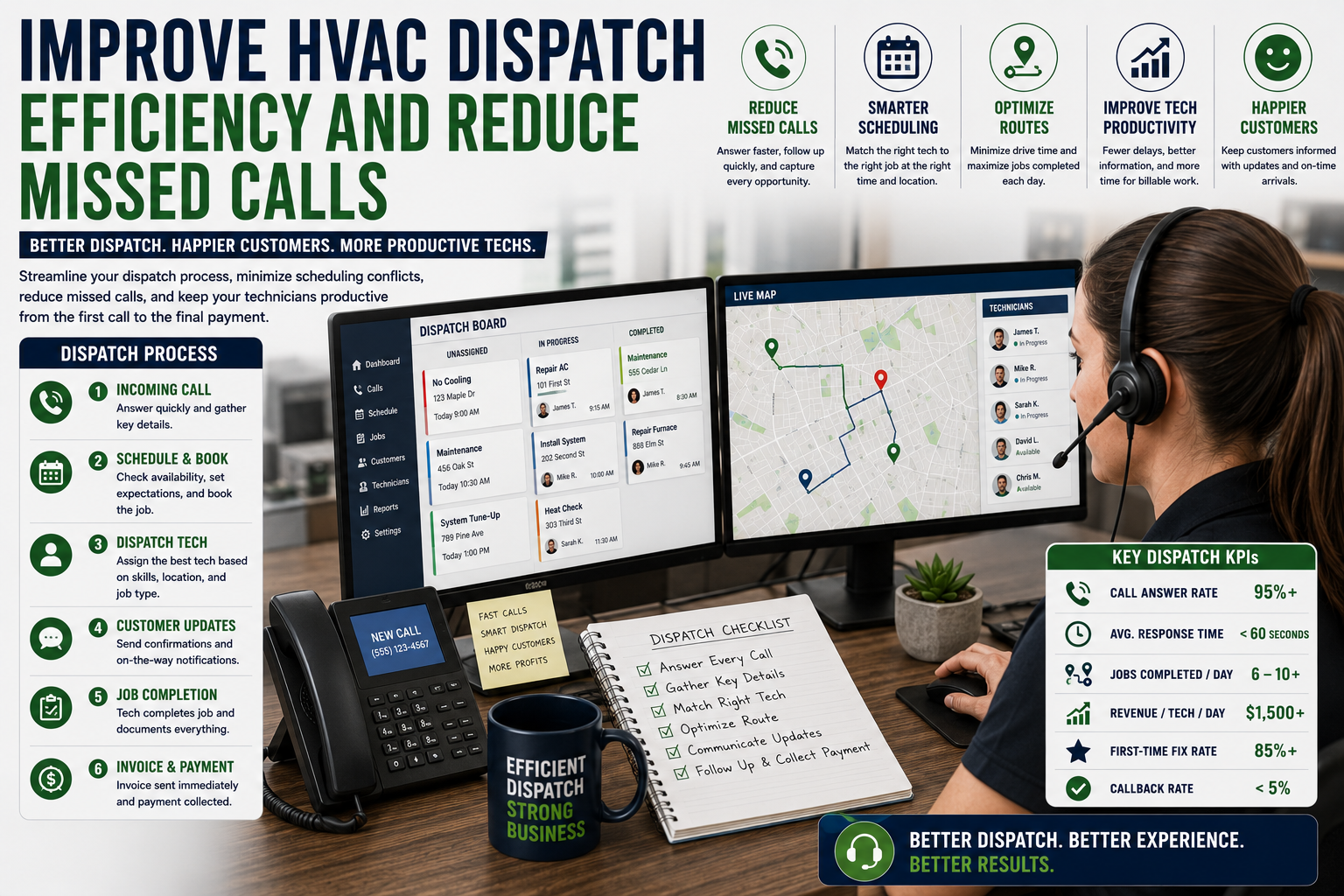
Table of Contents
Introduction
Most HVAC dispatch problems do not start with dispatch.
They start earlier.
The phone rings and nobody answers.
The CSR books the call without enough information.
The wrong technician gets assigned.
The schedule is already packed.
A job runs long.
The customer does not get an update.
Then the whole day starts falling apart.
That is not just frustrating.
It is expensive.
Every missed call costs potential revenue.
Every technician sent across town costs money.
Every schedule conflict creates stress for the office, field team, and customer.
Every unnecessary truck roll cuts into margin.
Dispatch efficiency is not about making the schedule look neat.
It is about getting more productive work out of every truck without making your team miserable.
See how HVACOpsHQ approaches scheduling and dispatch improvement as an operational problem rather than a software-only decision.
What HVAC Dispatch Efficiency Actually Means
Efficient dispatch means the office can move jobs through the day with less wasted time, fewer surprises, and better communication.
A strong dispatch process should help your company:
- Answer more calls
- Book more jobs
- Send the right technician
- Reduce drive time
- Avoid scheduling conflicts
- Improve first-time fix rates
- Keep customers informed
- Reduce callbacks
- Fill schedule gaps
- Increase revenue per truck
The goal is not to keep every technician busy every minute.
The goal is to keep technicians productive on the right work.
A technician driving across town, waiting on parts, or arriving without the right job information is not productive.
Why Missed Calls Are a Dispatch Problem
A missed call may look like a front-office problem.
But it becomes a dispatch problem the moment the company loses control of its schedule.
If calls are not answered or returned quickly:
- Customers call another company
- Emergency work goes elsewhere
- Membership customers feel ignored
- The office loses chances to fill schedule gaps
- Technicians may end up with open time they could have filled
A missed call is not just a missed phone call.
It is a missed chance to create revenue.
The first step toward better dispatch is making sure every inbound call has an owner.
A connected HVAC workflow optimization system makes missed-call recovery, booking, dispatch, invoicing, and follow-up part of one clear process instead of separate office tasks.
Build a Clear Call-Handling Process
Your office should have a simple system for new calls.
Every CSR should know:
- How to answer the phone
- What information to collect
- How to identify emergencies
- When to escalate a call
- How to check customer history
- How to check membership status
- How to book the right job type
- When to promise a callback
- How quickly callbacks must happen
At a minimum, collect:
- Customer name
- Address
- Best phone number
- Equipment issue
- Heating or cooling status
- Urgency
- Equipment type
- Preferred appointment window
- Membership status
- Previous service history
- Access instructions
The better the booking information, the better the dispatch decision.
Use Real Job Types
Do not label every appointment as a generic service call.
That gives dispatch almost nothing to work with.
Use job types such as:
- No cooling
- No heating
- Maintenance visit
- Diagnostic call
- Thermostat issue
- Water leak
- Warranty call
- Callback
- Replacement estimate
- Indoor air quality consultation
- Commercial service request
Clear job types help your company:
- Estimate job duration
- Assign the right technician
- Set better customer expectations
- Track conversion
- Review profitability
- Identify recurring operational problems
A no-cool call during a heat wave should not be treated like a routine maintenance appointment.
Match the Right Technician to the Right Job
The closest technician is not always the best technician.
Dispatch should consider:
- Technician skill level
- Equipment experience
- Certification requirements
- Customer history
- Membership status
- Job type
- Current location
- Current workload
- Parts or tools needed
- Whether the customer has an open estimate
- Whether the call could become a replacement opportunity
For example, a newer technician may be a good fit for maintenance visits.
A senior technician may be a better fit for a difficult diagnostic, repeat callback, or aging-system conversation.
Every wrong assignment increases the odds of a second trip.
Every second trip costs money.
Protect Technician Drive Time
Drive time is one of the biggest hidden costs in HVAC operations.
A technician can look busy all day and still produce weak results if they spend too much time in traffic.
Track where technicians are going.
Group calls by area when possible.
Use schedule gaps strategically.
Avoid sending one technician from one side of town to the other unless the job justifies it.
You will never eliminate all drive time.
Emergency calls happen.
Customers reschedule.
Technicians get delayed.
But you can reduce the obvious waste.
A better route can often create room for one more job per day without adding another truck.
For a deeper system around daily capacity, routing, and technician workload, see technician scheduling best practices for HVAC companies.
Leave Room for the Real World
One dispatch mistake is booking every technician to 100% capacity.
That looks efficient on paper.
It usually creates chaos in real life.
Jobs run long.
Parts are missing.
Customers need extra explanation.
Emergency calls come in.
A technician gets stuck in traffic.
When the schedule has no buffer, one delay ruins the whole day.
Build in room for:
- Emergency calls
- Jobs that run long
- Return trips
- Technician breaks
- Customer conversations
- Travel delays
- Follow-up work
The goal is not a perfectly full schedule.
The goal is a schedule that can survive the day.
Use On-the-Way Notifications
Customers do not like waiting without updates.
A late technician is not always the problem.
A late technician with no communication is the problem.
Use automated messages when possible:
- Appointment confirmation
- Reminder message
- On-the-way notification
- Delay update
- Reschedule message
- Technician arrival details
This reduces inbound “Where is the technician?” calls and gives the office more time to focus on real dispatch decisions.
Good communication protects the customer experience even when the day gets messy.
Give Technicians Better Job Information
A technician should not arrive at the house and immediately call the office for history.
Before the truck rolls, they should have access to:
- Customer notes
- Previous repairs
- Equipment details
- Warranty status
- Maintenance agreement status
- Open estimates
- Photos
- Job instructions
- Payment history
- Access notes
Prepared technicians diagnose faster.
They make fewer mistakes.
They create a better customer experience.
The customer should not have to explain the same issue every time someone arrives.
Track Jobs That Run Long
When a job runs long, do not just blame the technician.
Find out why.
Maybe:
- The job was booked incorrectly
- The wrong technician was assigned
- The estimated duration was wrong
- Customer history was missing
- Parts were unavailable
- The technician needed more training
- The customer added work
- The equipment was more complicated than expected
Track these patterns.
If the same job type keeps running long, update the booking process, price book, technician training, or schedule assumptions.
Dispatch gets better when the company learns from the jobs that did not go as planned.
Create a Missed Call Recovery Process
Even good companies miss calls sometimes.
What matters is how fast you recover.
Create a simple missed-call process:
| Step | Action |
|---|---|
| 1 | Return the call as quickly as possible |
| 2 | Identify whether the customer is new or existing |
| 3 | Check membership status |
| 4 | Determine urgency |
| 5 | Offer the earliest realistic appointment |
| 6 | Add the call to the dispatch board |
| 7 | Confirm the booking by text or email |
| 8 | Follow up if the customer does not answer |
The faster you return missed calls, the more likely you are to recover the opportunity.
Do not let missed calls sit in a voicemail inbox until the end of the day.
Use Dispatch Software the Right Way
Dispatch software can help you see:
- Technician schedules
- Current job status
- Customer history
- Technician locations
- Service areas
- Schedule gaps
- Job types
- Membership customers
- Open estimates
- Appointment reminders
- Customer notifications
- Revenue per technician
But software does not fix a weak process.
Bad dispatch inside expensive software is still bad dispatch.
Define the rules first.
Then use software to support them.
When comparing platforms, focus on whether they improve visibility, customer records, routing, live job status, and automated communication. See best HVAC dispatch software.
Dispatch Metrics That Matter
You do not need 50 reports.
Track the numbers that show whether dispatch is working.
Start with:
- Call answer rate
- Missed-call callback time
- Booking rate
- Average drive time
- Jobs completed per technician
- Revenue per truck
- Schedule utilization
- First-time fix rate
- Callback rate
- Average ticket
- On-time arrival rate
- Same-day booking rate
- Open schedule gaps
- Customer cancellation rate
These metrics help you find the real problem.
For example:
- Low booking rate may be a CSR issue.
- High drive time may be a routing issue.
- High callbacks may be a technician, training, or dispatch issue.
- Low revenue per truck may be a pricing, capacity, or schedule issue.
Daily Dispatch Huddle
A short morning dispatch huddle can prevent a lot of chaos.
It does not need to be a long meeting.
Review:
- Emergency calls
- Priority customers
- Membership calls
- Large jobs
- Technicians with open capacity
- Parts concerns
- Jobs likely to run long
- Customer special instructions
- Callback jobs
- Schedule gaps
Ten minutes of planning can save hours of confusion later.
Common Dispatch Mistakes HVAC Companies Make
Booking Every Technician Too Tight
A schedule with no buffer breaks the moment one job runs long.
Dispatching Only by Availability
The first available technician is not always the right technician.
Ignoring Customer History
Technicians should know what happened last time before they arrive.
Letting Missed Calls Sit Too Long
The customer is already calling another company.
Speed matters.
Sending Technicians Across Town All Day
A full schedule can still be an inefficient schedule.
Treating Dispatch Like Admin Work
Dispatch affects revenue, customer experience, technician productivity, callbacks, and profit.
It should be treated like an operating function.
How to Improve Dispatch This Week
Start simple.
Review Missed Calls
Find out:
- How many calls were missed
- How quickly they were returned
- How many became booked jobs
- Why some did not book
Review Drive Time
Look at the last week.
Which technicians spent too much time driving?
Which service areas create the most waste?
Where can calls be grouped better?
Review Jobs That Ran Long
Find patterns.
Do certain job types need more time?
Are certain technicians getting stuck?
Is booking information incomplete?
Review Callbacks
Callbacks show where the process failed.
Track the reason.
Fix the root cause.
Create One Dispatch Standard
Pick one rule to improve first.
For example:
Every missed call gets returned within five minutes.
Or:
Every technician reviews customer history before leaving for the job.
Small improvements compound fast.
A written standard is easier to train, coach, and audit. Use HVAC SOPs every successful company should have to build the supporting procedures around calls, dispatch, closeout, and callbacks.
FAQ
What is HVAC dispatch efficiency?
HVAC dispatch efficiency is the ability to schedule and assign technicians in a way that reduces drive time, improves technician productivity, minimizes missed calls, and creates a better customer experience.
How can HVAC companies reduce missed calls?
Use a clear call-handling process, assign ownership for inbound calls, return missed calls quickly, use call tracking, review missed-call reports, and make sure the office has enough coverage during busy periods.
How can dispatch software improve HVAC operations?
Dispatch software can help companies schedule technicians, view job status, track customer history, reduce routing mistakes, send customer updates, identify schedule gaps, and improve communication between the office and field team.
What should HVAC dispatchers track?
Dispatchers should track technician availability, job type, customer history, service area, drive time, appointment windows, job status, callbacks, emergency calls, and schedule gaps.
Final Thoughts
Better dispatch does not mean squeezing more jobs into every technician’s day.
It means running the right jobs with less wasted time.
Answer calls faster.
Book jobs correctly.
Match technicians to the work.
Protect drive time.
Give technicians the information they need.
Keep customers updated.
Track where the schedule breaks.
That is how an HVAC company gets more productive without adding more chaos.
Continue Reading
- HVAC Workflow Optimization: From Call to Payment System
- Technician Scheduling Best Practices for HVAC Companies
- Reduce HVAC Job Time Without Cutting Corners
- HVAC SOPs Every Successful Company Should Have
- Best HVAC Dispatch Software: Tools for Scheduling Technicians
- Field Service Management Software for HVAC: What to Look For
- HVAC Workflow Optimization: From Call to Payment System