
HVAC CRM vs ERP Systems: What’s the Difference?
Understand the differences between CRM and ERP software for HVAC businesses, when each makes sense, and whether your company needs one or both.
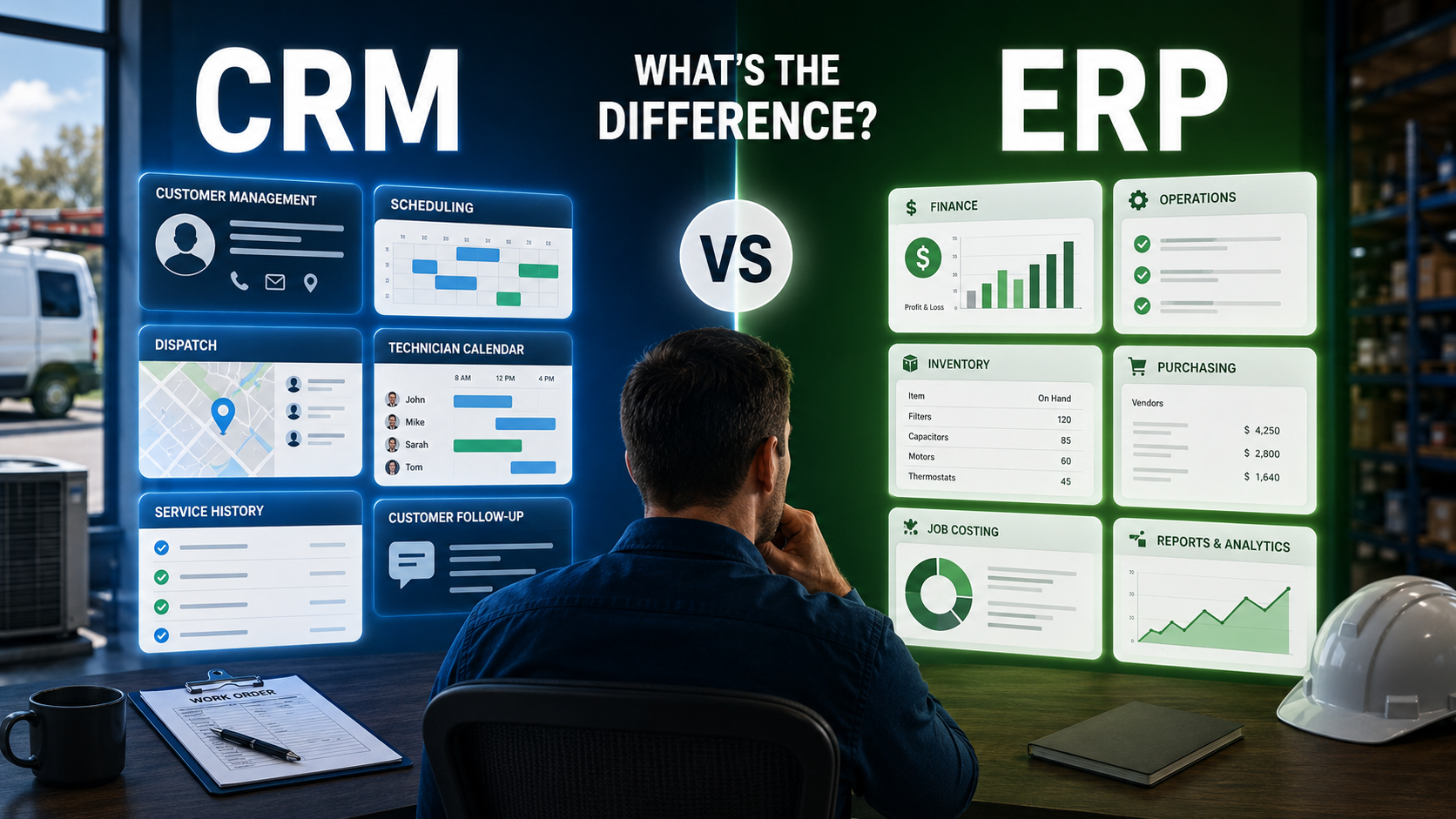
Table of Contents
Introduction
A lot of HVAC owners hear “CRM” and “ERP” and assume they are basically the same thing.
They are not.
A CRM helps you manage customers, calls, estimates, follow-up, dispatch, and service work.
An ERP helps you manage the deeper financial and operational side of the company: accounting, inventory, purchasing, payroll, projects, job costing, and reporting across departments.
The simple version:
A CRM helps you win and manage the work.
An ERP helps you control the business behind the work.
Most small HVAC companies do not need an ERP.
They need a better CRM and field-service system.
But as a company gets bigger, adds departments, carries more inventory, manages commercial projects, or operates across multiple locations, the lack of deeper financial control becomes expensive.
This guide breaks down the difference, when each system makes sense, and how to know whether your company actually needs one.
What Is an HVAC CRM?
CRM stands for customer relationship management.
For HVAC companies, a CRM is usually tied into field-service software.
It helps manage the customer journey from the first phone call through the completed job and future follow-up.
A good HVAC CRM can help with:
- Customer records
- Equipment history
- Scheduling
- Dispatch
- Estimates
- Invoices
- Payments
- Maintenance memberships
- Service reminders
- Review requests
- Customer communication
- Technician job details
- Estimate follow-up
Think of it as the system that keeps customer-facing work from falling through the cracks.
A customer calls.
The office books the job.
The technician gets dispatched.
The estimate gets sent.
The invoice gets paid.
The maintenance reminder goes out later.
That is CRM territory.
Companies evaluating platforms for those workflows should start by comparing HVAC CRM software options based on their dispatch, estimate, payment, communication, and membership features.
What Is an ERP System?
ERP stands for enterprise resource planning.
That sounds corporate because it usually is.
An ERP system is designed to connect the financial and operational side of a larger business.
For HVAC companies, an ERP may help manage:
- General ledger accounting
- Accounts payable
- Accounts receivable
- Payroll
- Inventory
- Purchasing
- Warehousing
- Vendor management
- Financial forecasting
- Job costing
- Project budgets
- Multi-location reporting
- Department profitability
- Commercial projects
- Work in progress
An ERP is less focused on booking a repair call.
It is more focused on answering questions like:
- Which department is actually profitable?
- How much inventory are we carrying?
- Which install jobs are losing margin?
- Are labor costs staying on budget?
- What do we owe vendors?
- Which branch is underperforming?
- Can we forecast cash flow next month?
That is a different level of business control.
HVAC CRM vs ERP: The Main Difference
| Area | HVAC CRM | ERP System |
|---|---|---|
| Main focus | Customers, jobs, dispatch, follow-up | Finance, inventory, operations, and company-wide reporting |
| Best for | Small to mid-sized HVAC service companies | Larger, more complex HVAC and mechanical contractors |
| Scheduling and dispatch | Core function | Usually secondary or integrated |
| Customer history | Core function | Often limited without CRM integration |
| Estimates and invoices | Core function | Can support financial workflows |
| Service agreements | Common feature | Usually not the main purpose |
| Inventory | Basic to moderate | Deep inventory, purchasing, and warehouse control |
| Job costing | Basic to advanced depending on platform | More detailed financial and project costing |
| Accounting | Usually integrates with accounting software | Often includes financial management tools |
| Multi-location reporting | Limited to moderate | Stronger for enterprise operations |
| Commercial projects | May be limited | Better suited for complex project work |
The biggest difference is not the feature list.
It is the question each system is designed to answer.
A CRM asks:
“What is happening with this customer and job?”
An ERP asks:
“What is happening across the entire business?”
When an HVAC CRM Is Enough
For most small and growing HVAC companies, a strong CRM and field-service platform is enough.
That is especially true if your company is mainly focused on:
- Residential repair calls
- Maintenance visits
- Tune-ups
- Replacements
- Smaller install work
- Memberships
- Local service areas
- A small office team
- A few technicians
At this stage, the biggest leaks are usually not enterprise problems.
They are basic problems:
- Calls are missed
- Estimates are not followed up
- Invoices go out late
- Technicians price from memory
- Memberships are forgotten
- Dispatch is messy
- Customer history is scattered
- The owner cannot see what technicians are producing
A good CRM can solve a lot of that.
You do not need an ERP to stop missing calls.
You need a better process and a system your team actually uses. A capable field service management platform is usually the more important investment for a service company at this stage.
When an HVAC Company Starts to Need ERP-Level Control
The need for an ERP usually shows up when the company becomes more complex than a typical service business.
That may happen when you have:
- Multiple locations
- Large commercial accounts
- Construction or mechanical projects
- Project managers
- A warehouse
- Heavy inventory needs
- Large equipment purchasing
- Multiple departments
- Complex payroll
- Larger install operations
- Significant accounts payable
- More detailed financial reporting needs
- Leadership teams managing multiple branches
At that point, disconnected systems start creating problems.
The office has one version of the numbers.
Accounting has another.
Install managers track labor in a spreadsheet.
The warehouse tracks inventory somewhere else.
Marketing knows how many leads came in but not which ones turned into profitable jobs.
That creates blind spots.
An ERP can help connect those parts of the business.
CRM Problems vs ERP Problems
A simple way to decide what you need is to look at the problem.
You Probably Need a Better CRM If:
- Calls are being missed
- Estimates are going cold
- Dispatch is disorganized
- Technicians do not have customer history
- Invoices are delayed
- Membership renewals are slipping
- Review requests are inconsistent
- Customer communication is weak
- The owner cannot see technician activity
- Job notes are scattered across texts and emails
You May Need ERP-Level Systems If:
- Inventory is out of control
- Purchasing is disconnected from jobs
- Vendor bills are hard to track
- Commercial projects are losing money
- You cannot see department profitability
- Labor costs are hard to control
- Multiple locations report numbers differently
- Accounting is constantly cleaning up field mistakes
- You need stronger cash-flow forecasting
- The business relies on too many spreadsheets to understand financial performance
The difference comes down to where the pain is happening.
CRM pain shows up around customers and jobs.
ERP pain shows up around operations, finance, inventory, and scale.
If the biggest problem is unclear labor, material, or install margin, improving your HVAC job-costing process may solve the real issue before an ERP becomes necessary.
Can One Platform Handle Both?
Sometimes.
Some larger field-service platforms offer deeper accounting, reporting, inventory, job-costing, and project-management tools.
That can be enough for many HVAC companies.
You do not always need a separate ERP system.
For example, a growing service company may use one field-service platform for dispatch, customers, pricing, memberships, and reporting while integrating it with accounting software.
That can work well.
The question is whether the systems give you the control you need.
Do not add an ERP because someone told you “real companies use ERP.”
Add deeper systems when the current setup is creating expensive blind spots.
For many growing companies, all-in-one HVAC business software may offer enough operational control without the cost and complexity of a separate ERP rollout.
The Biggest Mistake HVAC Companies Make
The biggest mistake is jumping into an ERP before the company has basic systems.
An ERP will not fix:
- Weak call handling
- Bad dispatch
- Poor technician communication
- Inconsistent pricing
- No estimate follow-up
- Lack of leadership
- A team that avoids using software
- An owner who never looks at the numbers
A larger system does not replace discipline.
It requires more discipline.
Before adding ERP-level complexity, make sure the business already has clear processes around:
- Call booking
- Dispatch
- Price-book use
- Estimate follow-up
- Payment collection
- Membership renewals
- Install handoff
- Job costing
- Reporting
Bad processes inside a bigger platform are still bad processes.
CRM and ERP by Company Stage
Small HVAC Company: One to Five Trucks
Most small HVAC companies need:
- A field-service CRM
- Scheduling and dispatch
- Estimates and invoices
- Payments
- Basic accounting
- Customer history
- Review requests
- Maintenance reminders
This is usually not ERP territory.
Keep the stack simple.
Growing HVAC Company: Five to 20 Trucks
At this stage, you may need:
- Stronger price books
- Better dispatch
- Membership tracking
- Technician reporting
- Job costing
- Marketing attribution
- Better accounting integrations
- Install workflow controls
- More structured reporting
You may still not need a full ERP.
But you do need better visibility.
The right platform should support increasingly complex dispatch, reporting, and customer workflows without forcing your team to operate from separate spreadsheets. See the best HVAC software stack for small business vs enterprise for a clearer breakdown of what to add at each stage.
Larger or Commercial HVAC Company
At this stage, the company may need:
- Deeper project accounting
- Purchasing controls
- Inventory management
- Multi-location reporting
- Department profitability
- Contract management
- Commercial billing
- Advanced job costing
- Cash-flow forecasting
- Leadership dashboards
This is where ERP-level systems become more relevant.
How to Decide What Your Company Needs
Ask these questions.
Can We See What Is Happening With Every Customer?
If the answer is no, start with CRM.
You need visibility into calls, jobs, estimates, follow-up, memberships, and customer history.
Can We See What Is Happening With Every Dollar?
If the answer is no, you may need stronger accounting, job costing, or ERP-level reporting.
You should know where money is coming from, where it is going, and which departments are creating profit.
A better cash flow management process for HVAC companies can also reveal whether the issue is financial discipline rather than a missing software category.
Are We Losing Money Because of Customer Problems or Operations Problems?
Customer problems usually point toward CRM.
Operational and financial problems usually point toward ERP.
Are We Ready to Use a More Complex System?
More software means more setup, more training, more reporting, and more accountability.
Do not build a bigger system than the leadership team can manage.
FAQ
Does an HVAC company need both CRM and ERP software?
Not always.
Most small and growing HVAC companies can run well with a strong CRM or field-service platform connected to accounting software.
ERP systems become more useful when the company has larger commercial operations, inventory needs, multiple departments, multiple locations, or more complex financial reporting.
Is ServiceTitan a CRM or ERP?
ServiceTitan is primarily a field-service platform with CRM capabilities.
It can also provide deeper reporting, job costing, inventory, project, and operational tools that may reduce the need for separate systems in some HVAC companies.
Is QuickBooks an ERP?
QuickBooks is accounting software.
It can handle important financial tasks for many small businesses, but it is not a full ERP system for complex multi-location, inventory-heavy, project-based operations.
When should an HVAC company move from CRM to ERP?
Consider it when your current systems no longer give you enough control over inventory, purchasing, job costing, commercial projects, multi-location reporting, cash flow, or department profitability.
Final Thoughts
CRM and ERP systems solve different problems.
A CRM helps your HVAC company manage customers, calls, dispatch, estimates, payments, memberships, and follow-up.
An ERP helps a larger company control financial operations, inventory, purchasing, projects, reporting, and scale.
Most HVAC companies need a strong CRM before they need an ERP.
Do not buy a bigger system because it sounds more advanced.
Buy the system that solves the problem costing your business the most money right now.