
How HVAC Companies Should Structure Service Pricing in 2026
Explore modern HVAC pricing models, including flat-rate, hourly, maintenance plans, and value-based pricing, to maximize profitability in 2026.
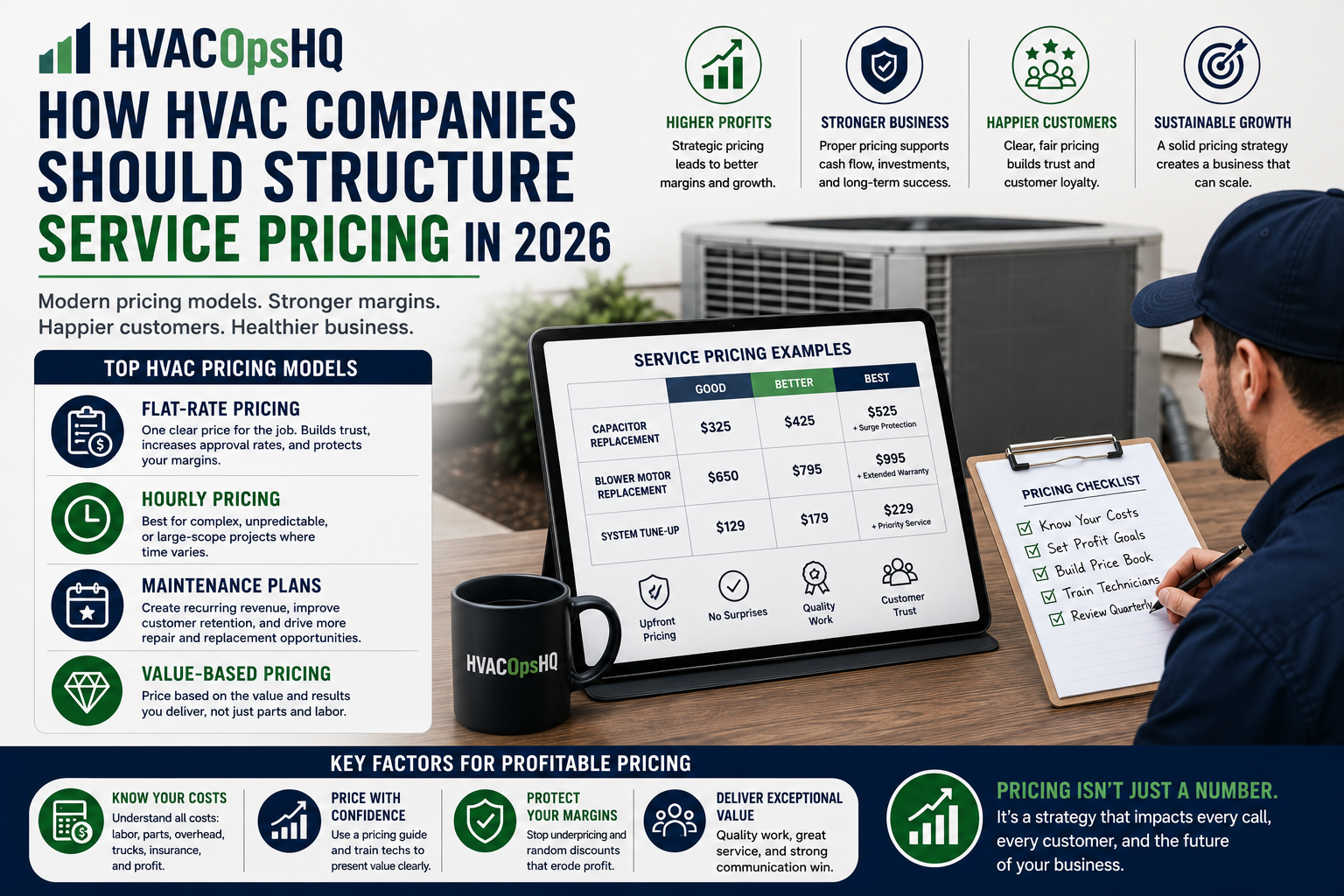
Table of Contents
Introduction
A lot of HVAC companies are still pricing like it is ten years ago.
They charge a low service-call fee, add a little markup to the part, hope the technician finishes quickly, and wonder why the bank account never grows.
That model breaks fast.
Labor costs are higher.
Parts are more expensive.
Trucks cost more.
Insurance costs more.
Customer expectations are higher.
And every callback eats into the profit from the jobs that went right.
In 2026, HVAC service pricing has to do more than win the job.
It has to protect the business.
That means your pricing needs to cover the real cost of serving the customer, give technicians a consistent way to present options, and leave enough margin behind to build a stronger company.
The goal is not to be the cheapest company in town.
The goal is to stop doing work that keeps everyone busy but leaves nothing behind.
Why HVAC Service Pricing Matters More Than Ever
A full schedule can hide a weak business.
You can run ten calls a day and still lose money if:
- Diagnostic fees are too low
- Technicians discount too often
- Labor is underpriced
- Parts are marked up inconsistently
- Dispatch is inefficient
- Callbacks are too high
- Invoices go unpaid
- Membership visits lose money
- Emergency work is priced like regular-hour work
Revenue is not the same as profit.
A company doing less revenue with strong margins can be healthier than a company doing twice as much revenue with weak pricing.
The real question is not:
“How many calls did we run?”
The better question is:
“How much money did we keep after serving those customers?”
That is where pricing strategy matters. The broader HVAC pricing strategies that increase profit margins article explains how pricing, discounts, options, and overhead should work together.
The Main HVAC Pricing Models
Most HVAC companies use some version of four pricing models.
The best one depends on your service mix, technician experience, customer base, and how well you understand your own costs.
Flat-Rate Pricing
Flat-rate pricing gives the customer one price for the repair before work begins.
The price usually includes labor, parts, truck costs, overhead, warranty risk, and profit.
For residential HVAC service, flat-rate pricing is usually the strongest long-term model.
Why Flat-Rate Pricing Works
Customers like certainty.
They do not want to watch a technician work for two hours wondering what the invoice will be.
A flat-rate price gives them a clear number before the repair starts.
It also protects the company when a technician is slower than expected.
If the technician takes longer, the customer does not get punished for it.
But the company still has to make sure the price book was built correctly.
A flat-rate repair price should account for:
- Labor
- Payroll burden
- Parts
- Truck costs
- Fuel
- Insurance
- Office support
- Software
- Warranty risk
- Overhead
- Target profit
If you leave those out, flat-rate pricing becomes another way to undercharge.
Best Use Cases
Flat-rate pricing works well for:
- Capacitors
- Contactors
- Thermostats
- Drain repairs
- Blower motors
- Maintenance repairs
- Electrical components
- Common heating and cooling repairs
- Service-call recommendations
The key is consistency.
Technicians should not be making up prices in the driveway.
Hourly Pricing
Hourly pricing charges the customer based on time spent, plus parts and materials.
This model is common in commercial work, difficult diagnostics, unusual repairs, and projects where the scope is unclear.
Why Hourly Pricing Can Work
Hourly pricing is useful when the work is hard to predict.
For example:
- Complex diagnostics
- Older equipment
- Commercial systems
- Rooftop units
- Custom ductwork
- Specialty controls
- Projects with unknown scope
- Repair work that may uncover more issues
In those situations, a flat-rate price can create risk if the technician runs into unexpected problems.
Where Hourly Pricing Creates Problems
Customers often dislike open-ended hourly pricing.
They may worry that the longer the technician takes, the higher the bill becomes.
That can create tension.
If you use hourly pricing, be clear up front.
Explain:
- Your diagnostic fee
- Your hourly rate
- What the customer can expect
- When you will stop and request approval
- How parts and materials are billed
- Whether travel time is included
Transparency matters.
The customer does not need to love the price.
They need to understand it before the work begins.
Diagnostic Fee Pricing
Your diagnostic fee should not be treated as a coupon.
It covers the cost of sending a trained technician, stocked truck, tools, insurance, fuel, and experience to the home.
Too many HVAC companies give away diagnosis.
They show up for free, troubleshoot for free, explain the problem, and then hope the customer approves the repair.
That is a fast way to attract price shoppers.
A proper diagnostic fee should help cover:
- Technician travel time
- Fuel
- Truck expense
- Initial diagnosis
- Office support
- Scheduling
- Tools
- Insurance
- Basic overhead
You can choose to apply the diagnostic fee toward a repair.
But that should be part of your pricing model, not an automatic reaction every time a customer pushes back.
Membership Pricing
Maintenance memberships are not cheap tune-ups.
They are a customer-retention system.
The membership price should cover the work you promise to provide while creating a reason for the customer to stay connected to your company.
A strong membership program can include:
- Seasonal maintenance visits
- Priority scheduling
- Reduced diagnostic fees
- Repair discounts
- Longer warranties
- Member-only offers
- Equipment reminders
- Service history tracking
The biggest value is not the monthly or annual fee.
The biggest value is that your company is in the home before the system fails.
That creates more repair opportunities, replacement opportunities, reviews, referrals, and repeat business.
The Membership Pricing Mistake
Do not sell memberships so cheaply that every included visit loses money.
Know the cost of:
- Technician labor
- Drive time
- Fuel
- Materials
- Office support
- Scheduling
- Member discounts
- Included visits
Then price the membership around the long-term value of customer retention.
Value-Based Pricing
Value-based pricing means you are not only charging for parts and labor.
You are charging for the outcome.
Customers are not buying a capacitor.
They are buying cooling again.
They are buying comfort.
They are buying speed.
They are buying confidence that the problem will be fixed correctly.
That matters most when your company differentiates itself through:
- Fast response times
- Better communication
- Strong warranties
- Higher-quality equipment
- Cleaner installs
- Better financing
- Professional technicians
- Strong reviews
- Membership benefits
- Better customer education
The cheapest company does not always win.
The company that makes the customer feel safest often wins.
How to Structure Your Service Pricing
A healthy HVAC pricing system should have layers.
Do not use one price for every situation.
Standard Service Pricing
This covers normal service calls during regular business hours.
It should include:
- Diagnostic fee
- Flat-rate repair pricing
- Standard labor assumptions
- Standard parts markup
- Normal dispatch costs
- Basic warranty coverage
This is your everyday pricing foundation.
Emergency and After-Hours Pricing
Emergency work costs more to provide.
The technician may be working overtime.
The truck may need to be rerouted.
The office may be handling calls after hours.
The customer expects a faster response.
Your pricing should reflect that.
Consider separate pricing for:
- After-hours service
- Weekend calls
- Holiday calls
- Same-day emergency service
- Remote service areas
- Difficult access
- Rooftop systems
- Commercial emergency calls
Do not apologize for charging more when the work costs more to provide.
Just be clear before the work starts.
Repair Pricing
Repair pricing should be consistent and easy for technicians to present.
Use a digital price book that gives technicians clear options.
For example:
| Option | Example |
|---|---|
| Good | Replace failed component |
| Better | Replace failed component and add system protection |
| Best | Repair issue, add protection, and enroll customer in maintenance |
The goal is not to pressure the customer.
The goal is to give them a clear choice.
Replacement Pricing
Replacement pricing needs more detail than a repair price book.
A replacement estimate should include:
- Equipment
- Labor
- Materials
- Permits
- Electrical work
- Ductwork
- Disposal
- Accessories
- Crane or lift costs
- Financing fees
- Sales commission
- Warranty cost
- Target margin
A system replacement can look profitable until the install crew spends two extra days on it.
That is why every replacement should be reviewed through HVAC job costing after completion.
How to Build Prices From Real Costs
Start with the numbers.
You need to know what it costs to operate the business before deciding what a repair should cost.
Fixed Costs
These are costs you pay whether you run one call or one hundred.
Examples include:
- Rent
- Office payroll
- Insurance
- Software
- Marketing
- Phones
- Management salaries
- Truck payments
- Licensing
- Accounting
- Training
Variable Costs
These increase when you do more work.
Examples include:
- Technician labor
- Payroll burden
- Fuel
- Parts
- Equipment
- Permits
- Disposal
- Credit-card fees
- Subcontractors
- Overtime
- Warranty work
Every service call needs to contribute to those costs.
If you do not build them into pricing, they come out of profit.
For a clearer view of what those margins should support, review how much profit an HVAC company should make.
Stop Letting Technicians Discount at Will
Discounting can feel harmless.
It is not.
A 10% discount comes straight out of your margin.
If your pricing is already weak, a discount can turn a decent repair into a bad job.
Discounts should have a purpose.
Good reasons include:
- Membership pricing
- Military or senior discounts
- Slow-season promotions
- Manufacturer rebates
- Multi-system discounts
- Referral incentives
- Bundle offers
Random technician discounts are different.
They usually happen because the technician feels uncomfortable talking about price.
That is not a discount strategy.
That is a training problem.
Train technicians to explain value instead.
Review Pricing Every Quarter
Your costs change.
Labor changes.
Parts change.
Equipment changes.
Fuel changes.
Insurance changes.
Your pricing cannot stay frozen.
Review your pricing at least quarterly.
Look at:
- Labor burden
- Material costs
- Equipment costs
- Gross margin by job type
- Callback rate
- Discount usage
- Diagnostic fee performance
- Membership profitability
- Average ticket
- Install margins
- Warranty work
- Technician pricing consistency
Do not wait until the end of the year to find out you were underpriced for six months.
A quarterly review should also include cash impact. Strong pricing does not matter much if invoices age, deposits are missed, or payroll pressure absorbs the margin. See cash flow management for HVAC companies for the financial side of protecting what your jobs earn.
Common Service Pricing Mistakes
Copying Competitor Prices
You do not know their costs.
You do not know their margins.
You do not know whether they are profitable.
Copying another company’s price is not a strategy.
Charging the Same Price for Every Call
Emergency service, remote calls, rooftop work, commercial calls, and regular-hour repairs do not cost the same to provide.
Your pricing should reflect the work.
Giving Away Diagnosis
Free diagnosis often attracts customers who only want free advice.
Protect technician time.
Ignoring Job Costing
If you never compare estimated costs to actual costs, you do not know whether your pricing works.
Discounting Too Easily
Discounts should be planned.
They should not be a reflex.
Selling Memberships Too Cheaply
Memberships should create retention and recurring revenue.
They should not create a growing list of unprofitable maintenance visits.
FAQ
Should HVAC companies use flat-rate pricing in 2026?
For most residential HVAC companies, yes.
Flat-rate pricing helps create consistent pricing, protects margins, makes customer communication easier, and reduces technician guesswork.
Should HVAC companies charge a diagnostic fee?
Yes.
A diagnostic fee helps cover the real cost of sending a trained technician and stocked truck to the customer’s home.
You can apply it toward repairs when that fits your model, but it should not be treated as free labor.
How often should HVAC companies update service prices?
Review pricing at least quarterly. Update sooner when major labor, equipment, material, fuel, or insurance costs change.
How can HVAC companies increase margins without raising every price?
Improve margins by tightening discounts, using better price books, reviewing job costs, charging properly for diagnostics, improving dispatch, reducing callbacks, presenting options, and following up on unsold estimates.
Final Thoughts
Service pricing is one of the biggest profit levers in an HVAC company.
A weak pricing model keeps the schedule full and the bank account empty.
A strong pricing model covers your real costs, protects technician time, gives customers clear options, and leaves money behind after the work is done.
Use flat-rate pricing where it makes sense.
Use hourly pricing where the scope is unclear.
Charge properly for diagnostics.
Price memberships for retention.
Review your numbers every quarter.
The goal is not to be the cheapest company in town.
The goal is to build a company that can serve customers well and stay profitable while doing it.