
How to Scale an HVAC Business from $1M to $5M Revenue
Learn the systems, hiring strategies, marketing, financial planning, and operational improvements required to grow an HVAC company from seven figures to a multi-million-dollar business.
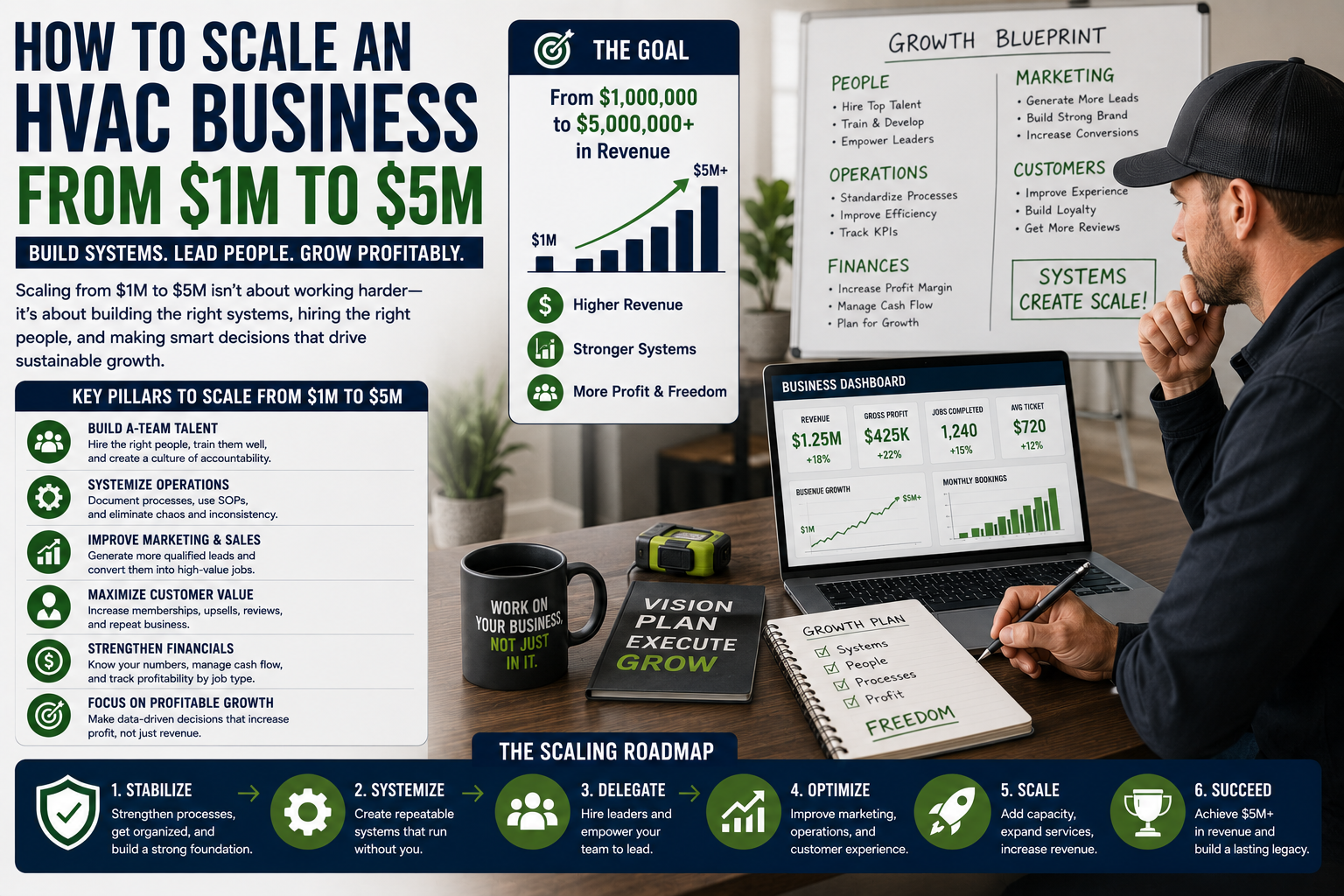
Table of Contents
Introduction
Getting an HVAC company to $1 million is hard.
Getting it from $1 million to $5 million is a different kind of hard.
At $1 million, the owner can still cover a lot of gaps personally.
You can answer calls, run service, sell replacements, handle dispatch, approve estimates, fix mistakes, and make most decisions yourself.
That stops working as the company grows.
More calls create more scheduling problems.
More technicians create more inconsistency.
More installs create more job-costing mistakes.
More customers create more follow-up work.
More revenue creates more payroll, more equipment purchases, and more pressure on cash flow.
The company does not scale because the owner works harder.
It scales because the business starts running on systems instead of memory.
The goal is not to become a giant company overnight.
The goal is to build a business that can handle more work without becoming more chaotic.
What Changes Between $1M and $5M
At $1 million, most HVAC companies are still owner-led.
The owner knows nearly every customer, every technician issue, every open estimate, and every major problem.
At $5 million, that is no longer possible.
The company needs:
- Better hiring
- Better dispatch
- Better leadership
- Better job costing
- Better marketing
- Better customer follow-up
- Better cash management
- Better technician accountability
- Better systems for service and install work
The biggest shift is this:
At $1 million, the owner is often the system.
At $5 million, the systems have to run without the owner touching everything.
That is what scaling really means.
The Biggest Mistake HVAC Owners Make
The biggest mistake is assuming more revenue automatically creates a better business.
It does not.
More revenue can create:
- More payroll pressure
- More callbacks
- More warranty work
- More scheduling issues
- More customer complaints
- More trucks to manage
- More cash-flow problems
- More stress for the owner
A company can grow from $1 million to $3 million and actually become less profitable.
That usually happens when growth outpaces systems.
The company adds people before it has clear expectations.
It adds trucks before it has enough productive work.
It adds leads before it has a clean call-handling process.
It adds installs before it can job cost them correctly.
Revenue is not the goal.
Healthy, profitable growth is the goal.
For a closer look at the owner bottlenecks that hold companies back, read why most HVAC companies stay small.
Build the Right Leadership Layer
You cannot scale a $5 million company while personally managing every call, technician, and customer issue.
At some point, you need leaders.
That does not mean hiring a bunch of managers too early.
It means deciding who owns what.
As the company grows, you may need clear ownership around:
- Service operations
- Dispatch
- Install operations
- Sales
- Marketing
- Finance
- Recruiting
- Training
- Customer service
The owner should not be the only person who knows whether the day is going well.
Start by assigning responsibility.
For example:
| Area | Owner |
|---|---|
| Service schedule | Dispatcher or service manager |
| Technician performance | Service manager |
| Install job handoff | Install manager |
| Open estimates | Sales manager or office manager |
| Membership renewals | CSR or customer success role |
| Job costing | Operations manager or bookkeeper |
| Cash flow | Owner and finance lead |
| Marketing results | Owner or marketing manager |
The title matters less than the ownership.
When nobody owns a number, nobody improves it.
A more detailed leadership system for HVAC businesses can help define scorecards, decision rules, coaching, and manager accountability as the company grows.
Hire for the Next Stage, Not Just the Current Emergency
A lot of HVAC companies hire because they are overwhelmed.
That is understandable.
But emergency hiring creates bad decisions.
The company hires the first available technician, throws them into the field, and hopes they work out.
That can create callbacks, unhappy customers, weak average tickets, and more work for the office.
A better approach is to hire based on the growth plan.
Ask:
- What type of work do we need more capacity for?
- Are we short on service technicians, installers, dispatchers, or salespeople?
- Can existing technicians produce more before we add another truck?
- Do we have enough work to support this role year-round?
- Can we train this person properly?
- Who will manage them?
Do not hire only for labor.
Hire for capacity, quality, and long-term fit.
A technician who can complete work correctly, communicate with customers, use software, present options, and avoid callbacks is worth more than someone who only fills a schedule slot.
Build a Recruiting System
At $5 million, hiring cannot depend on luck.
You need a steady recruiting process.
That may include:
- A careers page on your website
- Employee referrals
- Relationships with trade schools
- Ongoing job ads
- Technician referral bonuses
- Fast interview processes
- Clear compensation plans
- Strong onboarding
- A good reputation as an employer
Do not wait until you are desperate.
The best time to recruit is before you need someone tomorrow.
Good technicians are not sitting around waiting for a job posting.
You need to make your company a place they want to join.
For a full recruiting and retention process, see how to build a strong HVAC technician team.
Improve Technician Productivity Before Adding More Trucks
More trucks do not automatically mean more profit.
A company with eight productive trucks can outperform a company with 12 poorly managed trucks.
Before adding capacity, look at:
- Revenue per technician
- Jobs completed per day
- Drive time
- Average ticket
- Callback rate
- First-time fix rate
- Overtime
- Open schedule gaps
- Membership sales
- Estimate conversion
If technicians are spending too much time driving, waiting on parts, calling the office, or returning to jobs, the company may not need another truck yet.
It may need better operations.
Every unnecessary truck roll costs money.
Every missed estimate costs money.
Every callback costs money.
Fix those leaks before adding more overhead.
Build a Better Dispatch System
Dispatch becomes one of the biggest profit levers as the company grows.
At $1 million, the owner may be able to manage the schedule from a phone.
At $5 million, that is not enough.
You need a system that helps the office:
- Match technicians to jobs
- Reduce drive time
- Prioritize emergencies
- Track customer history
- Fill schedule gaps
- Manage maintenance calls
- Handle callbacks
- Keep customers updated
- Monitor technician status
Dispatch should not be treated like admin work.
Dispatch affects revenue, customer experience, technician productivity, and margin.
A good dispatcher can create more daily capacity without adding another truck.
Standardize Pricing and Estimates
Scaling companies cannot let every technician price work differently.
That creates confusion for customers and destroys margin.
Use a consistent price book.
Give technicians clear options.
Make sure estimates are tied to job costing.
For service work, standardize:
- Diagnostic fees
- Flat-rate repair pricing
- Membership pricing
- Good-better-best options
- Emergency pricing
- Financing options
- Discount rules
For installs, standardize:
- Labor assumptions
- Equipment markup
- Material allowances
- Permit costs
- Ductwork assumptions
- Commission structure
- Financing fees
- Change-order process
- Target margin
The goal is not to make every job identical.
The goal is to stop guessing.
Build a Strong Install Department
A lot of HVAC companies grow quickly through replacements.
That can be great.
It can also create major profit leaks.
Install work becomes dangerous when:
- Sales promises something operations cannot deliver
- Equipment is ordered before the job is fully scoped
- Materials are missed
- Labor runs long
- Change orders are not documented
- Financing fees are ignored
- The crew has to return
- Job costing is never reviewed
A strong install department needs a clean handoff from sales to operations.
Every install should include:
- Signed proposal
- Equipment details
- Scope of work
- Customer expectations
- Permit requirements
- Materials list
- Labor budget
- Installation date
- Financing status
- Change-order process
- Job-costing review after completion
The bigger the install department gets, the more important this becomes.
For better financial visibility on service and installation work, use a consistent HVAC job costing process.
Protect Cash Flow During Growth
Growth consumes cash.
You may need to buy trucks, equipment, tools, uniforms, software, marketing, and inventory before the new revenue shows up.
That is why growing companies often feel broke even when revenue is climbing.
Protect cash flow by:
- Collecting deposits on installs
- Collecting payment in the field
- Reducing old invoices
- Tracking weekly cash flow
- Avoiding unnecessary inventory
- Reviewing payroll regularly
- Building a slow-season reserve
- Watching financing fees
- Controlling discounts
- Job costing installs and large repairs
Revenue can grow faster than cash.
Do not confuse growth with financial health.
Use a disciplined cash flow management process to protect payroll, vendor obligations, reserves, and new growth investments.
Build a Marketing System, Not Random Campaigns
At $1 million, referrals and word of mouth may be enough to keep the phone ringing.
At $5 million, marketing needs to become more intentional.
You need a predictable system for generating and tracking leads.
That may include:
- Google Business Profile
- Local SEO
- Google Ads
- Local Services Ads
- Review generation
- Email follow-up
- Membership marketing
- Referral programs
- Direct mail
- Financing offers
- Reactivation campaigns
- Website conversion improvements
The key is not doing every marketing tactic.
The key is knowing which channels create profitable jobs.
Track:
- Leads by source
- Booked calls
- Revenue by source
- Cost per lead
- Cost per booked call
- Cost per acquired customer
- Membership conversion
- Replacement opportunities
- Return on ad spend
Traffic does not pay payroll.
Booked, profitable jobs do.
Improve Customer Retention
The easiest customer to sell to is the one who already trusts you.
A company trying to scale should not only chase new leads.
It should protect the customer base it already paid to acquire.
Focus on:
- Maintenance memberships
- Review requests
- Customer follow-up
- Seasonal reminders
- Repair follow-up
- Replacement campaigns
- Referral programs
- Clear communication
- On-time arrivals
- Strong warranties
Retention makes growth less expensive.
A company with a strong membership base has more predictable revenue, better scheduling, and more repair and replacement opportunities.
Create a Weekly Operating Rhythm
At $1 million, problems may get solved through random conversations.
At $5 million, you need a rhythm.
Set a weekly leadership meeting.
Review the numbers that matter.
For example:
- Revenue
- Gross margin
- Net profit
- Cash balance
- Accounts receivable
- Booked calls
- Call answer rate
- Estimate conversion
- Membership sales
- Revenue per technician
- Callback rate
- Install margin
- Marketing performance
- Open positions
- Customer complaints
Do not turn this into a meeting full of reports nobody acts on.
Use the meeting to identify the biggest bottleneck and assign ownership.
The goal is not more meetings.
The goal is faster decisions.
Use SOPs to Reduce Chaos
The business cannot scale if every employee does things their own way.
Create simple SOPs for repeatable work.
Start with:
- Call booking
- Emergency calls
- Dispatch
- Technician preparation
- Diagnostic process
- Estimate follow-up
- Membership sales
- Job closeout
- Payment collection
- Callback handling
- Install handoff
- Review requests
You do not need a giant manual.
You need simple checklists that help the team make fewer mistakes.
Systems are what allow a company to grow without the owner becoming the bottleneck.
Know When to Upgrade Software
Software should support growth.
It should not create more work.
A small HVAC company may run well with simple tools for scheduling, estimates, invoices, payments, and customer history.
As the company grows, it may need stronger systems for:
- Dispatch
- Price books
- Memberships
- Technician reporting
- Install workflows
- Job costing
- Marketing attribution
- Multi-location management
- Inventory
- Department reporting
The right software depends on the complexity of your business.
Do not buy enterprise software because it looks impressive.
Buy it when the current system is creating expensive bottlenecks.
Common Mistakes When Scaling From $1M to $5M
Adding Revenue Without Adding Systems
More work creates more problems when the process is weak.
Hiring Too Fast
More payroll can destroy cash flow if the company does not have enough profitable work.
Letting the Owner Stay in Every Decision
The owner eventually becomes the bottleneck.
Ignoring Job Costing
A growing install department can create more revenue and less profit at the same time.
Treating Marketing Like a Guessing Game
Track where leads come from and which ones turn into profitable jobs.
Not Developing Managers
The company cannot scale if the owner is the only leader.
Growing Without Cash Reserves
Growth creates expenses before revenue catches up.
FAQ
How long does it take to scale an HVAC company from $1M to $5M?
It depends on market, demand, team quality, systems, cash flow, and execution.
The more important question is whether the company can grow without losing margin, customer experience, and control.
What is the biggest challenge when scaling an HVAC company?
For most companies, the biggest challenge is moving from owner-led decisions to repeatable systems and leadership accountability.
How many technicians does an HVAC company need to reach $5M?
It depends on average ticket, service mix, replacement volume, commercial work, pricing, and technician productivity.
The better question is how much profitable revenue each technician and department can produce.
Should HVAC companies grow service first or install first?
Most companies benefit from a strong service base because service creates customer relationships, memberships, repair opportunities, and replacement leads.
Install growth can be powerful, but it needs strong job costing and operational control.
Final Thoughts
Scaling from $1 million to $5 million is not about becoming busier.
It is about becoming more organized.
You need stronger hiring.
Better dispatch.
Clear pricing.
Better install handoffs.
Stronger marketing.
Better cash control.
Leaders who own numbers.
And systems that keep the company running when the owner is not in the middle of every decision.
The company grows when the owner stops being the system.
Continue Reading
- Why Most HVAC Companies Stay Small
- Leadership Systems for HVAC Businesses
- Hiring HVAC Technicians: How to Build a Strong Team
- Expanding HVAC Service Areas Without Losing Profit
- HVAC Workflow Optimization: From Call to Payment System
- HVAC Job Costing Explained
- Cash Flow Management Tips for HVAC Business Owners