
Leadership Systems That Help HVAC Businesses Scale Smoothly
Build leadership systems, accountability structures, and management processes that allow your HVAC company to grow without sacrificing quality or customer experience.
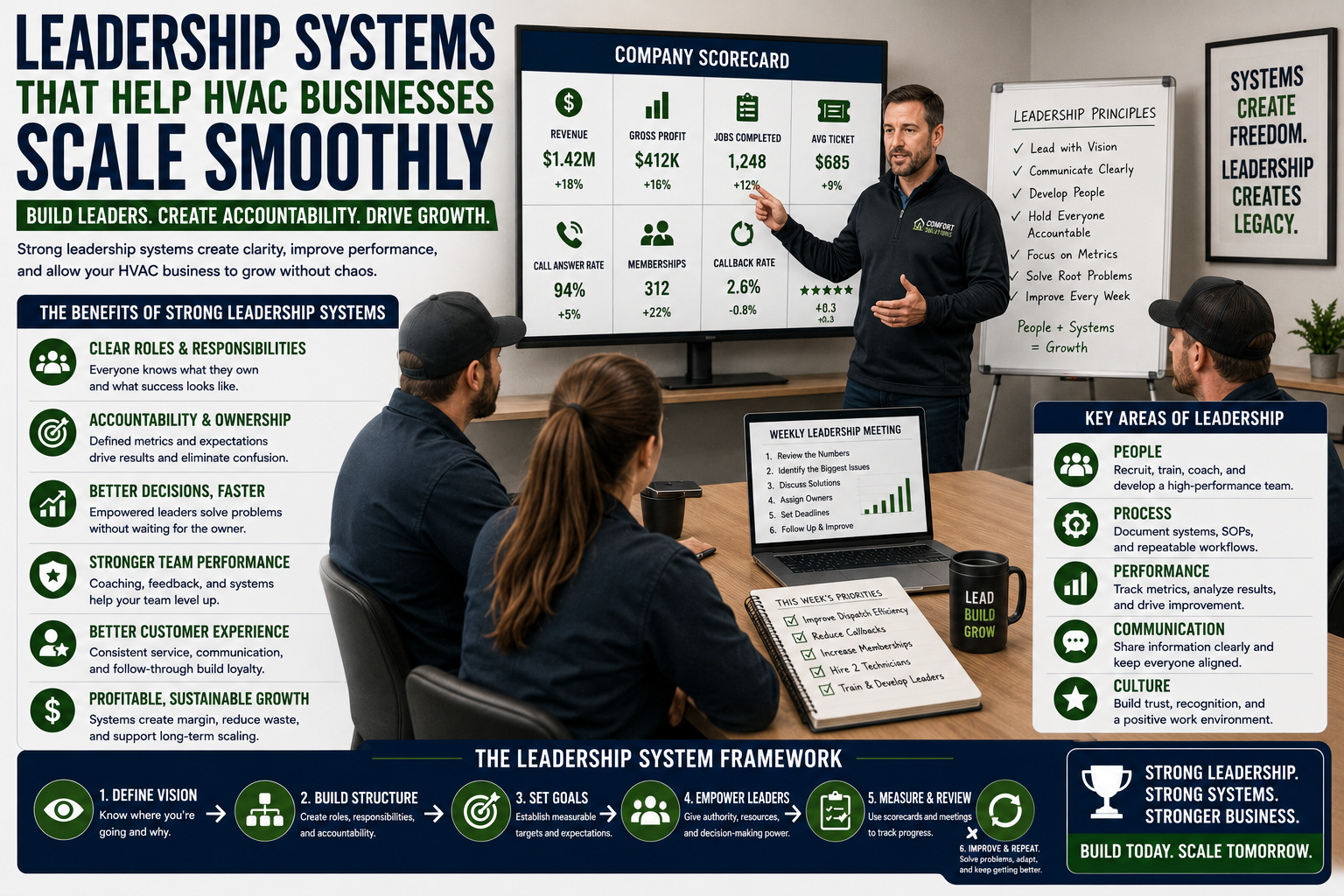
Table of Contents
Introduction
Most HVAC companies do not stop growing because the owner lacks ambition.
They stop growing because the owner becomes the bottleneck.
Every important decision still runs through one person.
The owner handles upset customers.
The owner approves discounts.
The owner fixes dispatch problems.
The owner trains technicians.
The owner checks every estimate.
The owner deals with payroll, vendor issues, callbacks, hiring, and customer complaints.
That can work when the company is small.
It does not work forever.
At some point, growth requires leadership systems.
A leadership system is not a fancy corporate structure.
It is a clear way to decide who owns what, how performance is measured, how problems get solved, and how the company stays aligned as more people join the team.
The goal is not to remove the owner from the business.
The goal is to stop the business from depending on the owner for every small decision.
What Is a Leadership System?
A leadership system is the structure that helps a company operate consistently as it grows.
It includes:
- Clear roles
- Defined responsibilities
- Performance expectations
- Weekly meetings
- Scorecards
- Decision-making rules
- Training systems
- Accountability
- Feedback loops
- Problem-solving processes
A small HVAC company may run on informal communication.
The owner talks to the dispatcher.
The dispatcher talks to the technicians.
The technicians call the owner when something goes wrong.
That can work for a few people.
But once the company has multiple technicians, office staff, installers, salespeople, and managers, informal communication creates confusion.
Leadership systems create clarity.
Why HVAC Companies Need Leadership Systems
Growth creates complexity.
More trucks create more scheduling issues.
More technicians create more training needs.
More installs create more job-costing risk.
More customers create more follow-up and customer-service work.
More revenue creates more payroll pressure, cash-flow management, and operational decisions.
Without leadership systems, the company becomes reactive.
Everyone waits for the owner to solve the next problem.
That creates delays.
It frustrates employees.
It burns out the owner.
It also makes the company harder to scale.
A strong leadership system helps the company:
- Make faster decisions
- Reduce confusion
- Improve accountability
- Train people faster
- Improve customer experience
- Protect margins
- Reduce callbacks
- Build stronger managers
- Keep the owner focused on high-level work
This is often the difference between a company that stays stuck and one that can grow into a more scalable operation. See why most HVAC companies stay small for the common owner bottlenecks that leadership systems are designed to remove.
The Owner Cannot Be the Only Leader
One of the biggest growth mistakes HVAC owners make is trying to stay involved in every decision.
The owner may feel like nobody can do things as well as they can.
Sometimes that is true at first.
But it becomes a trap.
If every decision requires owner approval, the company cannot move quickly.
Technicians wait.
Dispatch waits.
Customers wait.
Managers avoid responsibility.
The owner gets overwhelmed.
The business becomes limited by one person’s capacity.
The goal is not to hand off everything overnight.
The goal is to gradually build leaders who can own parts of the business.
Start With Clear Ownership
The first step is deciding who owns each major part of the company.
Titles matter less than accountability.
For example:
| Area | Primary Owner |
|---|---|
| Call booking and customer service | CSR or office manager |
| Dispatch and scheduling | Dispatcher or service manager |
| Technician performance | Service manager |
| Install scheduling and execution | Install manager |
| Open estimates and sales follow-up | Sales manager or office manager |
| Membership renewals | Customer service or membership coordinator |
| Job costing | Operations manager or finance lead |
| Cash flow and financial reporting | Owner and finance lead |
| Recruiting and onboarding | Owner, operations manager, or hiring lead |
| Marketing performance | Owner or marketing manager |
The key question is:
“Who owns this number or process?”
When nobody owns it, nobody improves it.
Build a Simple Accountability Chart
An accountability chart is different from a traditional org chart.
An org chart shows titles.
An accountability chart shows responsibilities.
| Role | Primary Responsibilities |
|---|---|
| Owner | Strategy, major financial decisions, leadership development, high-level accountability |
| Service manager | Technicians, dispatch, service KPIs, callbacks, coaching |
| Install manager | Install crews, job handoffs, install quality, labor and margin performance |
| Office manager | CSRs, billing, customer follow-up, collections, office process |
| Marketing or growth lead | Lead generation, reviews, retention campaigns, channel performance |
This does not need to be complicated.
It needs to answer:
- Who makes the decision?
- Who is responsible for the result?
- Who needs to be informed?
- Who gets involved when there is a problem?
Clarity prevents employees from stepping on each other or waiting for the owner to decide everything.
Create Weekly Leadership Meetings
Most HVAC companies have meetings.
The problem is that many meetings do not lead to decisions.
A useful leadership meeting should be short, consistent, and focused on the numbers.
A weekly meeting may cover:
- Revenue
- Gross margin
- Cash balance
- Accounts receivable
- Booked calls
- Call answer rate
- Estimate conversion
- Membership sales
- Callback rate
- Revenue per technician
- Install margins
- Hiring needs
- Customer complaints
- Major operational bottlenecks
The meeting should answer:
- What happened last week?
- What is the biggest issue this week?
- Who owns the next step?
- When will it be done?
Do not turn the meeting into a long conversation about every minor detail.
Focus on the biggest constraints.
Use Scorecards Instead of Opinions
Leadership gets easier when decisions are based on numbers instead of feelings.
A scorecard does not need to have 50 metrics.
It should track the numbers that show whether each department is healthy.
Service Department Scorecard
Track:
- Revenue per technician
- Average ticket
- Jobs completed
- Callback rate
- First-time fix rate
- Membership sales
- Estimate conversion
- Drive time
- On-time arrival rate
- Discount usage
Office Scorecard
Track:
- Call answer rate
- Missed-call callback time
- Booking rate
- Estimate follow-up rate
- Invoice collection time
- Accounts receivable
- Customer review requests
- Customer complaints
Install Department Scorecard
Track:
- Install revenue
- Gross margin
- Labor hours estimated vs actual
- Material cost estimated vs actual
- Return trips
- Change orders
- Customer satisfaction
- Install completion time
Marketing Scorecard
Track:
- Leads by source
- Booked calls
- Cost per lead
- Cost per booked call
- Revenue by lead source
- Review volume
- Website conversion rate
- Membership leads
- Replacement opportunities
Scorecards make it easier to see problems early.
For financial scorecards, include clear cash and collections metrics instead of relying only on revenue. Cash flow management for HVAC companies explains the financial visibility leadership needs before payroll, vendor bills, or slow months create a problem.
Train Managers to Lead, Not Just Report Problems
A manager should not only bring problems to the owner.
A manager should bring options.
For example, instead of saying:
“The schedule is a mess.”
A service manager should say:
“We are losing time because maintenance calls are spread across too many service areas. I recommend assigning zones by day and leaving a buffer for emergency calls.”
That is leadership.
Managers need to learn how to:
- Read the numbers
- Identify root causes
- Communicate clearly
- Make decisions
- Coach employees
- Hold people accountable
- Solve recurring problems
- Escalate only when needed
The owner should not be the only person capable of solving operational issues.
Build a Consistent Coaching System
Technicians and office staff should not only hear from leadership when there is a problem.
Regular coaching helps employees improve before issues become expensive.
A simple coaching rhythm may include:
- Weekly technician check-ins
- Monthly performance reviews
- Ride-alongs
- Call review sessions
- Callback reviews
- Sales and communication coaching
- Training on new systems
- Recognition for strong performance
The goal is not to create pressure.
The goal is to create growth.
Employees need to know:
- What they are doing well
- What needs improvement
- What numbers matter
- What support is available
- What growth opportunities exist
Clear coaching improves retention because employees feel like they are developing instead of just being judged.
For a deeper look at attracting, onboarding, and keeping strong people, read how to build a reliable HVAC technician team.
Create a Decision-Making Framework
As companies grow, employees need to know what they can decide without waiting for the owner.
For example:
Technicians Can Decide
- Basic repair options within price-book rules
- Standard discounts within company policy
- Small customer-service fixes
- Membership offers
- Whether to recommend a repair or replacement conversation
Dispatchers Can Decide
- Technician assignments
- Schedule changes
- Route adjustments
- Appointment windows
- Same-day rescheduling
Managers Can Decide
- Customer credits within a limit
- Technician coaching plans
- Overtime approval within policy
- Callback handling
- Training priorities
- Staffing adjustments
Owner Approval May Be Needed For
- Major customer refunds
- New truck purchases
- New hires above budget
- Compensation changes
- Large marketing spend
- New software contracts
- Major pricing changes
This reduces bottlenecks.
People know when to act and when to escalate.
Create a Problem-Solving Process
Every HVAC company has problems.
The goal is not to eliminate problems.
The goal is to stop solving the same problem repeatedly.
Use a simple process:
| Step | Action |
|---|---|
| 1 | Identify the issue |
| 2 | Gather the facts |
| 3 | Find the root cause |
| 4 | Choose a solution |
| 5 | Assign an owner |
| 6 | Set a deadline |
| 7 | Review the result |
For example:
Problem: Too many callbacks on no-cool calls.
Possible root causes:
- Weak diagnostic process
- Wrong technician assignments
- Missing truck stock
- Poor technician training
- Rushed scheduling
- Incomplete job notes
The solution may not be “work harder.”
It may be a new diagnostic checklist, better technician matching, or truck-stock changes.
Leadership systems help the company solve causes instead of symptoms.
Build Leadership Around Customer Experience
Growth should not come at the expense of customer experience.
As the company gets bigger, customers should still feel informed and taken care of.
Leadership should protect:
- Fast call response
- Clear appointment windows
- On-the-way notifications
- Professional technicians
- Clear pricing
- Accurate estimates
- Fast payment options
- Review requests
- Callback resolution
- Maintenance follow-up
A company that grows fast but creates unhappy customers is building a weak foundation.
Customer experience should be part of every department’s scorecard.
Develop Future Leaders Internally
Your next service manager may already be one of your technicians.
Your next install manager may already be leading a crew.
Your next office manager may already be solving problems behind the scenes.
Look for people who:
- Communicate clearly
- Take responsibility
- Help others
- Follow systems
- Stay calm under pressure
- Care about customer experience
- Use numbers well
- Want to improve the company
Then develop them.
Give them small responsibilities first.
Let them lead a training session.
Let them own a metric.
Let them manage a process.
Let them solve a recurring issue.
Leadership development should not start when you desperately need a manager.
It should happen before that.
Common Leadership Mistakes HVAC Companies Make
Keeping Every Decision With the Owner
This slows the company down and creates burnout.
Promoting Great Technicians Without Leadership Training
A strong technician is not automatically a strong manager.
Teach leadership skills.
Measuring Too Many Metrics
Track the numbers that matter.
Do not create dashboards nobody understands.
Holding Meetings Without Decisions
Every meeting should end with ownership and next steps.
Ignoring Poor Performance
Avoiding hard conversations creates larger problems later.
Treating Employees Differently Without Clear Standards
Consistency builds trust.
Failing to Recognize Good Work
People notice when only mistakes get attention.
How to Build Leadership Systems This Month
Start simple.
Choose Three Core Areas to Clarify
For example:
- Who owns dispatch?
- Who owns technician performance?
- Who owns estimate follow-up?
Create a Weekly Scorecard
Track a small set of numbers that show whether the business is healthy.
Start a Weekly Leadership Meeting
Keep it short.
Review numbers, identify bottlenecks, assign owners.
Create One Manager Role
You may not need a full management team yet.
Start by giving one trusted person clear ownership over one important area.
Document One Decision Rule
For example:
Dispatchers can reschedule routine maintenance calls without owner approval when an emergency call needs capacity.
Small systems create momentum.
FAQ
What are leadership systems in an HVAC company?
Leadership systems are the roles, accountability structures, meetings, scorecards, decision rules, and coaching processes that help the company operate consistently as it grows.
When should an HVAC company hire a manager?
A company should consider adding management when the owner can no longer effectively oversee technicians, dispatch, customer service, installs, and financial performance alone.
The right time depends on complexity, not only revenue.
How do HVAC companies hold managers accountable?
Use clear ownership, weekly scorecards, regular leadership meetings, defined expectations, and direct coaching.
Every important number or process should have one primary owner.
Why do HVAC companies struggle to scale leadership?
Many owners stay involved in every decision, promote people without training them to lead, or fail to define clear responsibility across departments.
Final Thoughts
Leadership systems are what allow an HVAC company to grow without the owner becoming the bottleneck.
You do not need a complicated corporate structure.
You need clear ownership.
Simple scorecards.
Regular meetings.
Managers who solve problems.
Coaching that helps people improve.
And systems that make good decisions repeatable.
The company scales when leadership becomes a system, not a personality.
Continue Reading
- How to Scale an HVAC Business from $1M to $5M Revenue
- Hiring HVAC Technicians: How to Build a Reliable Team
- HVAC SOPs Every Successful Company Should Have
- HVAC Workflow Optimization: From Call to Payment System
- How to Improve HVAC Dispatch Efficiency and Reduce Missed Calls
- Why Most HVAC Companies Stay Small
- Cash Flow Management Tips for HVAC Business Owners