
HVAC SOPs Every Successful Company Should Have
Discover the essential standard operating procedures every HVAC business should document to improve consistency, training, customer service, and operational efficiency.
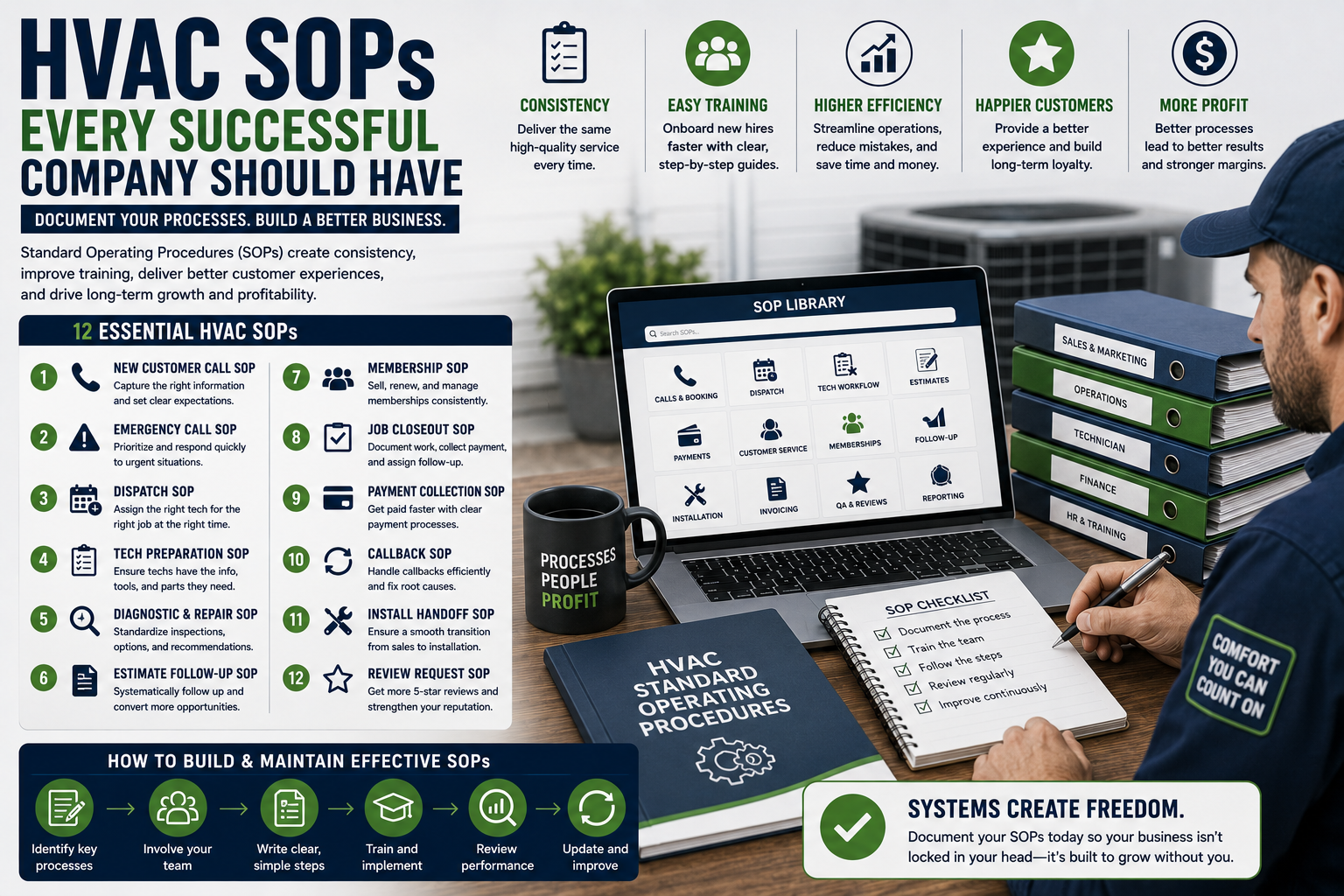
Table of Contents
Introduction
Most HVAC companies do not have a people problem.
They have a consistency problem.
One CSR books calls correctly.
Another forgets to ask important questions.
One technician documents every job.
Another leaves almost no notes.
One dispatcher protects technician drive time.
Another sends trucks across town all day.
That is what happens when the company relies on memory instead of systems.
An SOP fixes that.
SOP stands for standard operating procedure.
It is simply a documented way of doing repeatable work.
The goal is not to turn your HVAC company into a giant corporate machine.
The goal is to stop good work from depending on one person remembering what to do.
A strong HVAC company should be able to answer:
“How do we handle this every time?”
That answer should not live only in the owner’s head.
What Is an HVAC SOP?
An HVAC SOP is a written process for work your company does repeatedly.
It explains:
- What needs to happen
- Who owns it
- When it should happen
- What information needs to be collected
- What “done correctly” looks like
- What happens if there is a problem
For example, an SOP for booking a service call may explain:
- What questions the CSR should ask
- How to identify an emergency call
- How to check customer history
- How to choose the right job type
- How to confirm the appointment
- When to alert dispatch or management
That is not bureaucracy.
That is how you stop missed details from becoming lost jobs.
Why HVAC SOPs Matter
SOPs make the business easier to run.
They improve:
- Training
- Customer experience
- Dispatch
- Technician accountability
- Payment collection
- Estimate follow-up
- Membership renewals
- Callback reduction
- Office consistency
- Growth
Without SOPs, every new hire has to learn by watching someone else.
That creates problems fast.
The person training them may have bad habits.
The owner may explain the process differently every time.
The new hire may fill in the gaps with their own judgment.
That is how companies end up with five different ways of doing the same job.
A good SOP gives the team a clear standard.
For growing companies, documented processes also make leadership systems easier because managers can coach against a shared standard instead of personal opinion.
The SOP Rule: Document What Repeats
You do not need an SOP for every possible situation.
Start with the work that happens over and over.
A good rule:
If the same mistake costs you money more than once, write an SOP for it.
For most HVAC companies, that means starting with customer calls, dispatch, technician workflows, estimates, payments, and follow-up.
Essential HVAC SOPs Every Company Should Have
1. New Customer Call SOP
The first phone call matters.
A bad call-handling process can lose a job before the technician ever has a chance.
Your call-booking SOP should explain:
- How to answer the phone
- How quickly calls should be returned
- What customer information to collect
- How to identify emergency calls
- How to check service history
- How to identify membership customers
- How to set expectations
- How to confirm appointments
- How to document special instructions
At a minimum, collect:
- Customer name
- Address
- Phone number
- Equipment issue
- Heating or cooling status
- Urgency
- Equipment type
- Preferred appointment window
- Membership status
- Previous service history
A good booking process helps dispatch send the right technician with the right information.
2. Emergency Call SOP
Not every HVAC call should be handled the same way.
A no-cool call during extreme heat is different from a thermostat issue that can wait until tomorrow.
Your emergency-call SOP should define:
- What counts as an emergency
- Who gets priority
- When after-hours pricing applies
- Who approves overtime
- How customers are informed about pricing
- How dispatch handles the schedule change
- What notes technicians need before leaving
This prevents the office from making emergency decisions differently every time.
It also protects the company from giving away urgent work without charging appropriately.
3. Dispatch SOP
Dispatch is not just putting jobs on a calendar.
Dispatch affects technician productivity, customer satisfaction, callbacks, and profit.
Your dispatch SOP should cover:
- How jobs are prioritized
- How technicians are matched to jobs
- How routes are planned
- How schedule gaps are filled
- How emergency jobs are handled
- How delays are communicated
- How technician skill levels are considered
- How memberships are prioritized
- How callbacks are scheduled
- How dispatchers handle jobs that run long
Every unnecessary truck roll costs money.
A good dispatch SOP helps reduce wasted drive time and repeat trips. For more on the operational side, review how to improve HVAC dispatch efficiency.
4. Technician Arrival and Job Preparation SOP
Technicians should not arrive blind.
Before the technician goes to the call, they should review:
- Customer history
- Previous service notes
- Equipment details
- Membership status
- Open estimates
- Warranty information
- Job notes
- Special instructions
- Payment history
Your SOP should make it clear when technicians are expected to review job information.
The customer should not have to explain the same issue every time someone new arrives.
Prepared technicians work faster and make fewer mistakes.
5. Diagnostic and Repair SOP
The technician workflow should be consistent from diagnosis through recommendation.
Your SOP can include:
- How technicians document the issue
- Required photos
- Required diagnostic notes
- How recommendations are presented
- When to use price books
- How to explain good-better-best options
- When management approval is required
- How repairs are documented
- How customers are informed about next steps
Technicians should not be making up prices in the driveway.
They should not be guessing what to recommend.
A strong diagnostic SOP protects margin and makes the customer experience more consistent.
6. Estimate Follow-Up SOP
A lot of HVAC companies lose profitable work because nobody owns the follow-up.
The estimate gets sent.
The customer says they will think about it.
Then nothing happens.
Your estimate follow-up SOP should define:
- Who owns the follow-up
- How quickly the first follow-up happens
- How many follow-up attempts are made
- Which communication methods are used
- When an estimate gets marked lost
- How lost estimates are categorized
- When replacement opportunities go to a comfort advisor
- How open estimates are reviewed each week
A simple follow-up process can increase revenue without spending more on leads.
You already paid to create the opportunity.
Do not let it disappear because nobody called back.
7. Membership Sales and Renewal SOP
Maintenance memberships should not be an afterthought.
They are one of the best ways to create predictable revenue and keep customers loyal.
Your membership SOP should cover:
- When the membership is offered
- What benefits are included
- How pricing is explained
- How technicians present it
- How renewals are handled
- How recurring visits are scheduled
- How failed payments are handled
- How expired memberships are followed up
The easiest customer to sell to is the one who already trusts you.
Memberships help keep that relationship active.
8. Job Closeout SOP
A job is not complete when the technician fixes the issue.
It is complete when the paperwork, payment, notes, and follow-up are handled correctly.
Your closeout SOP should require:
- Completed job notes
- Required photos
- Equipment updates
- Parts used
- Customer signature when needed
- Invoice created
- Payment collected or scheduled
- Customer receipt sent
- Follow-up assigned
- Review request triggered
- Membership opportunity documented
This is where many companies lose control.
The technician finishes the job, but the office does not know what happened.
Then invoices get delayed, notes are missing, and follow-up disappears.
Close the job while the technician is still on site.
A connected HVAC workflow optimization system helps make that handoff from field work to invoicing and follow-up consistent.
9. Payment Collection SOP
A completed job should not become an unpaid invoice by default.
For residential work, the goal should usually be:
Complete the job. Collect payment.
Your payment SOP should explain:
- When payment is collected
- Which payment methods are accepted
- When deposits are required
- How financing is offered
- How unpaid balances are handled
- Who follows up on overdue invoices
- When the company stops work for nonpayment
- How commercial billing is handled differently
Cash flow problems often start with weak payment habits.
A clear payment SOP protects the business.
10. Callback SOP
Callbacks should not be buried inside the normal schedule.
They need to be tracked separately.
Your callback SOP should include:
- How a callback is identified
- How quickly it gets scheduled
- Who reviews the original job
- How the technician is chosen
- What notes are required
- Whether management is notified
- How the root cause is documented
- How customer communication is handled
- How the callback affects job costing
The goal is not to blame people.
The goal is to prevent the same issue from happening again.
11. Install Handoff SOP
The handoff from sales to install can create expensive mistakes.
The customer was sold one thing.
The install crew receives incomplete notes.
Materials are missing.
The schedule is wrong.
The homeowner is confused.
Your install handoff SOP should include:
- Approved proposal
- Equipment details
- Scope of work
- Labor assumptions
- Materials needed
- Ductwork or electrical details
- Permit requirements
- Financing status
- Customer expectations
- Installation date
- Special site conditions
- Change-order process
A clean handoff protects install margins and customer trust.
12. Review Request SOP
Happy customers do not always leave reviews on their own.
You need a simple process.
Your review SOP should explain:
- When to request the review
- Who asks for it
- Whether it is automated
- How the customer receives the link
- How negative feedback is handled
- How reviews are shared with the team
- How reviews are used in marketing
A review request should happen while the customer is still happy about the completed job.
How to Build SOPs Without Creating a Giant Manual
You do not need a 300-page binder.
Start simple.
Each SOP can fit on one or two pages.
Use this structure:
| SOP Element | What to Include |
|---|---|
| SOP Name | Clear name for the process |
| Purpose | Why the process exists |
| Who Owns It | Role responsible for the outcome |
| When It Applies | Trigger or situation where the SOP is used |
| Steps | Exact actions in order |
| Required Information | Details, notes, photos, or customer data needed |
| What Good Looks Like | Standard for successful completion |
| Common Mistakes | Issues to avoid |
| Escalation Process | When and how to involve management |
That is enough to get started.
You can improve the SOP later as the team uses it.
The important thing is documenting the process before the business grows around bad habits.
If you are not yet sure which process should be documented first, use the HVAC business operations assessment checklist to identify the highest-impact bottlenecks, ownership gaps, and weak handoffs.
How to Get Team Buy-In
SOPs fail when employees see them as rules created by someone who does not understand the job.
Get the people doing the work involved.
Ask technicians:
- What information do you need before arriving?
- What causes repeat trips?
- What slows down the job?
- What does the office forget to tell you?
Ask CSRs:
- What information is hardest to collect?
- Which calls create confusion?
- What questions should we ask every time?
Ask dispatchers:
- What makes scheduling difficult?
- Which technician details matter most?
- What information is usually missing?
The best SOPs come from the people closest to the work.
Review and Update SOPs
SOPs should not sit in a folder forever.
Review them when:
- A callback happens
- A customer complaint repeats
- A new tool is added
- A new hire asks the same question repeatedly
- A process changes
- A job type becomes more common
- A mistake costs the company money
The goal is continuous improvement.
Every repeated problem is a chance to improve the system.
Common SOP Mistakes
Writing SOPs Nobody Uses
A perfect document is useless if it lives in a folder nobody opens.
Keep SOPs practical.
Use checklists.
Make them easy to find.
Review them during training.
Making SOPs Too Complicated
The team does not need legal language.
They need clear instructions.
Write like you talk.
Keep steps short.
Use examples.
Failing to Train on the SOP
Do not hand someone a document and assume they understand it.
Walk through the process.
Watch them do it.
Give feedback.
Then hold people accountable.
Never Updating the Process
The business changes.
Your SOPs should change too.
If a process no longer works, fix the SOP instead of expecting the team to guess.
FAQ
What are HVAC SOPs?
HVAC SOPs are documented procedures that explain how repeatable work should be handled, including calls, dispatch, technician workflows, estimates, invoicing, payments, memberships, and customer follow-up.
Which SOP should an HVAC company create first?
Start with the workflow that creates the most mistakes or lost money. For many companies, that is call booking, dispatch, estimate follow-up, job closeout, or payment collection.
Do small HVAC companies need SOPs?
Yes.
Small companies benefit the most because the owner cannot be everywhere forever. SOPs make training easier and reduce dependence on memory.
How long should an HVAC SOP be?
Most SOPs should be short enough that the team will actually use them. One or two pages with clear steps and checklists is usually enough.
Final Thoughts
SOPs are not about making your company rigid.
They are about making good work repeatable.
A company with clear processes can train faster, reduce callbacks, protect payments, improve dispatch, and give customers a more consistent experience.
The owner does not need to answer every question.
The team does not need to guess what happens next.
That is how a small HVAC company becomes a business that can grow without creating more chaos.
Continue Reading
- HVAC Business Operations Assessment Checklist
- HVAC Workflow Optimization: From Call to Payment System
- Improve HVAC Dispatch Efficiency
- Technician Scheduling Best Practices for HVAC Companies
- Reduce HVAC Job Time Without Cutting Corners
- Leadership Systems for HVAC Businesses
- Best HVAC Software Stack for Small Business vs Enterprise
- Field Service Management Software for HVAC: What to Look For