
Hiring HVAC Technicians: How to Build a Reliable Team
Discover proven recruiting, interviewing, onboarding, and retention strategies to attract skilled HVAC technicians and build a dependable workforce.
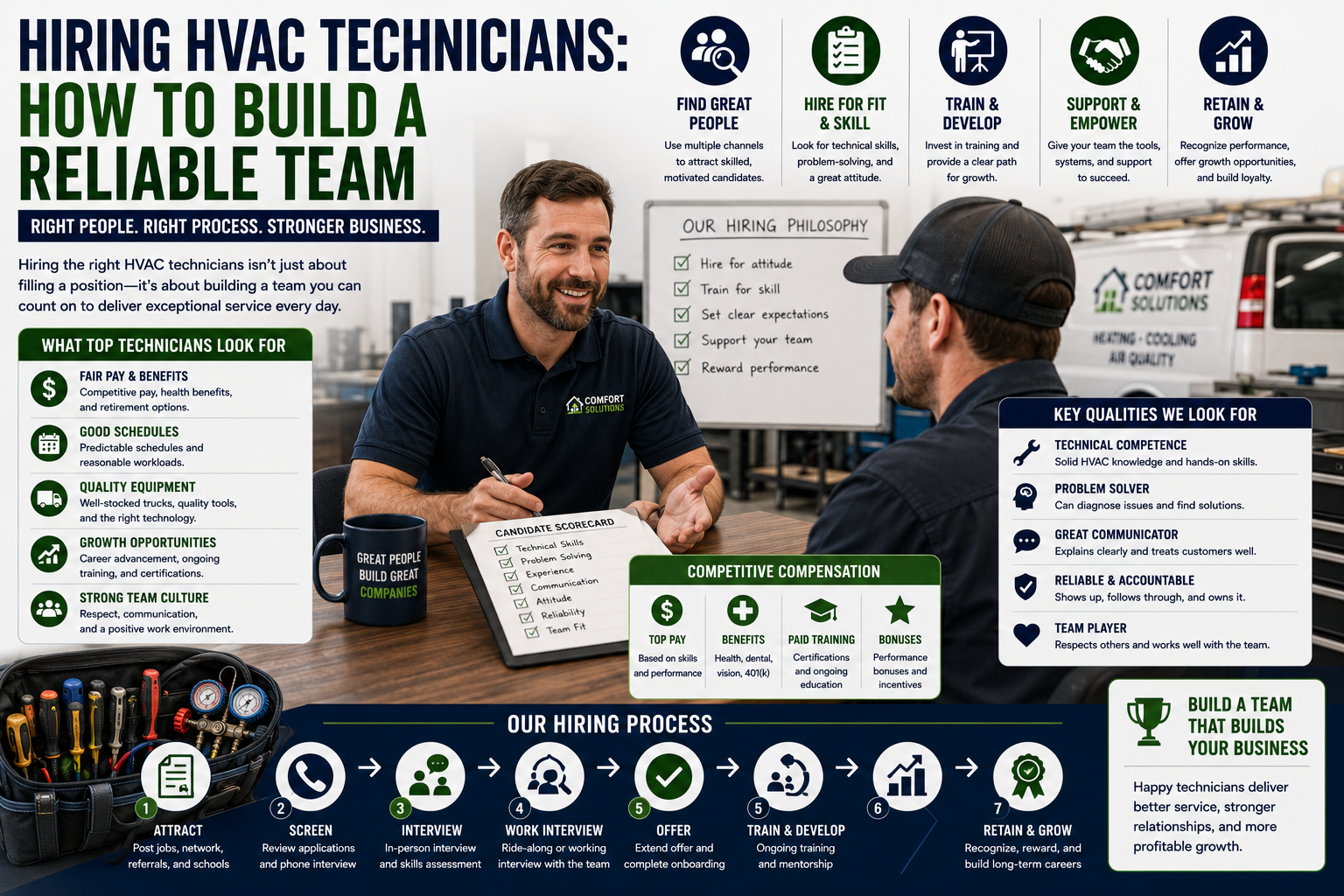
Table of Contents
Introduction
Most HVAC companies do not have a lead problem.
They have a capacity problem.
The phone rings.
The schedule fills up.
Customers want same-day service.
But there are not enough reliable technicians to run the calls.
That creates a dangerous cycle.
The company gets busy.
The owner hires whoever is available.
Training gets rushed.
Callbacks increase.
Customer service slips.
The good technicians get overloaded.
Then the company is back where it started.
Hiring HVAC technicians is not just about finding someone with a license and a truck background.
It is about building a team that can protect your reputation, serve customers well, use your systems, and grow with the company.
The goal is not to hire faster.
The goal is to hire better.
Why Hiring HVAC Technicians Is So Difficult
Good technicians are in demand.
That is not changing anytime soon.
The best technicians usually already have jobs.
They are not scrolling job boards every night hoping to find a company that treats them better.
That means you cannot rely only on posting an ad when you are desperate.
A strong HVAC hiring strategy has to run all year.
You need a pipeline.
You need a reputation as a good place to work.
You need a process for interviewing, onboarding, training, and retaining the people you bring in.
The companies that always struggle to hire usually wait until they are overwhelmed.
Then they rush.
Rushed hiring is expensive.
One bad technician can create callbacks, customer complaints, wasted parts, safety problems, and more pressure on your good people.
The First Step: Know Who You Actually Need
Do not hire “an HVAC technician.”
That is too vague.
Decide what type of person the company needs.
For example:
- Entry-level maintenance technician
- Residential service technician
- Senior diagnostic technician
- Install helper
- Lead installer
- Commercial service technician
- Comfort advisor
- Dispatcher
- CSR
- Service manager
Each role needs different skills.
A strong maintenance technician may not be ready for complex diagnostics.
A great installer may not enjoy residential service calls.
A senior technician may be strong technically but weak with customers.
Before you recruit, define:
- What work this person will handle
- What skills are required
- What equipment experience matters
- Whether the role is residential, commercial, install, or service
- What software they need to use
- What success looks like after 30, 60, and 90 days
- Who will train and manage them
The clearer the role, the better the hire.
Build a Recruiting System Before You Need It
The best time to recruit is before you are desperate.
A good recruiting system should run in the background all year.
That can include:
- A careers page on your website
- Ongoing job ads
- Employee referral bonuses
- Relationships with trade schools
- Local technical programs
- Apprenticeship programs
- Social media recruiting
- Industry events
- Supplier relationships
- Technician networking
- Previous applicants
- Former employees who left on good terms
Do not treat recruiting like a one-time emergency.
Treat it like marketing.
You would not turn off your marketing until the phone stopped ringing.
Do not wait until every technician is overloaded before you start looking for talent.
Make Your Company Easier to Say Yes To
Good technicians have options.
They are evaluating you too.
They want to know:
- Is the pay fair?
- Are the trucks maintained?
- Is the schedule reasonable?
- Does the company have enough work?
- Will they get proper training?
- Are dispatchers organized?
- Is the price book clear?
- Are customers treated well?
- Do managers communicate?
- Are good technicians recognized?
- Is there room to grow?
A technician may leave one company because of pay.
But many leave because the operation is chaotic.
They are tired of bad dispatch.
They are tired of being sent without job information.
They are tired of missing parts.
They are tired of getting blamed for office mistakes.
They are tired of working in a company with no standards.
A clean operation is a recruiting advantage. Better HVAC workflow optimization makes the office, dispatcher, technician, invoice, and follow-up process easier for new and experienced team members to trust.
Write Better Job Ads
Most HVAC job ads sound the same.
“Seeking experienced HVAC technician. Competitive pay. Must have valid driver’s license.”
That tells a good technician almost nothing.
Your job ad should explain why the role is worth considering.
Talk about:
- Type of work
- Service area
- Team size
- Compensation range
- Benefits
- Training opportunities
- Career path
- Truck and tool setup
- Schedule expectations
- On-call requirements
- Technology and software
- Leadership style
- Customer standards
Be specific.
For example:
We are hiring a residential HVAC service technician for a growing service team. You will run repair, maintenance, and replacement-lead calls using a stocked service truck, digital price book, and field-service software. We provide structured training, realistic schedules, strong dispatch support, and a clear path toward senior technician or service manager roles.
That speaks to the person you actually want.
Use Employee Referrals
Your best technicians often know other good technicians.
They know who is reliable.
They know who communicates well.
They know who is tired of working somewhere else.
Create a referral program.
Make it worth using.
For example:
- Bonus after 30 days
- Larger bonus after 90 days
- Extra bonus for senior technicians
- Recognition for successful referrals
Do not make the process complicated.
A good referral program can bring in better candidates than a job board because the person already knows someone inside the company.
Interview for More Than Technical Skill
Technical skill matters.
But it is not enough.
A technician can be great at diagnosing equipment and still be a poor fit if they cannot communicate, document work, show up on time, or follow process.
During the interview, look for:
- Communication skills
- Customer-service mindset
- Reliability
- Willingness to learn
- Comfort using technology
- Ability to explain technical issues simply
- Attitude toward teamwork
- Response to feedback
- Safety awareness
- Pride in workmanship
Ask practical questions.
For example:
- Walk me through how you diagnose a no-cool call.
- What do you do when you do not know the answer?
- How do you explain a repair recommendation to a homeowner?
- How do you handle a customer who is upset about price?
- What information should be in job notes before you leave?
- What makes a service call successful?
- Tell me about a callback and what you learned from it.
You are not only hiring someone to fix equipment.
You are hiring someone to represent your company inside customers’ homes.
Use a Working Interview
A resume tells you very little.
A working interview tells you more.
Have the candidate ride along with a senior technician or observe a controlled part of the day.
Watch for:
- How they communicate
- Whether they ask good questions
- How they treat customers
- Whether they respect the technician they are shadowing
- Whether they use tools safely
- How they respond to feedback
- Whether they are organized
- Whether they seem teachable
Do not expect perfection.
Look for potential, professionalism, and a willingness to learn.
A technically average technician with a great attitude can become valuable.
A highly skilled technician with a bad attitude can damage the team.
Build a Real Onboarding Process
Do not hire someone Monday and throw them into a truck Tuesday.
That creates avoidable mistakes.
A strong onboarding process should include:
- Company expectations
- Customer-service standards
- Safety procedures
- Software training
- Price-book training
- Truck organization
- Dispatch process
- Membership process
- Payment collection process
- Job-note standards
- Uniform and appearance expectations
- Ride-along time
- Technical training plan
- 30-, 60-, and 90-day goals
New technicians need structure.
They need to know what “good” looks like.
The owner should not assume that a new hire understands how your company wants jobs handled.
Every HVAC company has different standards.
Make yours clear.
A written set of HVAC SOPs turns those expectations into repeatable standards instead of relying on verbal reminders.
Pair New Technicians With Strong Mentors
A new technician learns fast from the person they ride with.
That is why mentorship matters.
Do not automatically assign new hires to whoever is available.
Pair them with technicians who:
- Follow the process
- Communicate well
- Use the software
- Treat customers professionally
- Document jobs correctly
- Explain repairs clearly
- Avoid unnecessary callbacks
- Represent the company well
Your best technical technician is not always your best trainer.
A mentor needs patience.
They need to explain why things are done a certain way.
They need to correct mistakes without humiliating the new person.
Good mentorship creates stronger technicians faster.
Set Clear Performance Standards
New technicians should know how they will be measured.
Do not wait until there is a problem.
Track things like:
- Attendance
- On-time arrival
- Jobs completed
- Callback rate
- First-time fix rate
- Average ticket
- Membership offers
- Job-note completion
- Payment collection
- Customer reviews
- Safety compliance
- Use of software
- Training progress
Do not use numbers only to pressure people.
Use them to coach.
For example:
- High callbacks may mean more training is needed.
- Low average ticket may mean the technician is not presenting options clearly.
- Weak documentation may mean the field app is confusing or expectations are not clear.
- Slow job times may mean truck stock or dispatch needs improvement.
The goal is improvement.
Not fear.
Keep Good Technicians From Burning Out
Hiring is expensive.
Replacing a good technician is even more expensive.
Retention should be part of the hiring strategy.
Good technicians burn out when:
- The schedule is unrealistic
- Dispatch is disorganized
- Trucks are poorly stocked
- They are sent to calls without enough information
- They are blamed for things they cannot control
- They have no career path
- Pay does not reflect performance
- Training is ignored
- Communication is weak
- The owner only talks to them when there is a problem
Protect your good people.
That means:
- Maintain trucks
- Stock common parts
- Give them good software
- Build realistic schedules
- Listen to field feedback
- Recognize good work
- Offer training
- Create career paths
- Review compensation regularly
- Avoid overloading the same top technician with every hard call
Your best technicians should not feel punished for being reliable.
Better technician scheduling practices can reduce overloaded routes, avoid unnecessary drive time, and help spread difficult calls more fairly across the team.
Build Career Paths
A technician should be able to see a future inside the company.
That may look like:
- Apprentice
- Maintenance technician
- Service technician
- Senior service technician
- Lead technician
- Field trainer
- Install lead
- Comfort advisor
- Service manager
- Operations manager
Not everyone wants to become a manager.
But people want to know that doing good work leads somewhere.
Career paths improve retention because they give employees a reason to grow with the company instead of leaving for a small pay increase somewhere else.
Use Compensation That Makes Sense
Compensation matters.
But pay plans should support the type of company you want to build.
You may use:
- Hourly pay
- Performance bonuses
- Commission
- Spiffs
- Membership incentives
- Training bonuses
- Referral bonuses
- Review bonuses
- Productivity incentives
- Seniority increases
Be careful with incentives.
Do not create a pay structure that pushes technicians to oversell, rush jobs, or ignore quality.
Reward the full picture:
- Customer satisfaction
- First-time fix rate
- Proper documentation
- Membership sales
- Revenue
- Low callback rate
- Safety
- Teamwork
- Training
The best pay plans reward profitable, high-quality work.
Not just fast work.
Build a Strong Team Culture
Culture is not free lunches and company shirts.
Culture is how the company operates when nobody is watching.
Technicians notice:
- Whether dispatch respects them
- Whether managers tell the truth
- Whether customers are treated fairly
- Whether the owner listens
- Whether poor behavior is tolerated
- Whether top performers are recognized
- Whether the company has standards
- Whether there is a future
A strong culture does not mean everyone is happy every day.
It means expectations are clear, people are treated fairly, and good work matters.
That is what keeps good people around.
Strong leadership systems for HVAC businesses give managers a way to reinforce those standards without the owner needing to solve every people problem personally.
Common Hiring Mistakes HVAC Companies Make
Hiring Only When Desperate
Desperate hiring leads to weak decisions.
Build a pipeline before you need someone tomorrow.
Hiring Only for Technical Skill
A technician also needs communication, professionalism, reliability, and the ability to follow systems.
Skipping Onboarding
Throwing a new hire into a truck without training creates callbacks and frustration.
Ignoring the First 90 Days
The first few months decide whether the technician becomes a strong long-term employee or leaves quickly.
Overloading Top Performers
Do not burn out your best people by giving them every difficult job.
Having No Career Path
Good technicians want to know how they can grow.
Failing to Fix Operational Problems
You cannot recruit your way out of bad dispatch, weak leadership, broken trucks, and poor communication.
FAQ
How do HVAC companies find good technicians?
Use a year-round recruiting system that includes employee referrals, trade schools, career pages, job ads, technician networks, supplier relationships, and a strong reputation as an employer.
What should HVAC companies look for when hiring technicians?
Look beyond technical skill. Strong candidates communicate well, show up reliably, use technology, follow processes, treat customers professionally, and are willing to learn.
How long should HVAC technician onboarding take?
The first 90 days should be structured. New hires need training on safety, software, pricing, dispatch, customer service, job notes, truck organization, and technical expectations.
How can HVAC companies retain technicians?
Retain technicians by offering fair pay, realistic scheduling, good dispatch support, stocked trucks, training, career paths, clear expectations, recognition, and strong leadership.
Final Thoughts
Hiring HVAC technicians is not just about filling open trucks.
It is about building a team your customers can trust.
The companies that hire best do not wait until they are desperate.
They recruit year-round.
They interview for attitude and communication, not just technical skill.
They train new hires properly.
They create career paths.
They protect their best people from burnout.
A reliable team is not built by accident.
It is built through better systems, better leadership, and a company people want to stay with.
Continue Reading
- How to Scale an HVAC Business from $1M to $5M Revenue
- Leadership Systems for HVAC Businesses
- Technician Scheduling Best Practices for HVAC Businesses
- How to Improve HVAC Dispatch Efficiency and Reduce Missed Calls
- HVAC SOPs Every Successful Company Should Have
- Why Most HVAC Companies Stay Small
- HVAC Workflow Optimization: From Call to Payment System