
Expanding an HVAC Company Into New Service Areas
Learn how to successfully expand into new cities and territories by evaluating market demand, staffing, operations, and marketing before opening additional service areas.
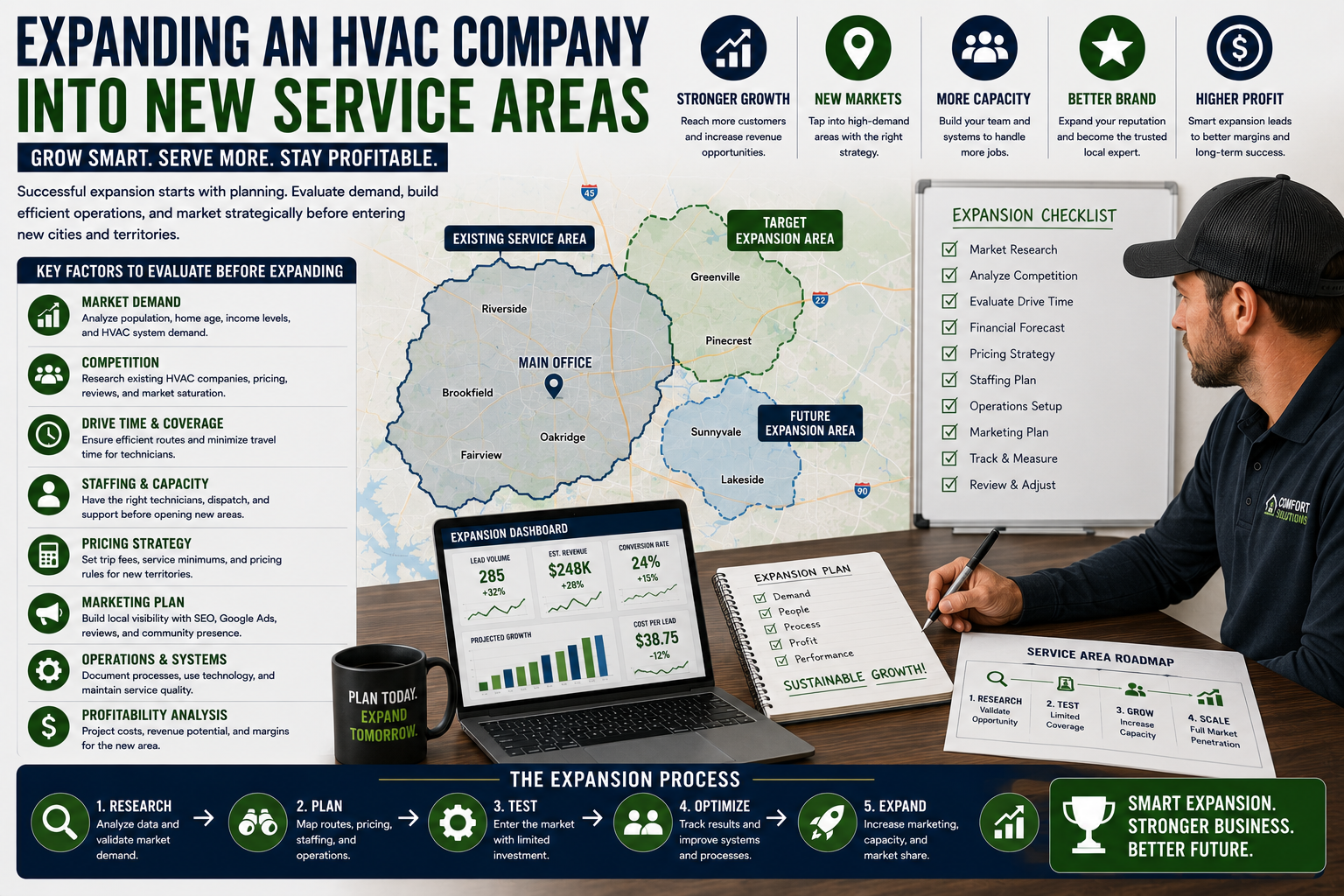
Table of Contents
Introduction
Expanding into a new service area can look like an easy way to grow.
More cities means more homeowners.
More homeowners means more calls.
More calls means more revenue.
But expansion can create problems fast when the company is not ready.
Technicians spend too much time driving.
Customers wait longer for service.
Dispatch becomes harder.
Marketing costs rise.
Callbacks become more expensive.
The company starts serving a larger territory without making more profit.
That is why expansion should not start with a map.
It should start with a plan.
The goal is not to cover every nearby city.
The goal is to expand into areas where your company can serve customers well, keep technicians productive, and still protect margin.
When an HVAC Company Is Ready to Expand
A company should not expand just because the owner wants more revenue.
Expansion makes sense when the current market is already running well.
Signs you may be ready include:
- Your current service area has strong demand
- Technicians are productive and schedules stay full
- Dispatch is organized
- Customer reviews are strong
- Your company has enough cash reserves
- You can hire or support more technicians
- Marketing is producing profitable leads
- You have clear workflows and SOPs
- The business can handle more volume without the owner managing every problem
If your current service area is already chaotic, expansion usually makes it worse.
Fix the existing operation first.
A company should not spread weak systems across a larger map. Strong leadership systems for HVAC businesses need to be in place before the owner tries to manage more technicians, customers, dispatchers, and service territory.
Start With Demand, Not Distance
The closest city is not always the best market.
A nearby area may have low demand, heavy competition, poor customer fit, or long drive times.
Before expanding, look at:
- Population density
- Household income
- Home age
- Climate conditions
- HVAC system age
- Number of competitors
- Local review competition
- Existing customer demand
- Search demand for HVAC services
- Commercial opportunities
- Service-call volume from nearby zip codes
You do not need to become a full-time market researcher.
But you should know whether people in the area are likely to need your services and whether you can compete there.
A city with more homes is not always better.
A smaller area with older systems, less competition, and strong homeowner demand may be more profitable.
Look at Existing Customer Demand
One of the best places to expand is where customers are already asking you to go.
Review your call data.
Look for:
- Calls from outside your current service area
- Website leads from nearby cities
- Referral traffic
- Existing customers who moved
- Maintenance customers with multiple properties
- Commercial customers with multiple locations
- Requests you currently decline because of distance
If customers are already trying to hire you in an area, that is a strong signal.
Expansion is safer when demand already exists.
It is riskier when you are trying to create demand from nothing.
Understand the Drive-Time Problem
Drive time is one of the biggest hidden costs in expansion.
A technician can look fully booked and still produce weak results if half the day is spent on the road.
Longer service areas can create:
- Fewer completed jobs per day
- Higher fuel costs
- More truck wear
- Less schedule flexibility
- Late arrivals
- More overtime
- Harder emergency response
- More frustrated customers
- Lower revenue per technician
Before expanding, estimate how much travel time the new area adds.
Ask:
- Can technicians run multiple jobs in that area on the same day?
- Can calls be grouped by ZIP code?
- Is there enough demand to justify regular coverage?
- Will technicians have to drive back and forth across the service area?
- Can a dedicated technician or route eventually support the area?
If the answer is no, the expansion may add revenue while reducing profitability.
Better technician scheduling practices can help protect route density, reduce dead time, and keep expansion from turning into an all-day drive.
Build Service Zones
A service zone is a geographic area your company serves with a clear dispatch plan.
Instead of treating the entire region like one large map, break it into zones.
For example:
- Core service zone
- Secondary growth zone
- Premium or emergency zone
- Limited-service zone
- Commercial zone
Each zone can have different rules for:
- Appointment windows
- Trip charges
- Same-day service
- Emergency availability
- Technician assignment
- Marketing budget
- Travel fees
- Membership coverage
Service zones give dispatch more control.
They also help customers understand what level of service they can expect.
Set Clear Pricing Rules for Expanded Areas
A call 10 minutes from your shop is not the same as a call 50 minutes away.
Your pricing should reflect the cost of serving the area.
That may include:
- Higher diagnostic fees
- Trip charges
- Minimum repair thresholds
- Limited same-day availability
- Premium emergency pricing
- Zone-based membership pricing
- Scheduled route days
- Different commercial pricing structures
You do not need to punish customers for living farther away.
But you should not quietly absorb the cost either.
If the company spends more time, fuel, and truck wear to serve an area, pricing needs to protect that margin.
Expand in Stages
Do not open a massive service radius overnight.
Expand gradually.
A simple approach may look like this:
Stage 1: Test Demand
Start by accepting selected jobs from a nearby area.
Focus on:
- Existing referrals
- High-value repairs
- Replacement opportunities
- Membership customers
- Commercial work
- Jobs near your existing routes
Track the results.
Stage 2: Add Scheduled Coverage
Once demand increases, create specific route days or technician coverage for that area.
For example:
- North zone on Tuesdays and Thursdays
- New city maintenance route every Wednesday
- Commercial calls grouped by region
- Dedicated replacement appointments on certain days
This reduces wasted drive time.
Stage 3: Invest in Local Marketing
Once your operations can support the area, begin targeted marketing.
That may include:
- City-specific service pages
- Google Business Profile optimization
- Local Services Ads
- Google Ads
- Reviews from local customers
- Direct mail
- Referral campaigns
- Partnerships with local businesses
- Community sponsorships
Do not spend heavily on marketing before you know the operation can handle the volume. Use HVAC lead generation strategies only after your scheduling, dispatch, and technician capacity can support the calls you create.
Stage 4: Add Dedicated Capacity
When demand becomes consistent, consider:
- Assigning a technician to the area
- Adding a service vehicle
- Hiring locally
- Creating a satellite dispatch point
- Renting a small warehouse or storage space
- Opening a second location
The goal is to earn the next investment through demand.
Not hope.
Do Not Expand Before Staffing Is Ready
Expansion creates more calls.
More calls require more capacity.
If your current technicians are already overloaded, adding more territory can hurt service quality.
Before expanding, ask:
- Do we have technicians who can take more work?
- Are current schedules already too tight?
- Can we hire for the new area?
- Do we have enough dispatch support?
- Do we have enough trucks, tools, and parts?
- Can we maintain fast response times?
- Will existing customers suffer because of the expansion?
A new area should not cause your core customers to wait longer.
Protect the market that already pays your bills.
Build Local Hiring Before Opening a New Market
As service areas expand, local hiring becomes more important.
A technician who lives near the new territory can reduce:
- Daily drive time
- Fuel costs
- Overtime
- Emergency response delays
- Wear on trucks
- Technician burnout
You may not need to hire immediately.
But once the area becomes a serious part of the business, local talent can make the expansion more profitable.
Look for:
- Technicians already living in the area
- Trade school relationships
- Local technician referrals
- Supplier relationships
- Service technicians unhappy with nearby competitors
- Installers interested in more stable work
Expansion gets easier when the team is closer to the customers.
For a more complete hiring process, see how to build a reliable HVAC technician team.
Make Sure Your Marketing Matches Your Capacity
Marketing can create more demand than operations can handle.
That is not always a good thing.
If your phones are ringing but appointments are booked out too far, customers may call another company.
If technicians are overloaded, callbacks and customer complaints can increase.
Before increasing marketing spend, make sure you can answer:
- Who will answer the calls?
- Who will dispatch the jobs?
- Which technicians will serve the area?
- What appointment windows can we realistically offer?
- Can we handle emergencies?
- Can we follow up on estimates?
- Can we collect payment efficiently?
- Can we maintain the same customer experience?
A marketing campaign without operational capacity can create expensive chaos.
Build Local Trust Before Expecting Leads
Customers in a new market may not know your brand.
You need proof.
Build trust through:
- Strong reviews
- Local testimonials
- City-specific service pages
- Fast response times
- Clear communication
- Professional technicians
- Community involvement
- Referral programs
- Partnerships with local businesses
- Consistent branding
The company does not need to be famous in the area.
It needs to look credible when someone searches for help.
A customer comparing HVAC companies wants to know:
- Do they serve my area?
- Do they have good reviews?
- Can they respond quickly?
- Do they look professional?
- Can I trust them in my home?
- Do they explain pricing clearly?
Expansion marketing should answer those questions.
Watch Profitability by Service Area
Do not assume every new territory is profitable because revenue is growing.
Track performance by area.
Review:
- Revenue by ZIP code
- Average ticket
- Drive time
- Fuel cost
- Jobs per technician
- Callback rate
- Booking rate
- Marketing cost
- Customer acquisition cost
- Membership sales
- Replacement opportunities
- Gross margin
- Customer reviews
- Cancellation rate
A new market may create lots of calls but weak profit.
That is why area-level reporting matters.
The goal is not simply to grow your service map.
The goal is to grow profitable service zones.
A strong HVAC workflow optimization process helps keep lead handling, dispatch, technician communication, invoicing, and follow-up consistent as the service area gets larger.
Know When to Open a Second Location
A second location is a major step.
Do not open one because it sounds impressive.
Consider it when:
- The new area has proven demand
- Drive time is hurting productivity
- You have consistent local lead volume
- You have enough technicians in the area
- Dispatch is becoming difficult from the main office
- Inventory and parts access are slowing jobs down
- Marketing performance is strong
- The new area can support fixed costs
A second location should solve a real operational problem.
It should not become another expensive overhead line.
Common Expansion Mistakes HVAC Companies Make
Expanding Too Far Too Fast
A wider service area can destroy technician productivity.
Ignoring Drive Time
More calls are not better if trucks spend the day on the road.
Marketing Before Operations Are Ready
More leads create more stress when capacity is already limited.
Underpricing Expanded Areas
Longer trips, higher fuel use, and lower route density need to be reflected in pricing.
Neglecting Existing Customers
Do not sacrifice your core market while chasing new territory.
Opening a Location Before Demand Is Proven
New locations create rent, payroll, inventory, and management costs.
Earn the expansion first.
How to Test a New Service Area
Start with a small experiment.
For 60 to 90 days, track:
- Lead volume
- Booked calls
- Drive time
- Revenue
- Average ticket
- Gross margin
- Callback rate
- Customer reviews
- Membership sales
- Marketing cost
- Technician feedback
Then ask:
- Is demand strong enough?
- Can we serve this area profitably?
- Are customers happy?
- Are technicians productive?
- Do we need a dedicated route or technician?
- Should we invest more marketing dollars?
- Should we limit the area?
Testing is better than guessing.
FAQ
How far should an HVAC company expand its service area?
There is no perfect radius. The right distance depends on demand, technician availability, drive time, pricing, route density, and how quickly the company can respond to customers.
Should HVAC companies charge more for distant service areas?
Often, yes. Longer drive time, fuel costs, truck wear, and reduced daily capacity can justify higher diagnostic fees, trip charges, or premium service pricing.
When should an HVAC company open a second location?
Open a second location only after demand is proven, technician drive time is hurting productivity, local staffing is available, and the new market can support the additional fixed costs.
How can HVAC companies market in a new city?
Start with city-specific service pages, Google Business Profile optimization, reviews, referral programs, local SEO, Google Ads, Local Services Ads, partnerships, and community visibility.
Final Thoughts
Expanding into new service areas can create real growth.
But only when the company can serve those areas well.
Start with demand.
Measure drive time.
Build service zones.
Protect pricing.
Test the market.
Keep your current customers happy.
Track profitability by area.
Then add capacity when the numbers support it.
The best expansion strategy is not covering the biggest map.
It is building profitable service areas that your company can support without losing quality or control.
Continue Reading
- How to Scale an HVAC Business from $1M to $5M Revenue
- Hiring HVAC Technicians: How to Build a Reliable Team
- Leadership Systems That Help HVAC Businesses Scale Smoothly
- How to Improve HVAC Dispatch Efficiency and Reduce Missed Calls
- Technician Scheduling Best Practices for HVAC Businesses
- HVAC Workflow Optimization: From Call to Payment System
- Best HVAC Lead Generation Strategies