
Technician Scheduling Best Practices for HVAC Businesses
Explore scheduling techniques that reduce travel time, improve technician utilization, increase customer satisfaction, and maximize daily revenue.
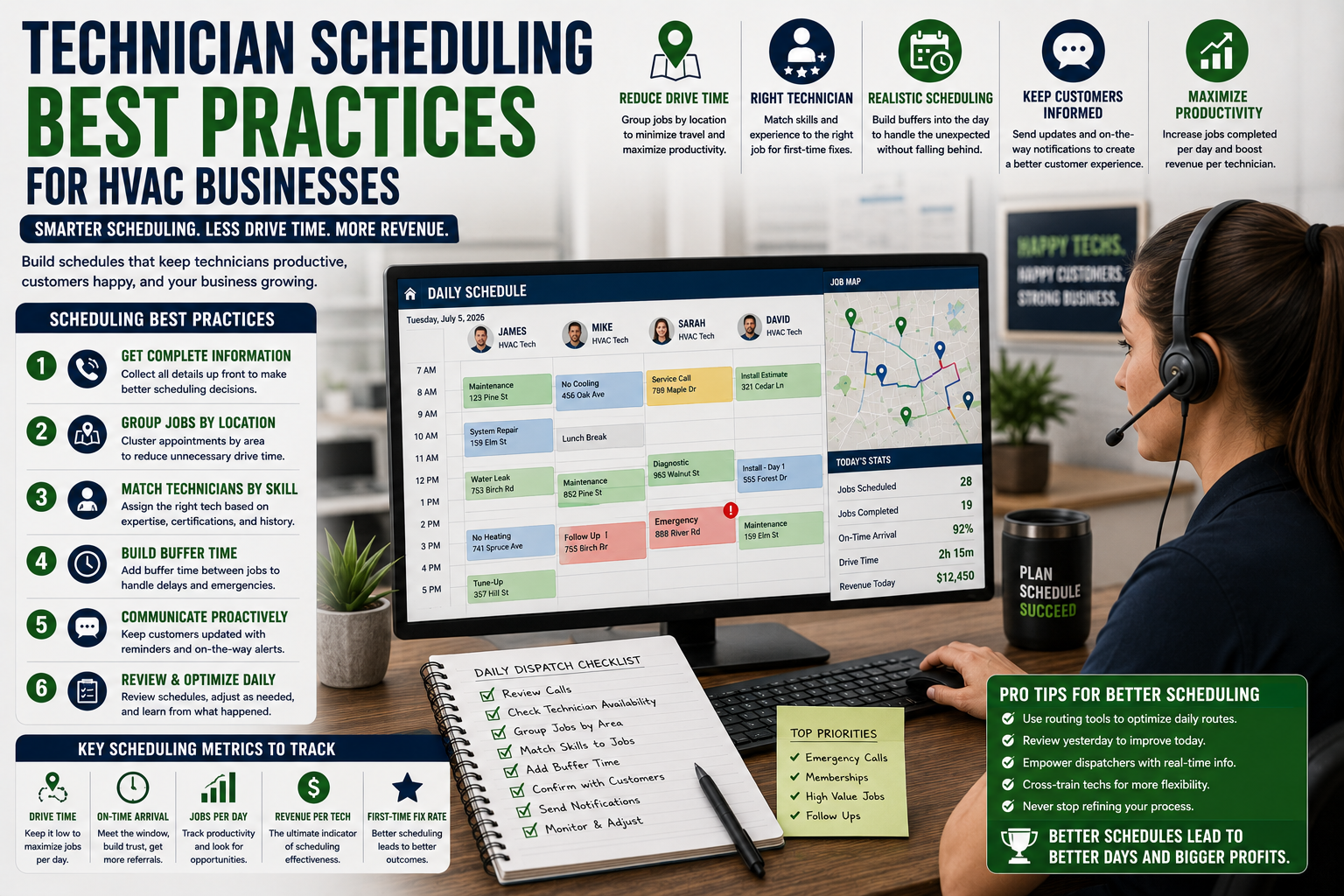
Table of Contents
Introduction
A bad schedule can ruin a profitable day before the first technician leaves the shop.
The office books too many calls.
The wrong technician gets assigned.
A maintenance visit is scheduled across town from an emergency repair.
One job runs long.
The rest of the day falls apart.
That is not a technician problem.
It is a scheduling problem.
Good technician scheduling helps HVAC companies get more out of every truck without pushing the team into burnout.
It reduces drive time.
It improves first-time fix rates.
It gives customers better appointment windows.
And it helps the company complete more profitable work each day.
The goal is not to pack every technician’s schedule as tightly as possible.
The goal is to build a schedule that works in the real world.
Why Technician Scheduling Matters
Scheduling affects almost every part of the business.
It affects:
- Technician productivity
- Customer wait times
- Drive time
- Fuel costs
- Callback rates
- Overtime
- Daily job capacity
- Customer satisfaction
- Revenue per truck
- Technician stress
A technician who spends two hours driving between calls is not productive.
A technician sent to a job without the right experience may need a second trip.
A technician booked too tightly may rush through diagnostics or arrive late all day.
Every unnecessary truck roll costs money.
Every schedule conflict costs money.
A stronger schedule gives your company more control before the day gets chaotic.
The Goal Is Productive Capacity, Not a Full Calendar
A full calendar can be misleading.
You can have every technician booked all day and still lose money.
For example:
- Jobs are scattered across the service area
- Technicians are assigned work they are not qualified for
- Appointment windows are too tight
- Emergency calls force constant reshuffling
- Maintenance calls get pushed back
- Install crews wait on missing materials
- Technicians arrive without customer history
That is activity.
It is not efficiency.
A good schedule should help your company complete the right work, with the right technician, in the right area, at the right time.
Start With Better Booking Information
Scheduling starts with the first call.
If the CSR books a job without enough information, dispatch has to guess.
That usually leads to bad technician assignments and wasted time.
Before scheduling a job, collect:
- Customer name
- Address
- Best phone number
- Equipment type
- Heating or cooling issue
- Urgency level
- Membership status
- Previous service history
- Open estimates
- Preferred appointment window
- Access instructions
- Whether the customer has already tried another repair
- Whether the system is completely down
The better the booking information, the better the schedule.
A no-cool call during a heat wave should not be booked the same way as a maintenance visit.
Schedule by Job Type
Do not treat every call as a generic service appointment.
Use clear job types.
Examples include:
- No cooling
- No heating
- Maintenance visit
- Diagnostic call
- Thermostat issue
- Water leak
- Callback
- Warranty call
- Replacement estimate
- Indoor air quality consultation
- Commercial service request
- Installation
Job types help the office estimate:
- How long the appointment may take
- Which technician is a fit
- Which tools may be needed
- Whether the call should be prioritized
- Whether the job could become a replacement opportunity
When everything is labeled “service call,” dispatch loses visibility.
Match Technicians to Their Strengths
The closest technician is not always the best technician.
A newer technician may be great for routine maintenance.
A senior technician may be better for a difficult diagnostic, repeat callback, aging system, or complex electrical issue.
When assigning jobs, consider:
- Technician skill level
- Equipment experience
- Certifications
- Job type
- Previous customer history
- Membership status
- Current location
- Current workload
- Parts and tools needed
- Whether the call may lead to a replacement discussion
The wrong technician on the wrong job creates wasted time.
It can also create a second truck roll, customer frustration, and a callback.
A stronger HVAC workflow optimization system makes it easier to pass job type, history, notes, warranty details, and open estimates from the office to the field.
Group Jobs by Area
Drive time is one of the biggest hidden costs in HVAC operations.
A technician can look busy all day and still produce weak revenue if half the day is spent crossing town.
Whenever possible, group jobs by:
- ZIP code
- Neighborhood
- Service zone
- Commercial property cluster
- Technician home base
- Existing route
You will not eliminate all drive time.
Emergency calls happen.
Customers reschedule.
Technicians run behind.
But you can stop obvious waste.
If one technician is in the north side of town all morning, avoid sending them across town for a routine maintenance call unless there is a real reason.
A cleaner route can create room for another job without adding another truck.
For more detailed routing, call-recovery, and dispatch guidance, see how to improve HVAC dispatch efficiency and reduce missed calls.
Build Time Buffers Into the Day
One of the biggest scheduling mistakes is assuming every job will go exactly as planned.
They will not.
Customers ask questions.
Technicians find additional problems.
Parts are missing.
Traffic gets worse.
The system is harder to diagnose than expected.
A schedule with no buffer is fragile.
One delay can push every appointment late.
Build time into the schedule for:
- Emergency calls
- Long diagnostics
- Drive-time changes
- Customer conversations
- Parts runs
- Callbacks
- Lunch and breaks
- Jobs that run over
- End-of-day paperwork
A schedule should not only look good at 7:00 AM.
It should still work at 2:00 PM.
Protect Appointment Windows
Customers care about appointment windows.
They may take time off work, arrange childcare, or wait at home for the technician.
If your company constantly misses windows, trust drops fast.
Use realistic windows.
Avoid promising exact arrival times unless you are sure you can meet them.
Then keep customers updated.
Send:
- Appointment confirmations
- Reminder messages
- On-the-way notifications
- Delay updates
- Reschedule options
A customer may understand that a technician is running late.
They are less likely to understand being ignored.
Schedule Maintenance Work Strategically
Maintenance calls are easy to treat as filler work.
That is a mistake.
Maintenance customers are often your best long-term customers.
They create repeat business.
They create repair opportunities.
They create replacement opportunities.
They refer friends and leave reviews.
Schedule maintenance work strategically.
Use slower days and shoulder seasons to complete planned maintenance.
Group membership customers by area.
Avoid pushing them back so long that they feel like low-priority customers.
The easiest customer to sell to is the one who already trusts you.
Your maintenance schedule helps protect that relationship.
Protect Time for Emergency Calls
Emergency calls will happen.
The issue is not whether they happen.
The issue is whether your schedule can absorb them.
If every technician is booked wall-to-wall, emergency calls create chaos.
You may need to:
- Reserve flex capacity
- Rotate emergency coverage
- Use designated rapid-response technicians
- Set realistic same-day expectations
- Prioritize membership customers
- Use after-hours pricing when appropriate
You do not need to drop everything for every caller.
But you do need a clear process for deciding which calls get priority.
Review Jobs That Run Long
If jobs regularly run long, do not just blame the technician.
Look for the root cause.
Ask:
- Was the job booked correctly?
- Was the right technician assigned?
- Was the duration estimate realistic?
- Did the technician have the customer history?
- Were parts available?
- Did the customer add work?
- Was the price book accurate?
- Does the technician need more training?
If a job type regularly takes longer than expected, update the schedule assumptions.
Otherwise, the business keeps repeating the same mistake.
Use Technician Capacity Correctly
Not every technician has the same capacity.
A senior technician may handle more complex work but need more time for detailed diagnostics and customer communication.
A newer technician may complete maintenance calls efficiently but need help with advanced repairs.
Do not schedule every technician the same way.
Track:
- Jobs completed per day
- Revenue per technician
- Average ticket
- Callback rate
- First-time fix rate
- Drive time
- Overtime
- Job duration by type
- Membership sales
- Estimate conversion
Use the numbers to schedule smarter.
The goal is not to compare technicians unfairly.
The goal is to understand how each person can contribute best.
Give Technicians Access to Job Information
A technician should not arrive at the home and call the office for basic details.
Before leaving, they should see:
- Customer history
- Equipment details
- Previous repairs
- Warranty status
- Membership status
- Open estimates
- Job notes
- Photos
- Payment history
- Special instructions
Prepared technicians work faster.
They make fewer mistakes.
They create a better customer experience.
The customer should not need to explain the same problem over and over.
Avoid Overloading Your Best Technicians
Every HVAC company has one or two technicians everyone trusts.
They get the difficult calls.
The callbacks.
The aging systems.
The upset customers.
The commercial jobs.
The replacement opportunities.
That can become a problem.
If the same top technician handles every difficult job, they eventually burn out.
They also become a bottleneck.
Use your best technicians strategically.
Let them handle complex work.
But also use them to train others.
Build systems so more technicians can handle more jobs correctly.
That is how the company becomes less dependent on one person.
Documented HVAC SOPs give senior technicians a practical way to pass their standards and repeatable processes to the rest of the team.
Hold a Short Daily Scheduling Review
A quick morning huddle can prevent a lot of problems.
It does not need to be a long meeting.
Review:
- Emergency calls
- Priority customers
- Membership calls
- Technicians with open capacity
- Jobs likely to run long
- Parts concerns
- Callback jobs
- Schedule gaps
- Customer special instructions
- Install crew schedules
Ten minutes of planning can save hours of confusion.
Weekly Scheduling Metrics to Track
You do not need a complicated dashboard.
Start with the numbers that show whether scheduling is improving.
Track:
- Average drive time
- Jobs completed per technician
- Revenue per truck
- On-time arrival rate
- Callback rate
- First-time fix rate
- Overtime hours
- Schedule utilization
- Appointment cancellation rate
- Jobs that run over estimated time
- Missed-call callback time
- Same-day booking rate
These numbers show where the schedule is breaking.
For example:
- High overtime may mean jobs are booked too tightly.
- High drive time may mean routes are poorly grouped.
- High callbacks may mean technician matching is weak.
- Low revenue per truck may mean too much empty time or too much travel.
Common Scheduling Mistakes HVAC Companies Make
Booking Every Technician Too Tight
A schedule with no buffer breaks as soon as one job runs long.
Sending the Closest Technician Every Time
The closest technician may not be qualified for the job.
Ignoring Drive Time
A full schedule can still be inefficient if trucks spend half the day in traffic.
Treating Maintenance Customers as Fillers
Membership customers should be part of your long-term growth system.
Overloading Senior Technicians
Your best people should solve hard problems and help develop the rest of the team.
Scheduling Without Job History
Technicians should not arrive blind.
How to Improve Your Schedule This Week
Start with one improvement.
You could:
- Group calls by service area
- Add 30-minute buffers between certain job types
- Create better job types
- Review the last week of drive time
- Track jobs that ran long
- Match technicians by skill level
- Set a missed-call callback standard
- Add customer confirmation messages
- Create a daily dispatch huddle
Small changes compound.
A cleaner schedule creates better dispatch.
Better dispatch creates fewer callbacks.
Fewer callbacks improve margins.
That is how operations get stronger.
Reducing avoidable drive time, second trips, and overtime also improves the accuracy of HVAC job costing, since labor and truck time are part of what determines job profitability.
FAQ
What is the best way to schedule HVAC technicians?
The best approach is to schedule based on job type, technician skill level, location, customer history, urgency, and realistic appointment duration.
Avoid scheduling only based on who is available.
How can HVAC companies reduce technician drive time?
Group jobs by location, use service zones, review routes daily, avoid unnecessary cross-town assignments, and leave room for emergency calls instead of reshuffling the entire schedule.
How many calls should an HVAC technician run per day?
It depends on job type, service area, technician skill level, drive time, and whether the calls are maintenance, repairs, diagnostics, or install-related.
The goal should be productive capacity, not an arbitrary number of calls.
Why do HVAC schedules fall apart during the day?
Schedules usually fall apart because jobs are booked too tightly, job durations are underestimated, dispatch lacks customer information, technicians are assigned incorrectly, or there is no buffer for emergencies and delays.
Final Thoughts
Technician scheduling is not about filling every empty slot.
It is about building a day that works.
Book jobs correctly.
Match technicians to the work.
Group calls by area.
Protect drive time.
Leave room for emergencies.
Give technicians the information they need.
Keep customers updated.
A better schedule creates more productive trucks, happier technicians, better customer experiences, and stronger margins.
Continue Reading
- How to Improve HVAC Dispatch Efficiency and Reduce Missed Calls
- HVAC Workflow Optimization: From Call to Payment System
- Reduce HVAC Job Time Without Cutting Corners
- HVAC SOPs Every Successful Company Should Have
- Best HVAC Dispatch Software: Tools for Scheduling Technicians
- Field Service Management Software for HVAC: What to Look For
- HVAC Job Costing Explained