
How to Reduce Job Time Without Sacrificing Quality
Learn how successful HVAC companies complete more jobs each day through better preparation, standardized processes, and technician efficiency—without compromising workmanship.
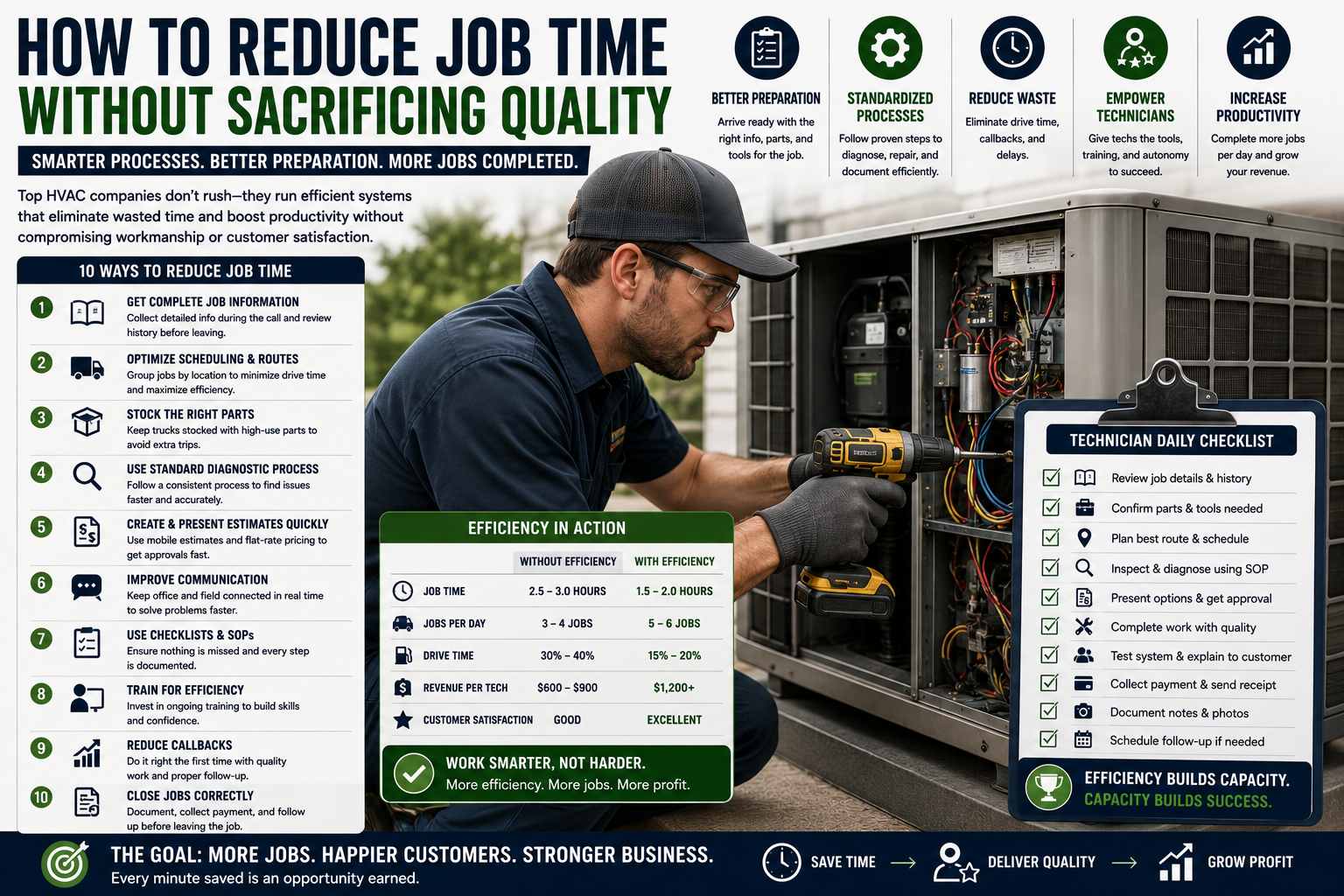
Table of Contents
Introduction
Most HVAC companies do not need technicians to work faster.
They need technicians to waste less time.
There is a big difference.
Working faster can create rushed diagnostics, missed details, callbacks, and unhappy customers.
Working smarter means the technician arrives prepared, has the right information, follows a clear process, gets approval quickly, and does not lose time hunting for parts or calling the office for basic details.
That is how good HVAC companies complete more work without cutting corners.
Every wasted minute adds up.
A technician who loses 20 minutes on every call can lose more than an hour and a half of productive time in one day.
Across a whole team, that becomes thousands of dollars in lost capacity every month.
The goal is not to rush the work.
The goal is to remove the friction around the work.
Why HVAC Jobs Take Longer Than They Should
Most slow jobs are not caused by lazy technicians.
They are caused by broken systems.
The technician gets dispatched without enough information.
The truck does not have the part.
The customer history is missing.
The estimate takes too long to build.
The office does not answer when the technician needs approval.
The technician has to return because the first visit did not solve the problem.
That is not a technician productivity issue.
That is an operations issue.
Common reasons HVAC jobs take too long include:
- Poor call booking
- Weak dispatch
- Missing customer history
- Incomplete job notes
- Missing parts
- Poorly stocked trucks
- No standard diagnostic process
- Slow estimate approvals
- Weak communication between office and field
- Too many callbacks
- Bad route planning
- Technicians doing paperwork after hours
The fastest way to reduce job time is to find where time is being lost before, during, and after the service call.
Start Before the Technician Leaves the Shop
A faster job starts before the truck rolls.
The technician should not have to call the office asking basic questions after arriving.
Before dispatching the job, make sure the technician can see:
- Customer name and contact information
- Equipment type
- Previous service history
- Open estimates
- Membership status
- Warranty information
- Notes from the CSR
- Photos from previous visits
- Special access instructions
- Known equipment problems
- Parts or tools that may be needed
Prepared technicians diagnose faster.
They make fewer mistakes.
They create a better customer experience.
The customer should not have to explain the same issue every time someone new arrives.
A connected HVAC workflow optimization system makes this pre-arrival information available across booking, dispatch, technician preparation, and closeout.
Improve the Call Booking Process
Job time often gets wasted because the original call was booked badly.
A customer says, “My AC is not working.”
The CSR books a generic service call.
The technician arrives and finds out the customer has a zoning issue, an old heat pump, a commercial rooftop unit, or a warranty problem that needs different parts or a more experienced technician.
That creates delays before the diagnosis even starts.
The office should collect better information up front.
Ask:
- Is the system cooling at all?
- Is the system making noise?
- Is there a water leak?
- Is the thermostat working?
- What kind of equipment do you have?
- Has another company worked on it recently?
- Is this a recurring issue?
- Is the system under warranty?
- Are you a maintenance member?
- Is the problem urgent?
- Is there anyone vulnerable in the home?
The more information the office collects, the better the technician can prepare.
Standardize the Diagnostic Process
Every technician has experience.
But every technician should not have a completely different diagnostic process.
A standard process helps technicians move faster without skipping steps.
For example, a diagnostic SOP may include:
| Step | Action |
|---|---|
| 1 | Review customer history |
| 2 | Confirm the customer complaint |
| 3 | Inspect the system |
| 4 | Check common failure points |
| 5 | Test electrical components |
| 6 | Identify root cause |
| 7 | Document findings |
| 8 | Present repair options |
| 9 | Get approval |
| 10 | Complete and test the repair |
The exact process will vary by equipment type.
The important thing is consistency.
When technicians follow a clear sequence, they spend less time guessing and are less likely to miss something that creates a callback later.
This is where documented HVAC SOPs help turn good technician habits into a repeatable standard for the whole team.
Keep Trucks Stocked for Common Repairs
A technician cannot complete a job quickly if the truck does not have the part.
A parts run may only take 20 minutes.
But it can turn into an hour once you include traffic, waiting at the supply house, returning to the job, and resetting the work area.
Truck stock should be based on real job data.
Look at the parts your company uses most often.
For many HVAC companies, that may include:
- Capacitors
- Contactors
- Fuses
- Thermostats
- Drain line materials
- Wire
- Disconnects
- Filters
- Common motors
- Refrigerant supplies
- Electrical connectors
- Safety switches
- PVC fittings
Do not stock every possible part.
That ties up too much cash.
Stock the items that prevent the most common second trips.
The goal is not a warehouse on wheels.
The goal is fewer avoidable delays.
Use Better Price Books and Mobile Estimates
Technicians lose time when they have to call the office for pricing.
They also lose time when they build every estimate from scratch.
A digital price book helps the technician present options quickly and consistently.
It should include:
- Common repairs
- Flat-rate pricing
- Labor assumptions
- Parts
- Good-better-best options
- Membership pricing
- Add-ons
- Financing options
- Warranty details
The technician should be able to build and present the estimate while standing with the customer.
That reduces delays.
It also gives the customer clearer choices.
The goal is not to pressure customers.
The goal is to avoid losing time because the technician has to leave, call the office, or wait for someone else to create a quote.
Reduce Time Spent Driving
Drive time is one of the biggest productivity leaks in HVAC operations.
A technician can have a full schedule and still lose most of the day crossing town.
Look for ways to group calls by:
- ZIP code
- Neighborhood
- Service zone
- Technician home base
- Commercial property clusters
- Existing route
You will never eliminate all drive time.
Emergency calls happen.
Customers reschedule.
Jobs run long.
But you can reduce obvious waste.
A better route can create room for another job without adding another truck.
For route planning, job grouping, and schedule buffers, see how to improve HVAC dispatch efficiency and reduce missed calls.
Give Technicians More Control in the Field
Technicians lose time when every small decision requires office approval.
For example:
- Pricing approval
- Customer history questions
- Payment questions
- Warranty confirmation
- Membership status
- Scheduling follow-up
- Equipment lookup
- Job notes
- Financing options
Your field software should help technicians access this information without calling the office.
A technician should be able to:
- View job history
- Access price books
- Send estimates
- Collect payment
- Upload photos
- Update job status
- Check membership details
- Review equipment history
- Send customer receipts
- Request support only when needed
The less time technicians spend waiting on the office, the more time they can spend solving customer problems.
When evaluating tools, prioritize platforms that support records, estimates, payments, mobile job updates, and communication in one system. See field service management software for HVAC.
Reduce Callbacks
Callbacks are one of the biggest time leaks in HVAC operations.
A callback means:
- Another truck roll
- More technician labor
- More fuel
- Lost schedule capacity
- Customer frustration
- Lower margins
- Fewer new jobs completed
Do not treat callbacks as only a customer-service issue.
Treat them as a productivity issue.
Track callbacks by:
- Technician
- Job type
- Equipment type
- Part used
- Root cause
- First-time fix rate
- Customer complaint
- Time between original visit and return visit
Then look for patterns.
Maybe the technician needs training.
Maybe the job type needs a better checklist.
Maybe the dispatch team is sending the wrong technician.
Maybe the truck stock is missing common parts.
The goal is not blame.
The goal is fewer repeat visits.
Make Approval Faster
A technician can diagnose the problem quickly and still lose time if approval takes too long.
Customers may need to talk to a spouse.
They may need financing.
They may want a written estimate.
They may have questions.
Your process should make approval easy.
Use:
- Digital estimates
- Clear good-better-best options
- Financing links
- Digital signatures
- Text and email delivery
- Clear warranties
- Customer-friendly descriptions
- Same-day follow-up
The customer should understand:
- What is wrong
- What needs to be done
- What each option costs
- What happens if they wait
- What warranty is included
- How they can pay
Clarity speeds up decisions.
Improve Communication Between Office and Field
A lot of wasted time comes from poor handoffs.
The office books a job but does not include useful notes.
The technician completes the work but does not update the job status.
The office does not know whether payment was collected.
The customer calls for an update because nobody sent one.
Every weak handoff creates more calls, more confusion, and more wasted time.
Set standards for communication.
For example:
- CSRs document the issue clearly
- Dispatchers include customer history
- Technicians update status when leaving and arriving
- Technicians attach notes and photos before closing the job
- Office staff review incomplete jobs before the day ends
- Customers receive appointment updates automatically
The cleaner the handoff, the faster the workflow.
Track Job Duration by Type
You cannot improve job time if you do not know where time is being lost.
Track average job duration for:
- Maintenance visits
- Diagnostic calls
- No-cool calls
- No-heat calls
- Thermostat replacements
- Capacitor repairs
- Drain line repairs
- Blower motor replacements
- System replacements
- Warranty calls
- Callbacks
Then compare:
- Estimated duration
- Actual duration
- Technician
- Travel time
- Parts availability
- Callback rate
- Margin
This helps you spot problems.
For example:
- If maintenance calls are taking too long, the checklist may be too loose.
- If diagnostics are taking too long, technicians may need training.
- If repairs take too long, trucks may not be stocked correctly.
- If installs take too long, labor assumptions may be wrong.
Use Checklists for Repeatable Work
Checklists are not about treating technicians like robots.
They are about making sure important steps do not get missed.
A simple checklist can help technicians complete work faster because they do not have to rely on memory.
Examples:
Maintenance Checklist
- Confirm customer concerns
- Inspect filters
- Check electrical connections
- Inspect drain line
- Test thermostat
- Check refrigerant performance
- Inspect blower and outdoor unit
- Document findings
- Present recommendations
- Collect payment or update membership
Service Call Closeout Checklist
- Repair completed
- System tested
- Photos attached
- Parts documented
- Customer informed
- Invoice created
- Payment collected
- Follow-up assigned
- Review request triggered
Checklists reduce rework.
Less rework means faster jobs.
Train for Efficiency, Not Speed
Do not tell technicians to “work faster.”
That usually creates rushed work.
Train them to:
- Diagnose in a consistent order
- Use the software correctly
- Prepare before arriving
- Present options clearly
- Use price books
- Document work while on site
- Keep trucks organized
- Avoid unnecessary trips to the office
- Communicate with customers efficiently
- Ask for help early when needed
Efficiency is a skill.
It can be trained.
The best technicians are not always the fastest.
They are the ones who solve the problem correctly the first time.
Common Mistakes HVAC Companies Make
Packing the Schedule Too Tight
A schedule with no buffer breaks as soon as one job runs long.
Sending Technicians Without Enough Information
Prepared technicians work faster.
Unprepared technicians waste time.
Not Stocking Common Parts
A missing capacitor or contactor can turn a one-visit repair into two trips.
Ignoring Callbacks
Callbacks are lost capacity.
Track them and fix the cause.
Making Technicians Wait for Pricing or Approval
Give technicians tools to create estimates and collect approvals in the field.
Treating Every Technician the Same
Different technicians have different strengths, experience levels, and job capacity.
Schedule and train accordingly.
How to Reduce Job Time This Week
Start with one improvement.
You could:
- Review the top five reasons technicians call the office
- Audit truck stock for common parts
- Add a pre-arrival checklist
- Create better job types
- Track jobs that run over
- Build a standard diagnostic checklist
- Review the last week of callbacks
- Add digital estimate templates
- Group calls by service area
- Improve technician access to customer history
Small changes compound.
A better booking process leads to better dispatch.
Better dispatch leads to more prepared technicians.
More prepared technicians complete jobs faster.
Faster jobs create more capacity and better margins.
FAQ
How can HVAC companies reduce job time without hurting quality?
Focus on preparation, standardized diagnostics, better dispatch, stocked trucks, technician access to customer history, digital estimates, clear checklists, and callback reduction.
The goal is to remove wasted time, not rush the work.
Why do HVAC technicians take too long on service calls?
Common reasons include poor job information, missing parts, weak dispatch, unclear diagnostic steps, long drive times, slow approvals, callbacks, and lack of training.
How can HVAC companies reduce callbacks?
Track callback reasons, improve technician training, use checklists, stock common parts, improve customer history access, and review first-time fix rates.
Should HVAC companies use checklists?
Yes.
Checklists help technicians complete repeatable work consistently, reduce missed steps, improve documentation, and prevent rework.
Final Thoughts
The fastest HVAC companies are not the ones rushing through calls.
They are the ones with fewer wasted steps.
They book jobs correctly.
They dispatch the right technician.
They keep trucks stocked.
They give technicians the information they need.
They use clear diagnostic processes.
They collect approval quickly.
They reduce callbacks.
That is how you complete more jobs without sacrificing quality.
Continue Reading
- Technician Scheduling Best Practices for HVAC Businesses
- How to Improve HVAC Dispatch Efficiency and Reduce Missed Calls
- HVAC Workflow Optimization: From Call to Payment System
- HVAC SOPs Every Successful Company Should Have
- Field Service Management Software for HVAC: What to Look For
- Best HVAC Dispatch Software: Tools for Scheduling Technicians
- HVAC Job Costing Explained