
ServiceM8 vs Housecall Pro: Which Is Better for HVAC Contractors?
Compare ServiceM8 and Housecall Pro for HVAC contractors based on pricing, scheduling, mobile apps, quoting, invoicing, recurring work, reporting, and small-business fit.
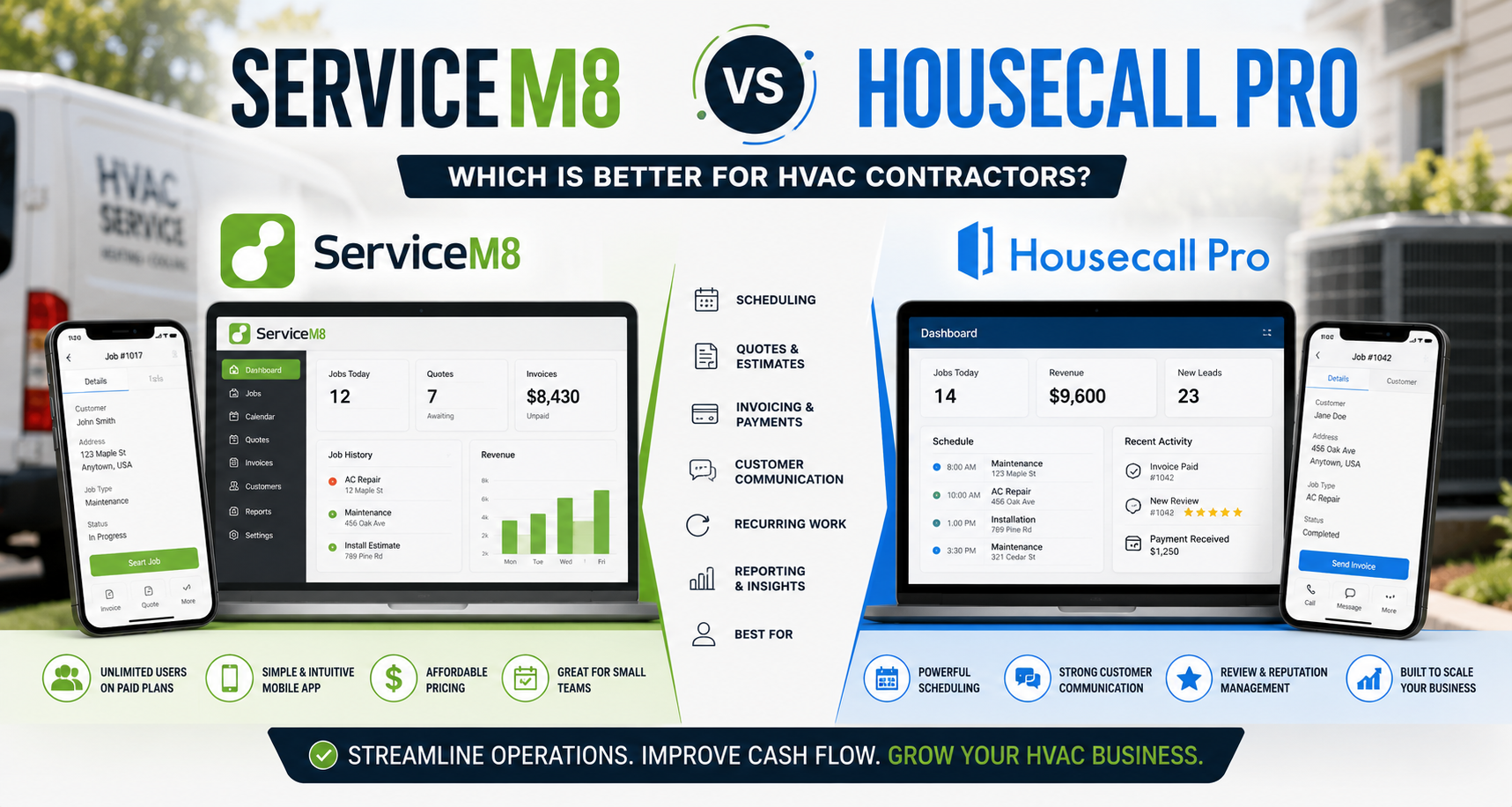
Table of Contents
Introduction
ServiceM8 and Housecall Pro both help small service businesses get organized.
For HVAC contractors, that usually means replacing a messy mix of:
- Paper job sheets
- Text-message dispatch
- Shared calendars
- Spreadsheet customer lists
- Manual quotes
- Late invoices
- Scattered customer notes
- Missed follow-up
Both platforms can help a small HVAC business manage jobs, customers, quotes, invoices, payments, and field communication.
But they are not built for the exact same buyer.
ServiceM8 is often attractive to very small contractors because it has clear pricing, unlimited users on paid plans, job-based usage tiers, mobile workflows, quoting, invoicing, recurring jobs, and simple field-service management.
Housecall Pro is often attractive to small and mid-sized residential service companies because it has a polished home-service workflow with scheduling, dispatch, online booking, estimates, invoices, payments, review management, customer communication, price books, job costing, and higher-plan tools for growing teams.
The question is not:
“Which software has more features?”
The better question is:
“Which one fits the way your HVAC company actually works?”
This comparison breaks down ServiceM8 vs Housecall Pro by pricing, features, ease of use, technician workflow, customer communication, recurring work, reporting, and best-fit contractor type.
Quick Verdict
ServiceM8 is usually the better fit for very small HVAC contractors that want affordable field service software, unlimited users on paid plans, simple job management, quotes, invoices, payment collection, and technician mobile access.
Housecall Pro is usually the better fit for small to mid-sized residential HVAC companies that want a stronger home-service platform with online booking, scheduling and dispatch, customer communication, review management, price books, job costing, recurring service plans, and more room to grow.
The simple version:
| Choose ServiceM8 if… | Choose Housecall Pro if… |
|---|---|
| You want lower-cost field service software | You want a more complete residential service platform |
| You need multiple users at a lower monthly price | You want stronger customer-facing workflows |
| You have modest job volume | You want online booking, review tools, and communication features |
| You want simple job management and mobile access | You are building maintenance plans and repeat customer systems |
| You are a very small contractor getting organized | You are a small to mid-sized HVAC company professionalizing operations |
For a broader category breakdown, see field service management software for HVAC.
What ServiceM8 and Housecall Pro Both Do
ServiceM8 and Housecall Pro both help contractors manage the basic service workflow.
For an HVAC company, that workflow usually looks like this:
| Step | Service Workflow |
|---|---|
| 1 | Customer calls or books online |
| 2 | Office creates the job |
| 3 | Technician gets scheduled |
| 4 | Technician receives job details |
| 5 | Quote or work order is completed |
| 6 | Invoice is sent |
| 7 | Payment is collected |
| 8 | Customer history is saved |
| 9 | Follow-up or recurring work is scheduled |
That is the core job cycle.
If your HVAC company is still managing that process through memory, texts, and spreadsheets, either platform can be a meaningful upgrade.
The real difference is how much structure you need around customer communication, reviews, online booking, price books, reporting, recurring service plans, and growth.
ServiceM8 Overview
ServiceM8 is field service management software built for small trade and service businesses.
For HVAC contractors, it can help with:
- Scheduling
- Job management
- Quotes
- Invoices
- Payments
- Technician mobile access
- Customer history
- Photos and job notes
- Recurring jobs
- Client communication
- Reporting
- Accounting integrations
ServiceM8 is especially appealing to small teams because its paid plans include unlimited users.
That matters when the owner, dispatcher, technicians, bookkeeper, and admin support all need access but the company does not want software costs to climb with every login.
The tradeoff is that ServiceM8 pricing is tied heavily to monthly job volume.
That can work well for small companies with several users but a controlled number of jobs.
For the full breakdown, read the ServiceM8 review for HVAC contractors.
Housecall Pro Overview
Housecall Pro is an all-in-one field service platform built for home-service businesses.
For HVAC contractors, it can help with:
- Scheduling
- Dispatch
- Customer records
- Estimates
- Invoices
- Payments
- Online booking
- Customer communication
- Review management
- Price books
- Job costing
- Technician GPS on higher plans
- Custom checklists on higher plans
- Photo reports on higher plans
- Recurring service plans on higher plans
- Reporting
- QuickBooks integration on higher plans
Housecall Pro is usually a strong fit for small to mid-sized residential HVAC companies that want a smoother system for managing customers from first call through payment and follow-up.
Its biggest advantage is that it feels more complete as a residential home-service operating system.
The tradeoff is cost.
Housecall Pro can become more expensive than ServiceM8 as you move into higher plans, add features, or need more users.
For a deeper review, see Housecall Pro Review: Pros, Cons, and Pricing Breakdown.
Pricing Comparison
Pricing is one of the biggest differences between ServiceM8 and Housecall Pro.
ServiceM8 is usually easier to budget for small teams because paid plans include unlimited users and pricing is based mostly around monthly job count.
Housecall Pro is built around plan tiers, included users, and feature depth. Lower plans can work well for smaller companies, but higher tiers may be needed for flat-rate pricing, GPS tracking, custom checklists, photo reports, recurring service plans, route optimization, advanced support, and broader growth features.
ServiceM8 Pricing
At the time of writing, ServiceM8’s U.S. pricing is structured around job volume:
| ServiceM8 Plan | Price | Users | Job Volume |
|---|---|---|---|
| Free | $0/month | 1 user | 30 jobs/month |
| Starter | $29/month | Unlimited users | 50 jobs/month |
| Growing | $79/month | Unlimited users | 150 jobs/month |
| Premium | $149/month | Unlimited users | 500 jobs/month |
| Premium Plus | $349/month | Unlimited users | 1,500+ jobs/month |
This can be attractive for a small HVAC company with multiple people who need access.
For example, if the owner, two technicians, a dispatcher, and a bookkeeper all need logins, ServiceM8’s unlimited-user structure may be easier to budget.
The main question is job count.
If your company runs many small service jobs each month, make sure the job-volume limit fits your operation.
Housecall Pro Pricing
At the time of writing, Housecall Pro’s annual-billed pricing includes:
| Housecall Pro Plan | Annual-Billed Price | Included Users | Best For |
|---|---|---|---|
| Basic | $59/month | 1 user | Getting started with core tools |
| Essentials | $149/month | 5 users | Teams managing more jobs and customers |
| Max | $299/month | 8 users | Scaling teams needing advanced tools and support |
Housecall Pro also lists monthly pricing that is higher than annual billing.
Basic includes core tools such as online booking, scheduling and dispatch, estimates and invoicing, payments, consumer financing, price book, job costing, and review management.
Essentials adds features such as routes, flat-rate pricing, checklist automations, photo reports and annotations, employee GPS tracking, commissions, and QuickBooks Online sync.
Max adds tools such as visual sales proposals, recurring service plans, route optimization, open API access, dedicated onboarding, and escalated support.
Housecall Pro may cost more than ServiceM8, but it also includes more home-service-specific features as the company grows.
Pricing Verdict
| Category | Winner |
|---|---|
| Lowest paid monthly price | ServiceM8 |
| Multiple users at low cost | ServiceM8 |
| Clearer job-volume pricing | ServiceM8 |
| More residential service features | Housecall Pro |
| Better for growing HVAC teams | Housecall Pro |
| Better for recurring service plans | Housecall Pro |
| Better for strict budget control | ServiceM8 |
| Better for customer-facing workflows | Housecall Pro |
If your main concern is giving multiple people access without increasing user costs, ServiceM8 may be easier to justify.
If your main concern is building a more complete residential HVAC operating system, Housecall Pro may be worth the higher cost.
Scheduling and Dispatch
Both ServiceM8 and Housecall Pro can help with scheduling and dispatch.
For a small HVAC company, the key questions are:
- Can the office see the schedule clearly?
- Can jobs be assigned easily?
- Can technicians see job details?
- Can customers receive updates?
- Can the company reduce back-and-forth texting?
- Can the team keep customer history connected to the job?
ServiceM8 gives small contractors a practical way to create jobs, schedule work, assign staff, and keep job details together.
Housecall Pro has stronger residential service scheduling and dispatch workflows, especially when paired with customer reminders, online booking, technician tracking, routing, and job-status visibility on higher plans.
For a one- or two-truck contractor, ServiceM8 may be enough.
For a growing residential HVAC company with more schedule complexity, Housecall Pro may be the stronger fit.
For deeper dispatch-specific buying criteria, read best HVAC dispatch software compared.
Technician Mobile App
The technician app matters because the field team is where the software either works or fails.
A good HVAC technician workflow should give the field team access to:
- Job notes
- Customer address
- Contact details
- Equipment history
- Photos
- Quote details
- Invoice tools
- Payment collection
- Tasks or checklists
- Office communication
ServiceM8 has a strong mobile-first feel and is designed around completing work in the field.
Housecall Pro also gives technicians mobile access to job details, estimates, invoices, payments, customer information, notes, and communication tools.
The practical difference is workflow depth.
ServiceM8 may feel leaner and simpler.
Housecall Pro may feel more complete for a residential service company trying to standardize dispatch, field updates, customer communication, invoicing, payment, reviews, and recurring service.
Quotes, Estimates, and Proposals
For HVAC companies, quoting is not just about making a document look professional.
It affects profit.
A quote needs to protect labor, materials, overhead, margin, and scope.
ServiceM8 supports quoting and invoicing, which can be enough for many small HVAC contractors handling repairs, maintenance, and simpler replacements.
Housecall Pro has stronger estimate, proposal, and pricing tools for residential service companies, especially as you move into higher plans.
That matters if your company wants to:
- Send estimates faster
- Present clearer options
- Use a price book
- Track job costs
- Use flat-rate pricing
- Offer financing
- Create more polished sales proposals
- Improve customer approval rates
For contractors focused heavily on pricing, repair options, equipment replacement, and proposal structure, see HVAC estimating software.
Invoicing and Payments
Both platforms can help HVAC contractors invoice faster and collect payment more consistently.
That matters because a completed job should not sit unpaid because paperwork is stuck in the office.
ServiceM8 lets contractors create quotes and invoices, send them to customers, and accept payments.
Housecall Pro also supports invoicing and payment collection, with stronger customer-facing payment workflows, automated reminders, financing options, and job-cost visibility depending on the plan.
For a very small contractor, either platform can reduce late invoices.
For a growing residential HVAC company that wants tighter payment follow-up, financing, and office-to-field consistency, Housecall Pro may have the edge.
Customer Communication
Customer communication is one of Housecall Pro’s biggest advantages.
Housecall Pro is built around a polished home-service customer experience, including online booking, appointment communication, estimates, invoices, payments, review management, and follow-up.
That matters because homeowners care about the experience as much as the repair.
They want to know:
- Did the company receive my request?
- When is the technician coming?
- Can I book online?
- Can I approve the estimate?
- Can I pay easily?
- Will I get a reminder?
- Can I leave a review?
ServiceM8 also supports communication tools, including confirmations, reminders, on-the-way messages, email, text messaging, and job updates.
But Housecall Pro tends to feel more purpose-built for residential home-service customer communication.
If your biggest issue is internal organization, ServiceM8 may be enough.
If your biggest issue is customer experience, review collection, quote follow-up, and repeat business, Housecall Pro may be stronger.
Online Booking and Reviews
Housecall Pro has a clear advantage for companies that care about online booking and review management.
Those features matter for residential HVAC because homeowners often compare companies quickly.
A customer who can book online, receive reminders, approve estimates, pay digitally, and leave a review has a smoother experience.
That can help a smaller HVAC company look more professional.
ServiceM8 also includes online booking features, but Housecall Pro is more directly positioned around home-service customer acquisition, reputation, and repeat customer experience.
For a residential HVAC business trying to improve booking and reviews, Housecall Pro is likely the better fit.
Recurring Work and Maintenance Plans
Maintenance work is important for HVAC companies.
It creates repeat visits.
It keeps customers connected.
It creates future repair and replacement opportunities.
ServiceM8 includes recurring job tools, which can support repeat maintenance visits and scheduled work.
Housecall Pro includes recurring service plans on higher plans, which makes it more attractive for HVAC companies that want to build a real maintenance membership base.
The difference is depth.
For simple recurring tune-ups, either can work.
For maintenance agreements, renewal tracking, plan benefits, customer communication, route planning, and growth around recurring service revenue, Housecall Pro may be stronger.
Reporting and Visibility
Small HVAC companies do not need dozens of dashboards.
But they do need visibility into the basics:
- Jobs completed
- Open quotes
- Invoices sent
- Payments collected
- Revenue
- Team productivity
- Follow-up
- Outstanding work
- Job profitability
ServiceM8 includes reporting and can help small contractors understand job activity, productivity, and revenue.
Housecall Pro has stronger reporting potential as you move into higher-tier plans, especially with job costing, GPS tracking, route tools, commissions, QuickBooks sync, and recurring service plan features.
If you need basic visibility, both can help.
If you need stronger residential service reporting, technician accountability, route visibility, and recurring-plan management, Housecall Pro may be better.
For a broader view of what small and growing contractors should track, see best HVAC CRM software compared.
ServiceM8 Pros and Cons
| Pros | Cons |
|---|---|
| Lower-cost entry point | May feel lighter for growing HVAC companies |
| Paid plans include unlimited users | Pricing is tied to job volume |
| Good mobile job workflow | Less HVAC-specific than larger platforms |
| Useful quoting, invoicing, payments, and job history | May require setup discipline to fit HVAC workflows |
| Recurring jobs can support maintenance visits | Less robust for maintenance membership programs |
| Practical for very small contractors | May not match Housecall Pro’s customer-facing workflow |
Housecall Pro Pros and Cons
| Pros | Cons |
|---|---|
| Strong residential service workflow | More expensive than ServiceM8 |
| Good scheduling, dispatch, estimates, invoices, and payments | Lower plans include fewer users |
| Online booking and review management are useful for HVAC | Advanced features require higher plans |
| Price book and job costing tools included | Costs can rise as the team grows |
| Stronger fit for small to mid-sized home-service companies | May be more platform than a very small contractor needs |
| Recurring service plans on higher plans | Not as low-cost for multiple-user teams |
Who Should Choose ServiceM8?
ServiceM8 is usually the better choice when:
- You are a very small HVAC contractor
- You want simple field service management
- You need multiple users without a high monthly cost
- Your job volume fits the plan limits
- You want mobile job access for technicians
- You need quotes, invoices, payments, and job notes in one place
- You are not ready for a heavier HVAC software platform
- You want to replace spreadsheets, texts, and paper workflows
ServiceM8 is especially attractive for a small team that needs organization more than advanced automation.
The key is making sure its workflow matches how your company handles HVAC service, maintenance, and quoting.
Who Should Choose Housecall Pro?
Housecall Pro is usually the better choice when:
- You are a small to mid-sized residential HVAC company
- You want online booking
- You want better customer reminders
- You care about review management
- You need price-book and job-costing tools
- You want stronger quote, invoice, and payment workflows
- You are building maintenance plans
- You want a more polished customer experience
- You need room to grow into stronger service-business features
Housecall Pro is especially useful when the company wants to look more professional to customers while also improving internal organization.
If customer experience, booking, reviews, payments, and recurring service are major priorities, Housecall Pro may be the better fit.
Who Should Consider Something Bigger?
Neither ServiceM8 nor Housecall Pro may be enough if your HVAC company has:
- Multiple departments
- A large service team
- Install crews
- Comfort advisors
- Complex commercial work
- Advanced price books
- Deep membership reporting
- Department-level dashboards
- Heavy job costing needs
- Multiple branches
- Inventory and purchasing workflows
At that stage, you may need FieldEdge, ServiceTitan, BuildOps, or another larger HVAC-focused platform.
For a broader software-stage comparison, see top HVAC software tools ranked by real contractor needs.
ServiceM8 vs Housecall Pro: Side-by-Side Comparison
| Category | ServiceM8 | Housecall Pro |
|---|---|---|
| Best fit | Very small trade businesses | Small to mid-sized residential service companies |
| HVAC fit | Good for simple service workflows | Strong for residential HVAC workflows |
| Pricing style | Job-volume based | Plan, user, and feature-tier based |
| Users | Unlimited users on paid plans | Included users vary by plan |
| Scheduling | Good for small teams | Stronger for residential service teams |
| Mobile app | Strong mobile job workflow | Strong technician and customer workflow |
| Quotes/invoices | Practical and simple | More polished and feature-rich |
| Payments | Supported | Strong payment and financing workflows |
| Online booking | Available | Stronger residential customer experience |
| Reviews | Less central | Strong review-management tools |
| Recurring work | Recurring jobs | Recurring service plans on higher plans |
| Reporting | Practical small-business visibility | Stronger as plans increase |
| Best advantage | Lower-cost access for multiple users | More complete home-service platform |
| Main caution | May feel light as HVAC company grows | Costs more as needs increase |
Common Mistakes When Choosing Between ServiceM8 and Housecall Pro
Choosing Based Only on Monthly Price
ServiceM8 may look cheaper.
Housecall Pro may look more expensive.
But the cheapest platform is not always the best value.
The right question is:
Which platform will help us stop losing the most money?
If missed quotes, late invoices, weak customer communication, and poor follow-up are costing more than the software, the more expensive platform may still be the better value.
Ignoring Job Volume
ServiceM8 pricing depends heavily on monthly job count.
That can work well for small teams.
But if your company does a high volume of service calls, the right plan may cost more than expected.
Compare your real monthly job count before choosing.
Ignoring Technician Adoption
If technicians do not use the app, the system fails.
Before choosing either platform, make sure technicians can easily:
- View jobs
- Add notes
- Upload photos
- Send quotes
- Create invoices
- Collect payment
- Update job status
A platform the field team actually uses is better than a more powerful system they avoid.
Overbuying Too Early
A one- or two-truck HVAC company may not need every feature Housecall Pro offers on higher plans.
ServiceM8 may be enough to fix the immediate problem.
Do not buy a bigger system just to look like a bigger company.
Waiting Too Long to Upgrade
The opposite mistake is staying too simple after the business becomes more complex.
If dispatch, memberships, reviews, pricing, reporting, and job costing become serious bottlenecks, the company may need a stronger platform.
Software should match the stage of the business.
Final Recommendation
Choose ServiceM8 if you want a lower-cost field service platform with unlimited users on paid plans, mobile job management, quotes, invoices, payments, recurring jobs, and simple customer history.
Choose Housecall Pro if you want a more complete residential HVAC software platform with online booking, review management, stronger customer communication, price books, job costing, recurring service plans, and better room to grow.
For very small HVAC contractors, ServiceM8 may be the more cost-efficient starting point.
For small to mid-sized residential HVAC companies that want a polished service workflow and stronger customer-facing tools, Housecall Pro may be the better long-term fit.
The best question is not:
“Which software is better?”
Ask:
“Which one solves the problem that is costing our HVAC company the most money right now?”
That answer will usually point you in the right direction.
FAQ
Is ServiceM8 better than Housecall Pro for HVAC contractors?
Not automatically.
ServiceM8 may be better for very small contractors that want lower-cost job management and unlimited users on paid plans.
Housecall Pro may be better for small to mid-sized residential HVAC companies that want stronger online booking, customer communication, review management, price books, job costing, and recurring service workflows.
Is Housecall Pro more expensive than ServiceM8?
Usually, yes.
ServiceM8 starts at a lower paid monthly price and includes unlimited users on paid plans.
Housecall Pro costs more, but it includes more residential home-service features as you move into higher plans.
Which is better for a one-truck HVAC company?
A one-truck HVAC company could use either platform.
ServiceM8 may be attractive if the owner wants simple job management and low cost.
Housecall Pro may be attractive if the owner wants stronger online booking, payments, review tools, customer communication, and a more polished home-service workflow.
Which is better for a growing HVAC company?
Housecall Pro is usually better for a growing residential HVAC company because it has stronger customer-facing tools, recurring service plans on higher plans, route tools, GPS tracking, checklists, photo reports, and broader service-business workflows.
ServiceM8 can still work if the company’s needs are simpler and job volume fits the plan.
Can ServiceM8 and Housecall Pro replace spreadsheets?
Yes.
Both platforms can help HVAC contractors move away from spreadsheets by centralizing customers, jobs, quotes, invoices, payments, and follow-up.
The bigger issue is not the tool.
It is whether the team uses the system consistently.
Continue Reading
- ServiceM8 Review for HVAC Contractors
- Housecall Pro Review: Pros, Cons, and Pricing Breakdown
- ServiceM8 vs Jobber: Which Is Better for HVAC Contractors?
- Jobber Review for HVAC Businesses
- Best HVAC CRM Software Compared
- Field Service Management Software for HVAC: What to Look For
- Best HVAC Dispatch Software Compared
- Best HVAC Software Stack for Small Business vs Enterprise
- Top HVAC Software Tools Ranked by Real Contractor Needs